MASTERING THE MATRIX…
UNLOCK ING THE FIREBL A DE’S ELEC TRONICS A ND SET-UP POTENTIAL
Over the past two decades, digital wizardry has transformed the way we ride, from early traction control systems to today’s fully adjustable electronic suspension and power modes. But how much of it is actually useful on the road? To find out, I spent a week with the hi-tech Honda Fireblade, going deep into its electronic systems to separate the musthaves from the marketing hype. The result? A ride transformed—not by more power, but by smarter set-up. Here’s what I learned…
WORDS: BIG MAC
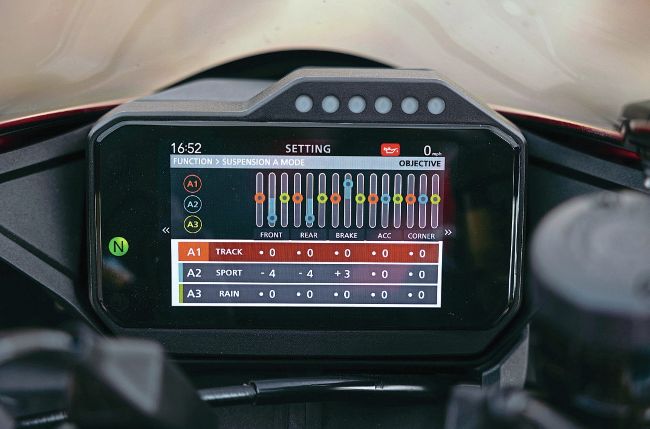
Feeling your age? We are too...
PICS: CHAPPO
Love ‘em or hate ‘em, electronic rider aids are here to stay. That particular technical genie got out of the bottle a long time ago, somewhere between 2006 when the first ride-by-wire production bike landed – the Yamaha R6 – and probably 2010 when the first-generation BMW S1000RR gave us rider modes, traction control and electronic semi-active suspension all at the same time. Since then, the performance envelope of a sportsbike has been defined by 1s and 0s as much as it has by bhp, lb.ft and kgs.
Things have still moved on in the analogue world, especially when you consider how much cleaner engines must be today compared to 2010, but they haven’t moved on anything like as much or as rapidly as they have in the digital world. Today’s bikes are virtually unrecognisable in terms of what they are capable of doing to assist the rider to either go fast or stay out of the hedgerows with little more than lines of code that exist only in the form of millions and millions of tiny, separate, low-voltage electrical pulses every second and a lot of sensors.
A generational divide?
This rapid advancement in technology was brought into sharp focus for me last summer when I rode the 2004 Honda Fireblade alongside the all-new 2024 Fireblade to celebrate the 20th anniversary of Honda making the Fireblade into a superbike. Free of the responsibility to make a careful and detailed assessment of each bike for the purpose of a review, I was able to spend the day just enjoying each bike and only really noting the major differences – and how, if at all, they made the bike better or worse than the other.
Unsurprisingly, the fact that the 2024 bike had switchgears covered in switches and buttons compared to the 2004 version and a dashboard that in 2004 would have looked like it belongeded in a sci-fi film with menus and acronyms all over it were the standout and most obvious differences. What was curious, however, was that both mine and Michael Rutter’s reaction to all the options and all the adjustability was to just leave it all as it was and carry on with our day out. I found this a predictable but also slightly sad reaction to an aspect of the bike that no doubt has been the focus of attention for a lot of very brainy people, and that the fruits of all their labour can be overlookedoked so easily for no reason other than perceived hassle factor. It doesn’t help that the bike is so damn good as it comes that it’s easy to think that it can’t be any better.
So, after our little trip down memory lane, I really wanted to spend more time in the company of the 2024 Fireblade for the sole purpose of delving into the electronics. A call to Honda and the 2024 bike was mine for another week – plenty of time to do a lot of laps of my 18-mile test route that I use and really get into the world of high-end electronic rider aids on the road. I wanted to suss out if they’re all just solutions to problems that don’t exist, and tackle the question that often gets asked – do we need them at all?
SINCE 1995, BIKES HAVE GAINED AT LEAST 20BHP EVERY 10 YEARS: ’95 FIREBLADE 120BHP, ’05 GSX-R1000 170 BHP, ’15 R1 200BHP, ’25 PANIGALE 216BHP…’
ELECTRONIC WARFARE
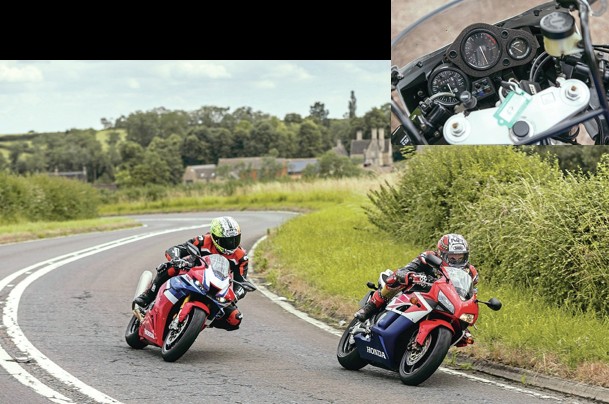
Rutter recently gave Johnny a spanking on a bike 20 years his younger...
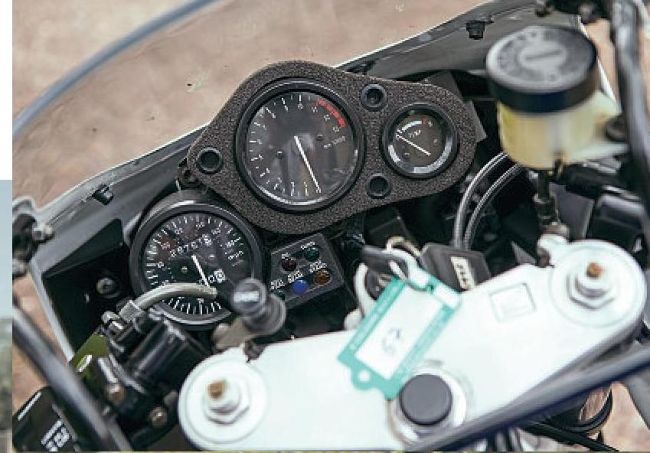
The original Blade’s cockpit. How times have changed.
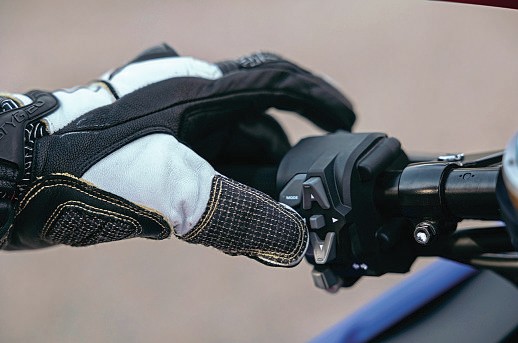
Power to the fingertips...
I guess the first thing that really needs to be considered if I’m going to dive into the world of 1s and 0s is why all too often you hear the line that all the electronic rider aids on modern bikes are just pointless, and I suppose it’s probably a generational thing. There’s a whole load of people who grew up on bikes without even a digital dashboard, let alone adjustable slide control or adjustable anti-wheelie or rider modes, but I’m in the very fortunate position of being one of those people who did grow up with early R1s, Fireblades, GSXRs and so on from the late 1990s and early 2000s and then, through my chosen line of work, have had a front row seat for the electronic revolution. Thus, I have a unique perspective on the topic, having lived with and ridden pretty much everything from the 1990s, 2000s, 2010s and 2020s – the era that has seen the transition from nothing, through the early crude systems, right up to the very latest mega-sophisticated systems as found on the 2024 Fireblade.