Q&A
YOUR QUESTIONS ANSWERED
... WHAT IS A DORMANT BLACK HOLE?
... WHY CAN’T ROBOTS ON MARS CLEAN THEMSELVES?
... WHY DOES SUGARY PUFFED WHEAT CEREAL MAKE MY WEE SMELL?
... WHERE SHOULD YOU STORE YOUR EGGS?
... HOW DO SHARK TEETH WORK?
... WHY DO I GET SO JEALOUS?
... WHY IS LITHIUM SO RARE IN THE UNIVERSE?
... WHY CAN’T YOU EAT OR DRINK BEFORE A GENERAL ANAESTHETIC?
... HOW INCOGNITO IS INCOGNITO MODE?
... CAN THE CLOTHES YOU WEAR REALLY AFFECT YOUR MOOD?
... WHY DOESN’T FUSION GENERATE RADIATION?
Email your questions to questions@sciencefocus.com or submit on Twitter at @sciencefocus
OUR EXPERTS
PETE LAWRENCE Astronomy expert
AMY ARTHUR Science writer
DR NISH MANEK GP and medical expert
HOLLY SPANNER Staff writer, BBC Science Focus
DR HELEN PILCHER Biologist and science writer
DR EMMA DAVIES Science writer and editor
DR EZZY PEARSON Space and science journalist
PROF PETER BENTLEY Computer scientist
DR CHRISTIAN JARRETT Psychologist and author
DR ALASTAIR GUNN Astrophysics lecturer
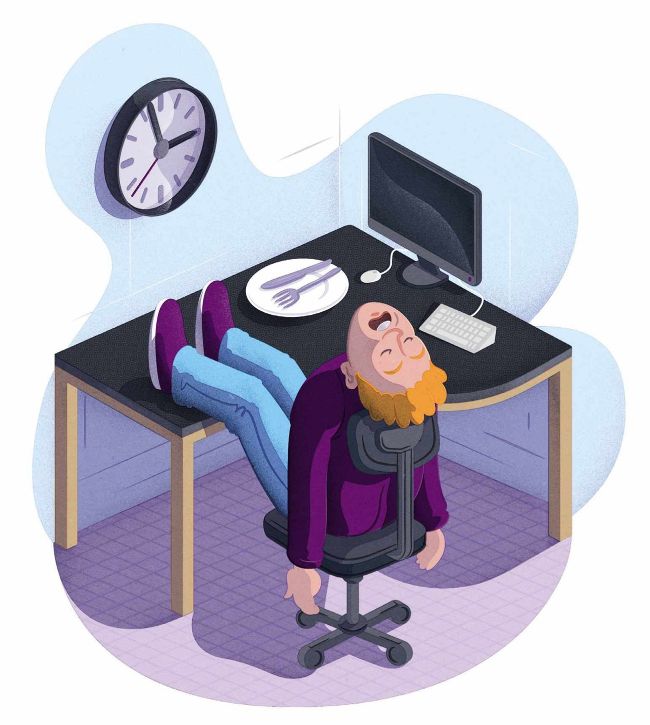
ILLUSTRATION: DANIEL BRIGHT
IS THERE ANYTHING I SHOULD AVOID AT LUNCH, TO DODGE THE AFTERNOON SLUMP?
MANDY WILSON, LONDON
It sounds as if you suffer from the common affliction of postprandial somnolence, otherwise known as a food coma. Postprandial somnolence is not completely understood in humans, although there have been experiments on rodents, fruit flies and nematode worms.
A meal filled with high-carb and high-sugar foods, such as potatoes, breakfast cereals and white bread, may be more likely to make you slump. These foods have a high glycaemic index, rapidly releasing sugars in the body. The spike in blood glucose instructs the body to produce more insulin, which sets off a chain of biological events leading to muscle and fat cells taking up glucose. This can cause blood sugar levels to crash, leading to low energy.
When you eat, your body activates its parasympathetic nervous system and enters a ‘rest and digest’ mode, which contrasts with the sympathetic nervous system’s ‘fight or flight’ mode. The extent to which the rest and digest mode induces sleepiness depends on how much food you eat in one sitting. More food requires more rest.
The amino acid tryptophan may also play a role in postprandial somnolence. Tryptophan is present in many protein-based foods, including eggs, fish and meat. Insulin stimulates the uptake into muscle of some amino acids, but not tryptophan. This leaves tryptophan available to travel on an amino acid transporter, into the brain. There, it converts to serotonin and melatonin, both of which increase relaxation and sleepiness.
The best way to avoid a food coma is to avoid having high-carb meals, like sandwiches or rice. Add in some protein, healthy fats and vegetables to balance things out, and don’t eat too much in one sitting.
ED
DEAR DOCTOR...
HEALTH QUESTIONS DEALT WITH BY OUR EXPERTS
LIZZIE WHITE, VIA EMAIL
WHY DOES SUGARY PUFFED WHEAT CEREAL MAKE MY WEE SMELL?
Your urine can change colour and smell according to what you eat. Foods like beetroot, blackberries, and broad beans can turn urine pink or red, for example, as the pigments are excreted by your kidneys.
But if truth be told, your urine shouldn’t really smell sweet. Google brings up various anecdotal articles about sugary cereals making our urine smell like them, but this has not been scientifically proven. You might want to consider getting checked for diabetes if you really think this is the case.
Diabetes results from issues with the hormone insulin and leads to more blood glucose circulating in the bloodstream. When these blood sugar levels get really high, the body tries to find balance in any way that it can, including through the urine. Urine that contains glucose may well smell sweet because it actually contains sugar. But since that is not a normal route for glucose to leave the body, it’s a sign that warrants further investigation.
Some medicines can give urine vivid tones too, such as orange or greenish-blue. For example, the information leaflet for the cold medicine Day Nurse states that: “One of the excipients of this medicine (Riboflavin 101) may cause your urine to turn bright yellow/orange. If this continues even after stopping taking this medicine, you should contact your doctor”. So this one isn’t something to be worried about! Riboflavin is a water-soluble vitamin, and excess amounts are excreted by the kidneys. As riboflavin is bright yellow in colour, it can make your wee luminous while you’re taking the Day Nurse.