ROGUE PLANETS
GOING ROGUE
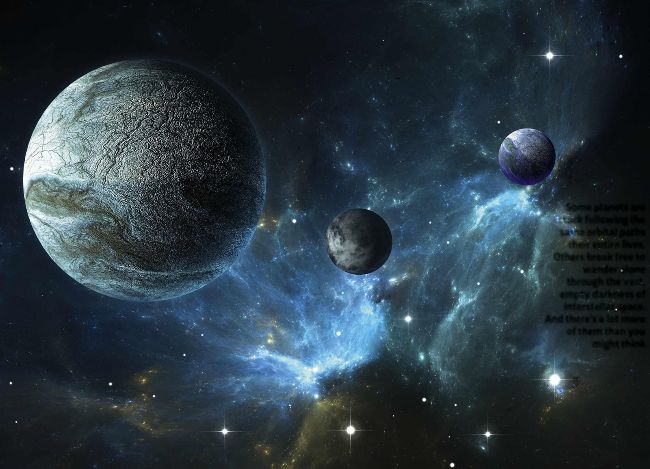
Some planets are stuck following the same orbital paths their entire lives. Others break free to wander alone through the vast, empty darkness of interstellar space. And there’s a lot more of them than you might think
by COLIN STUART
GETTY IMAGES
Imagine a world where the sun never rises. A planet that doesn’t even have a sun. A place with no pastel-painting-sunsets and no dawn choruses, just a constant veil of faint stars twinkling in a perpetual, indelible inky night.
This unfamiliar scenario would be the reality for any life calling a starless planet home, such as one that’s somehow become untethered from its star, rendering it free to wander through the Universe.
When we think about planets, we usually picture the eight worlds of our Solar System silently orbiting the central star that’s pulling on invisible gravitational strings to keep them close. Yet in recent years astronomers have uncovered an increasingly large population of a very different kind of planet. Worlds that no longer orbit a star at all, worlds that wander the void between stars. Free-floating, rogue planets.
“They are planets that originally orbited a star, but then something happened and they were kicked out,” says Dr Alexander Scholz, an astronomer from the University of St Andrews, who studies these strange, orphaned worlds.
Early in their lives, solar systems are particularly chaotic places. Two sibling planets could gravitationally duel for supremacy, flinging the losing planet out of the system entirely. A planet’s trajectory could also be set onto a similar exit route simply by interacting with the disc of material that it formed from in the first place.
Or perhaps the planet’s banishment came later. A passing star could wrench a planet out of place, or the death of the planet’s star could tip the delicate gravitational balance and destabilise that planet.
Computer simulations have shown that somewhere in the region of 20 to 30 per cent of gas planets could get ejected from their home solar systems to end their lives wandering free. “There are likely to be billions of rogue planets in the Milky Way,” says Scholz. There may even be trillions.