NUCLEAR FUSION
HEREE COMES THE SUN
CHRISTMAS WAS CANCELLED LAST YEAR FOR MANY OF US. JUST IN CASE THIS YEAR SUFFERS THE SAME FATE, WE’VE ROUNDED UP A SELECTION OF WINTER SOLSTICE CELEBRATIONS FROM AROUND THE GLOBE. AFTER ALL, YOU CAN’T ABOLISH AN ASTRONOMICAL EVENT!
WORDS: HAYLEY BENNETT
A NEW DAWN
GETTY IMAGES
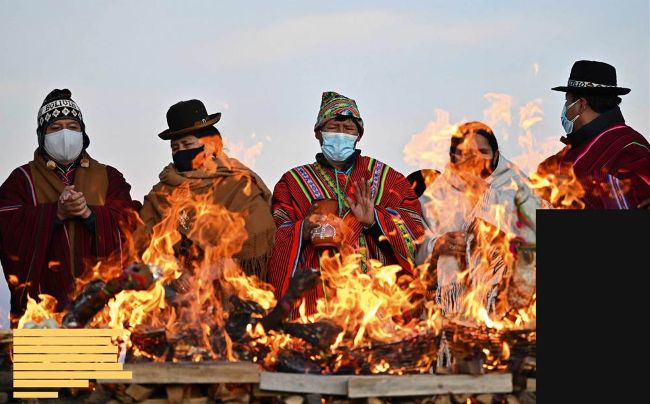
WILLKAKUTI CELEBRATION, BOLIVIA
Roman pagans celebrated the shortest, darkest day, or winter solstice, on 25 December, welcoming the longer daylight hours ahead. This is probably why we celebrate Christmas on this date; not because it was Jesus’ birthday. As astronomy presenter Colin Stuart explains: “Before temples made way for telescopes, many civilisations saw the Sun as a god. On the winter solstice… they figured that the deity was furthest from the Earth and so did all they could to beckon it back again to warm and sustain them for the year ahead.” We now know the astronomical reason for the solstice: the Earth is tilted on its axis. On 21 December, in the northern hemisphere, the Earth receives the least light it will get all year because it is most tilted away from the Sun, while the southern hemisphere has its winter solstice in June. Bolivians celebrate Willkakuti (‘return of the Sun’) on the 21 June, coinciding with New Year for the Amayran people of the Andes. The ruins at Tiwanaku are a popular place to greet the dawn, as the Sun appears through the entrance of a pre-Incan temple.