JAMES WEBB
JAMES WEBB’S FIRST YEAR IN SPACE
IN JUST A FEW SHORT MONTHS, THE JAMES WEBB SPACE TELESCOPE HAS IMAGED THE UNIVERSE AS NEVER BEFORE. HERE ARE ITS BIGGEST DISCOVERIES SO FAR
WORDS: DR STUART CLARK
This galaxy emitted its light 13.1 billion years ago. It was captured by the JWST’s microshutter array, part of its NIRSpec instrument. This is so sensitive that it can observe the light of individual galaxies that existed in the early Universe
NASA/ESA/CSA/STSCL
T he first images beamed back from NASA’s James Webb Space Telescope (JWST) have stunned the world this year. Launched on Christmas Day 2021, it took a month to arrive at its destination in space, a gravitational sweet spot 1.5 million kilometres further out into the Solar System. It then underwent an extraordinary sequence of deployment, unfurling a tenniscourt-sized sunshield and unfolding a segmented mirror measuring 6.5 metres in diameter before any further work could take place.
Once everything was powered up and online, operators began the painstaking job of commissioning the instruments and making sure everything was working correctly.
The JWST is the largest telescope ever launched into space. It works at infrared wavelengths of light. These are rays that have a longer wavelength than the light we can see with our eyes. We generally perceive infrared radiation to be heat, which is why socalled ‘thermal cameras’ are infrared in nature.
Finally, on 11 July 2022, we got to see its first images. And they were breathtaking. Giant celestial landscapes of dust and gas were revealed, as were the deepest reaches of the Universe. There were huge, interacting galaxies, and dying stars in their final throes of life.
But the images themselves, however mind-blowing, are just the tip of the iceberg. Behind them are mountains of data that are set to reshape our understanding of the Universe. From the deepest realms of the cosmos all the way home to the celestial backyard of our Solar System, there is not a single domain of the Universe that the JWST cannot make a meaningful investigation.
In truth it is still early days for the actual results. Astronomers around the world are still getting used to the data that is now streaming down to Earth. But it is very clear that the JWST looks set to fulfil every science promise and then some.
THE EARLY UNIVERSE
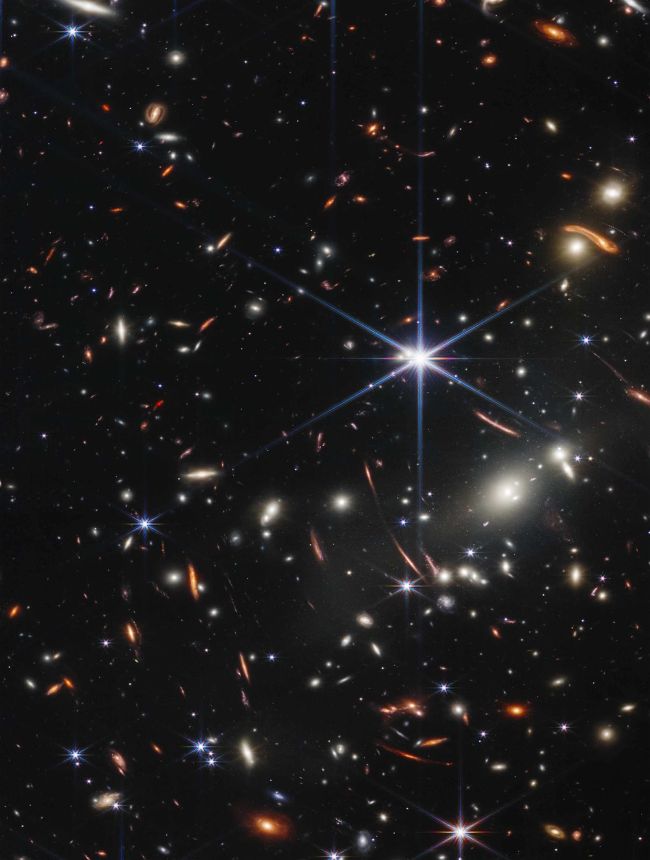
One of the JWST’s science objectives is to look into the distant reaches of the Universe to see how the first galaxies were born. It can do this because light takes billions of years to cross our cosmos. When the JWST collects this light, it is seeing those objects as they looked billions of years ago. To reflect this fact, astronomers refer to distances in light-years, which is the distance light can travel in a year. And the first image to be released by the team highlighted this point. It was unveiled on 11 July 2022 by US President Joe Biden, speaking from the White House, and it was a ‘deep field’ image. Deep fields came to prominence in 1995 when the Hubble
Space Telescope peered at a single patch of sky for 10 consecutive days, starting on 18 December. The selected patch was little more than a tiny speck, about one 24-millionth of the whole sky. Yet Hubble revealed around 3,000 previously unknown objects, mostly galaxies that are billions of light-years away. Centred around the galaxy cluster SMACS 0723, the JWST’s deep field spans a similarly minuscule patch of sky.