SPACE ODDITY
Above Earth, in orbit, there is a void, a no-go zone that spacecraft enter at their own peril. It’s at once lethal to machines, but also essential to the way satellites work. Welcome to the Southern Atlantic Anomaly… otherwise known as the Bermuda Triangle of Space
by GEORGINA TORBET
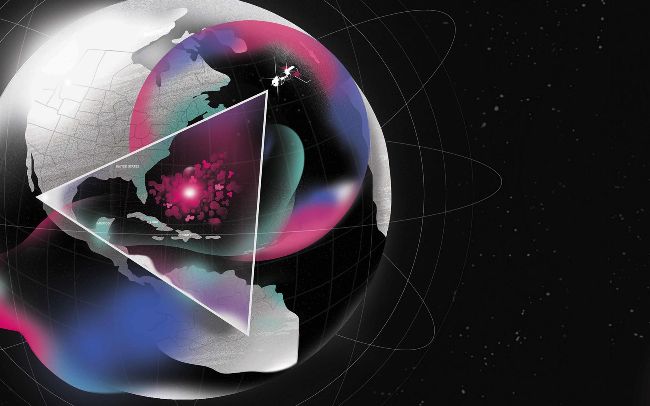
ILLUSTRATION: KUBA FERENC
High above Earth at an altitude of around 480km (300 miles), roughly over Brazil, is something strange. A spot where satellites go haywire, where the Hubble Space Telescope can’t collect data and where even the astronauts on the International Space Station (ISS) can’t go on spacewalks. You can’t see it, but it’s there. And it’s nicknamed the Bermuda Triangle of Space.
Officially known as the South Atlantic Anomaly, or SAA, the strange behaviour of electronics in this region is caused by a dent in Earth’s magnetic field. While the magnetic field around the planet helps keep us safe from radiation in the form of charged particles, the field is much weaker in this area – and that means more of these dangerous particles.
“In this region, charged particles routinely travel closer to the surface of Earth than they do elsewhere,” says Dr Ashley Greeley, a NASA heliophysicist. These particles get trapped in this dent and can hang around there for years, causing chaos to spacecraft. “If an energetic proton strikes sensitive electronics, it can cause a temporary issue, like data loss or bit flip, or a permanent loss, where the electronic component stops working entirely. Or charged particles can accumulate on the surface of the spacecraft and cause spacecraft charging, which can, in turn, damage electronic components.”
Space agencies and private companies make sure to turn their satellites off if they’re going to pass through the SAA and they take extra care not to schedule any spacewalks there either. But the presence of the anomaly isn’t something we have any control over. Nevertheless, we need to keep track of it because it’s moving.