GB
  
You are currently viewing the United Kingdom version of the site.
Would you like to switch to your local site?
12 MIN READ TIME

LIFE AS WE KNOW IT

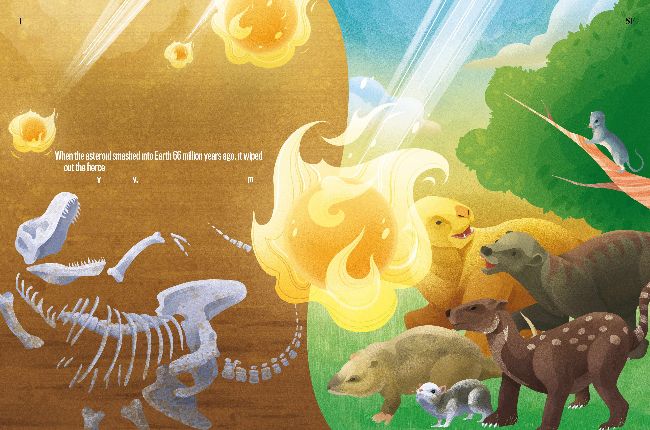
When the asteroid smashed into Earth 66 million years ago, it wiped out the fiercest, strongest creatures on Earth–the dinosaurs. So how exactly did our tiny, furtive ancestors thrive in the aftermath of an apocalypse?

ILLUSTRATION: MAGIC TORCH
The supercontinent Pangaea began to break apart in the early Jurassic, around 200 million years ago
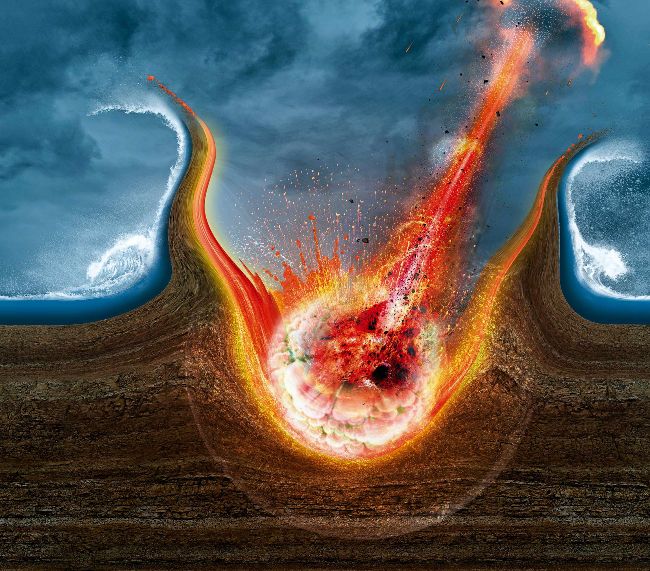
When the asteroid smashed into Earth some 66 million years ago, as visualised here, it altered the path of evolution for the planet’s species

D uringthe Triassic, some 225 million years ago, two types of animals went their separate ways.

They were both born on the supercontinent of Pangaea, the single slab of land that stretched from the North Pole to the South. Their fates would be different, but forever intertwined. One group was destined for grandeur, and before long, their aeroplane-sized bodies thundered across the land. Dinosaurs. The other group was relegated to the shadows to bide their time.

Mammals. Us, our distant ancestors.

Fast-forward some 160 million years, through the Jurassic and to the end of the Cretaceous. Temperatures spiked and crashed, sea levels rose and fell, and the supercontinent became the many continents of today. Through all of this time, dinosaurs and mammals lived together, but followed their own paths. No mammal ever got larger than a badger, as they were held in check by the dinosaurs. Conversely, the smart and furry little mammals kept dinosaurs from the small-bodied niches, so there never was a miniature T. rex or Triceratops. Like ships passing in the night, the dinosaurs and mammals both diversified, claiming separate realms as their own. Dinosaurs ruled the forests and plains by day, mammals the brush and underground in darkness.

Then, in an instant, everything changed. Sixty-six million years ago, a sudden disaster reshaped the world, and within days, months and years, it upended an evolutionary status quo that had persisted for more than 100,000 millennia. The dinosaurs – except for a few peculiar species with wings and feathers, which became today’s birds – couldn’t cope, and they went extinct.

Many mammals felt the pang of death, too, but some managed to endure. From these plucky survivors, the next great dynasty of Earth history would blossom.

Unlock this article and much more with
You can enjoy:
Enjoy this edition in full
Instant access to 600+ titles
Thousands of back issues
No contract or commitment
Try for 99p
SUBSCRIBE NOW
30 day trial, then just £9.99 / month. Cancel anytime. New subscribers only.


Learn more
Pocketmags Plus
Pocketmags Plus

This article is from...


View Issues
BBC Science Focus Magazine
Jun-22
VIEW IN STORE

Other Articles in this Issue


Editorial
FROM THE EDITOR
COVER: MAGIC TORCH THIS PAGE: GETTY IMAGES, NERISSA
WANT MORE?
Don’t forget that BBC Science Focus is available
REGULARS
Finding Nemo
NOLI, ITALY
Galactic disco
HUBBLE SPACE TELESCOPE, LOW EARTH ORBIT This assembly
Sloth snuggles
PUERTO VIEJO DE TALAMANCA, COSTA RICA Meet Mango
CONVERSATION
YOUR OPINIONS ON SCIENCE, TECHNOLOGY AND BBC SCIENCE FOCUS
DISCOVERIES
“Whether directly or indirectly, we’re all in some
SUPERMASSIVE BLACK HOLE AT THE CENTRE OF THE MILKY WAY SEEN FOR THE FIRST TIME
SPACE
HOW DOES THE EVENT HORIZON TELESCOPE WORK?
The Event Horizon Telescope (EHT) is often referred
HEPATITIS IN CHILDREN: WHAT WE KNOW ABOUT THE SURGE IN LIVER DISEASE CASES
No, it’s not caused by COVID-19 vaccines, as some social media posts have suggested
QUANTUM WEIRDNESS COULD BE THE DRIVING FORCE BEHIND DNA MUTATIONS
Potentially harmful changes in genetic code may be caused by subatomic particles ‘tunnelling’ across the DNA helix
VIDEOCONFERENCING STIFLES CREATIVITY
TECHNOLOGY
GUT MICROBES MAY INFLUENCE THE RISK AND SEVERITY OF STROKE
The discovery could lead to new methods of treating or preventing stroke
STRESSED CELLS OFFER HINTS TO NEW DEMENTIA TREATMENTS
A newly discovered mechanism suggests that when stressed, neurons can eliminate the toxic protein tangles seen in Alzheimer’s
STARGAZERS CALL FOR GREATER REGULATION OF SATELLITE LAUNCHES
“It’s time to clean up space,” say astronomers, as ever more satellites are launched into low Earth orbit
‘WALKING’ ROBOTIC ARM POWERED UP ON INTERNATIONAL SPACE STATION
Russian cosmonauts activated the European Space Agencydesigned bot during historic event that marked the 250th spacewalk carried out on the ISS
3D-PRINTED TERRACOTTA REEFS COULD SAVE THE WORLD’S CORALS FROM DEVASTATION
ENVIRONMENT
THE FUTURE’S BRIGHT...
As a remedy to all the bad news
TRAVELLING TO THE EDGE OF TIME
The James Webb Space Telescope won’t just show us the furthest reaches of space, it’ll take us back to the dawn of the Universe too…
WHY DOES RESEARCHING BISEXUALITY MATTER?
COMMENT
AI WILL NEVER THINK LIKE A HUMAN... AND THAT’S OKAY
There’s no point getting frustrated with artificial intelligence when it doesn’t do what we expect it to. Instead, we should focus on the ways it can help and support people
VAMPIRE ELECTRONICS: HOW MUCH POWER DO THESE DEVICES RE ALLY DRAIN?
Can you save £££s by switching off appliances at the mains, as suggested by some headlines?
HIGHLY SENSITIVE: IS IT THE SAME AS BEING SHY OR INTROVERTED?
Recently, several celebrities have announced that they are ‘highly sensitive people’. What does this term mean, and how can you spot the signs?
PHYSICS: DO GIRLS AVOID IT BECAUSE IT’S TOO HARD?
In late April, head teacher Katharine Birbalsingh commented that girls didn’t like physics and are put off it because of the hard maths
INNOVATIONS
PREPARE YOURSELF FOR TOMORROW
Can a VR headset provide peace and tranquillity?
REVIEW
The essentials... festival tech
After a two-year break, festivals are back. Don’t set off for a weekend of music, food and mud without these
Ideas we like…
Our pick of the month’s smartest tech
INTRODUCTORY OFFER! SAVE 40%
WHEN YOU SUBSCRIBE TO BBC SCIENCE FOCUS TODAY*
Q&A
YOUR QUESTIONS ANSWERED
THE EXPLAINER PSYCHEDELICS
WARNING Psychedelics, such as magic mushrooms and LSD,
CROSSWORD
PENCILS AT THE READY!
NEXT ISSUE
INSIDE JET: THE WORLD’S BIGGEST FUSION EXPERIMENT PLUS
Could we live alongside dinosaurs?
In Jurassic World Dominion, the toothy ones have integrated into society…
FEATURES
PUSH IT TO THE LIMIT
SCIENTISTS GO TO EXTRAORDINARY LENGTHS TO EXPAND OUR UNDERSTANDING OF RADICAL PHENOMENA IN THE MOST EXTREME LABS ON EARTH
EVERYTHINGYOU NEED TO KNOW ABOUT INTRUSIVE THOUGHTS
Occasionally, you’re minding our own business when a weird – and sometimes disturbing or upsetting – thought pops into your head. Why does your brain do this, and does it mean that you’re a bad person?
Chat
X
Pocketmags Support