Q&A
YOUR QUESTIONS ANSWERED
... HOW DOES A PHONE ‘READ’ MY FINGERPRINT?
... WHY DOESN’T HALLOUMI MELT?
... COULD YOU PROTECT ASTRONAUTS FROM COSMIC RADIATION BY CREATING A MAGNETIC FIELD AROUND THEIR SPACESHIP?
... WHICH IS BETTER: OPTIMISM OR PESSIMISM?
... HOW DOES A GROUND SOURCE HEAT PUMP BOILER WORK?
... WOULD EARTH BE DIFFERENT IF IT SPUN THE OTHER WAY?
... WHY DO I HAVE SUCH A LOW PAIN THRESHOLD COMPARED TO MY SISTER?
... WHY DON’T HUMANS HAVE A BACULUM?
... WHY CAN CHEMOTHERAPY CAUSE YOUR HAIR TO GROW BACK DIFFERENTLY?
Email your questions to questions@sciencefocus.com or submit on Twitter @sciencefocus
OUR EXPERTS
DR DEAN BURNETT Neuroscientist and author
DR PETER BENTLEY Computer scientist
DR STEVE BRUSATTE Veteran palaeontologist
DR EMMA DAVIES Science writer
PETE LAWRENCE Astronomy expert
DR ALASTAIR GUNN Astrophysics lecturer
LUIS VILLAZON Science and technology writer
DR NISH MANEK Medical expert and GP trainee
DR HELEN PILCHER Biologist and science writer
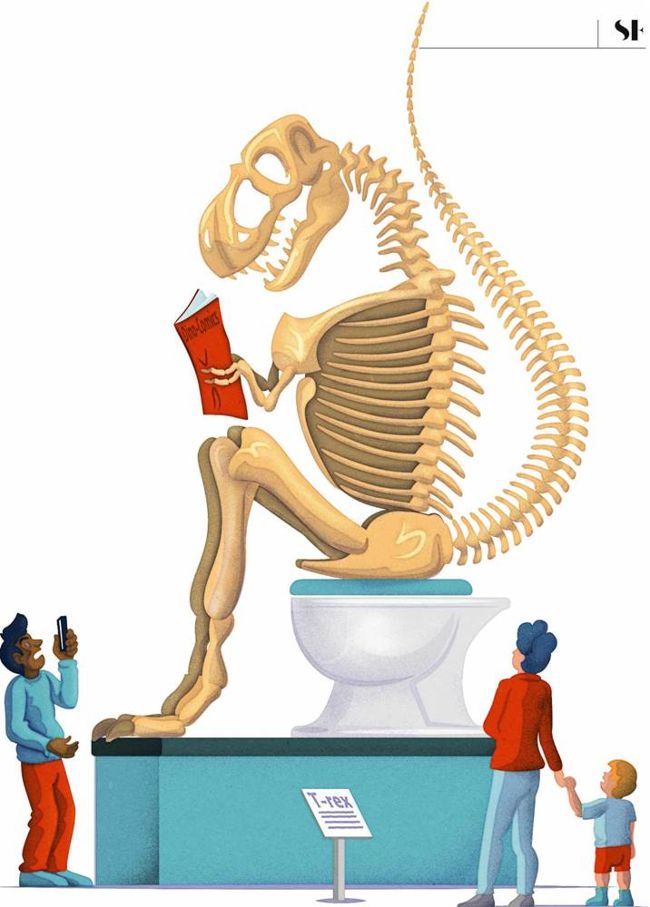
ILLUSTRATION: DANIEL BRIGHT
SARAH STONE, CHIPPING NORTON
DOES FOSSILISED DINOSAUR POO EXIST?
Dinosaurs, like all animals, would have needed to expel waste. Sometimes pieces of dinosaur faeces turned into fossils, which we can find today. These are called coprolites. Some palaeontologists specialise in studying coprolites and use them to understand what food dinosaurs ate, and how they fit into larger food chains.
The most famous dinosaur coprolite is an enormous specimen found in Late Cretaceous rocks in Canada. At over 30cm long and more than two litres in volume, this huge piece of scat could only have been produced by the largest predator in the ecosystem: Tyrannosaurus rex. Although a T. rex poo in itself is interesting (or perhaps disgusting, depending on your sensibilities), this fossil is also important. It’s full of chunks of bone, which tell us that T. rex could bite so hard that it crushed the bones of its prey –a highly unusual way of eating with no obvious modern equivalent.
Other dinosaur coprolites have been found with plants inside, and one even contains decomposing wood –a sign that the dinosaur was supplementing its nutrition with fungi and bugs that feed on rotting logs.
SB
ASTRONOMY FOR BEGINNERS
THE WINTER TRIANGLE
WHEN: DECEMBER TO APRIL
The Winter Triangle is what’s known as an asterism, basically an unofficial pattern in the night sky. Asterisms can be of any size, and can be contained within a single constellation or span several constellations (as is the case with the Winter Triangle). The triangle is formed from three bright stars visible in the winter sky; Betelgeuse in Orion the Hunter, Sirius in Canis Major the Great Dog and Procyon in Canis Minor the Little Dog.
Betelgeuse is the red supergiant star that marks the northeast (upper left) corner of Orion’s main pattern. Despite being described as ‘red’, to the naked eye the star appears to be tinted orange. The centre of Orion is marked by three stars of similar brightness sitting in a line, forming another asterism known as Orion’s Belt. Follow the line of the belt southeast (down and left) and eventually you’ll arrive at Sirius the Dog Star, the brightest night time star.
Sirius appears bright because it’s close. At a distance of 8.7 light-years, it’s one of the Sun’s nearer neighbours. For comparison, Betelgeuse is 548 light-years away. From the UK, Sirius never gets very high in the sky. This causes its light to be affected by low level atmospheric turbulence and it appears to scintillate (the technical term for twinkle) quite noticeably. It’ll often flash vivid colours too, an effect caused by atmospheric dispersion – light from low-altitude objects passing through our atmosphere and spreading into a spectrum of colour.