Q&A
YOUR QUESTIONS ANSWERED
... DOES BLOWING ON A HOT CUP OF TEA ACTUALLY DO ANY GOOD?
... WHY CAN’T MARINE ANIMALS SURVIVE IN FRESH WATER?
... HOW DOES A DEFIBRILLATOR WORK?
... ARE BIG HEADS SMARTER?
... IS MARMITE GOOD FOR YOU?
... WHAT IS WEB3?
... HOW DOES ECHOLOCATION WORK?
... WHAT’S THE DIFFERENCE BETWEEN WAVE ENERGY AND TIDAL ENERGY?
... WHAT IS TETRACHROMACY AND HOW DO I KNOW IF I’VE GOT IT?
... WHY DOES WRITING MY OWN NOTES HELP ME LEARN THINGS?
Email your questions to questions@sciencefocus.com or submit on Twitter @sciencefocus
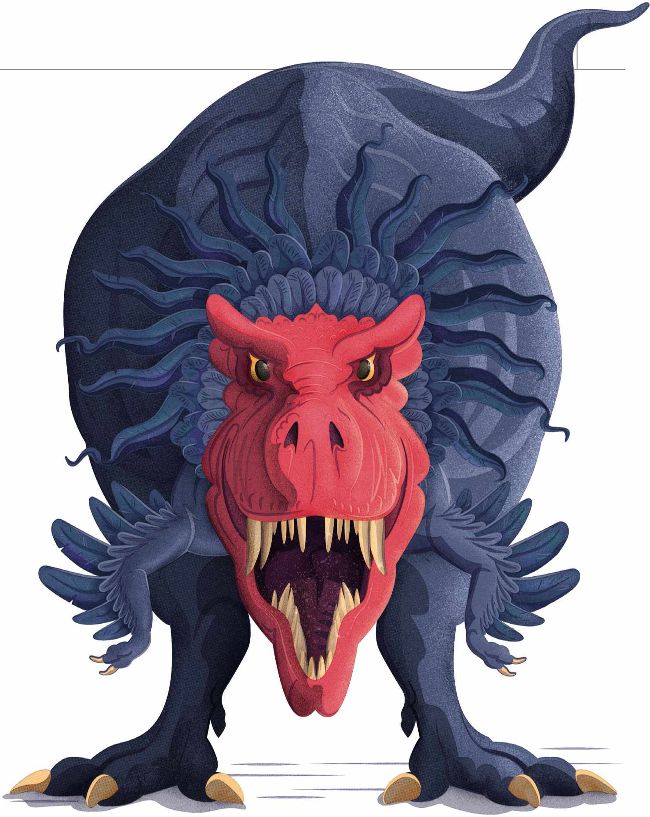
ILLUSTRATION: DANIEL BRIGHT
EDDIE SMITH, VIA EMAIL
DID THE T. REX ACTUALLY HAVE FEATHERS ?
The classic image of Tyrannosaurus rex is a reptilian monster. A green or brown, scalecovered brute that looks like an overgrown version of a crocodile or lizard. But in recent years, a new image has been making its way into books, television documentaries and online palaeoart: a feather-covered T. rex. Is this true?
First, there is not yet any direct fossil evidence of feathers on a T. rex. Nobody has found a T. rex skeleton cloaked in feathers, or any feathers sticking out of a T. rex arm bone. But this isn’t surprising. Feathers, muscle, skin, internal organs and other soft structures don’t often preserve as fossils. Most fossils are of hard objects like bones, teeth and shells, which can be more easily turned to rock and survive the ravages of geological time.
With that said, we have good reason to believe T. rex did have some feathers. In China, in the Early Cretaceous, volcanic eruptions buried entire ecosystems similar to how the city of Pompeii was buried by Mount Vesuvius. The dinosaurs were killed and interred quickly, and their soft tissues were locked in place. Many of these dinosaur skeletons are covered in feathers, including two tyrannosaurs – close cousins of T. rex – called Yutyrannus and Dilong. This means that the ancestors of T. rex had feathers, which means T. rex probably did too.
As an aside, a recent study made headlines by dividing T. rex into three separate species, based on differences in the proportions of the thigh bone. It’s a provocative study, but to me, this variation is minor, and not yet conclusive enough to show whether there was more than one type of T. rex.
SB
ASTRONOMY FOR BEGINNERS
DELPHINUS THE DOLPHIN
WHEN: LATE JULY TO AUGUST
There are many creatures depicted in the night sky. Some, such as Scorpius the Scorpion or Cygnus the Swan, do, with a bit of imagination, look like the thing they’re supposed to represent. Others, such as Delphinus the Dolphin, require more work. Delphinus is a small constellation of summer, located to the left (east) and slightly north of the summer star Altair, the brightest in the constellation of Aquila the Eagle. Altair is easily identified thanks to the two dimmer, but still bright, stars that sit either side of it; Tarazed and Alshain.
The best way to describe how Delphinus appears to the naked eye, is as a small diamond pattern with a tail. The diamond pattern is also an asterism (an unofficial pattern) known as Job’s Coffin. The constellation may not look too much like a dolphin at first, but that may be because you’re imagining it wrong. It’s supposed to represent the nose and neck of a bottle-nosed dolphin, its head poking out of the sea.
Delphinus is compact, and even though its stars aren’t particularly bright, it is distinctive. The two stars on the western (right) side of the diamond have the unusual names Sualocin and Rotanev. These first appeared on the Palermo Star Catalogue of 1814, courtesy of the Italian astronomer Niccolò Cacciatore. It took 45 years before the British astronomer Reverend Thomas Webb worked out what Cacciatore had done to create the star names. He’d Latinised the English version of his name to arrive at Nicolaus Venator and simply reversed the letters to generate the star names as a practical joke which has stuck.
The dolphin’s nose is marked by Gamma Delphini, a binary star which splits into a golden-orange primary and yellow secondary, when viewed through the eyepiece of a telescope.
PL