AMORIM
SPORTING CHANCE
Several managers have failed to return Manchester United to their perch since Sir Alex Ferguson’s retirement. Ruben Amorim overcame potential bans and a Christmas row with Jesus to revive a listing Lisbon giant, but can lightning strike twice at Old Trafford? Those who know him best reveal all
Words Chris FlanaganAdditional reporting Felipe Rocha, Marcus Alves
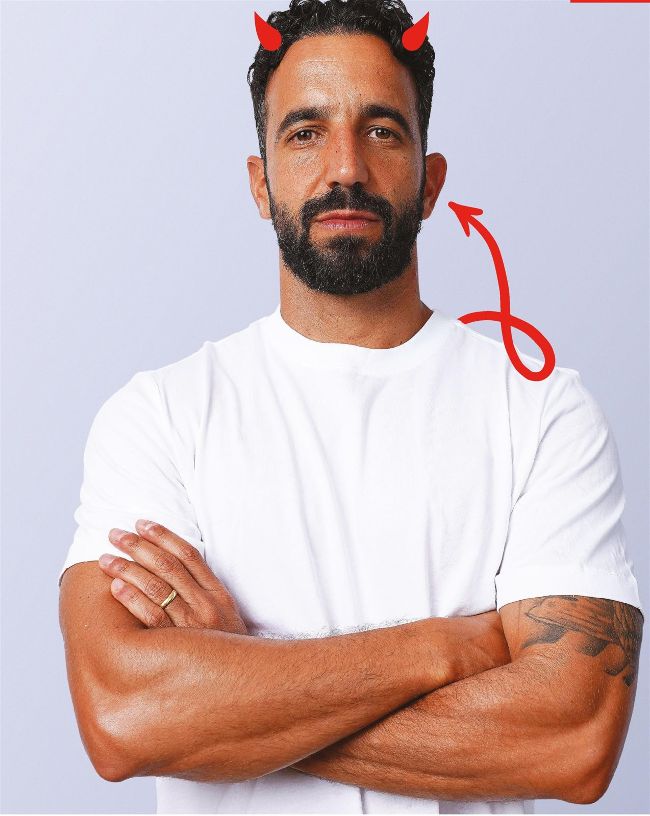
One simple sentence gave the game away, and has become more telling with every passing year. Sir Alex Ferguson knew. “Your job now is to stand by our new manager,” the Scot told the Old Trafford crowd after his final home game as Manchester United boss, in May 2013. That he felt it necessary to utter those words made it clear that Ferguson was concerned about whether United would remain united without him. Concerned, too, about whether United would remain United without him. In the near12 years since, the glory days have grown ever more distant. Stepping into Ferguson’s shoes always felt like it might be the impossible job, and so it proved for his first five permanent successors. David Moyes, Louis van Gaal, Jose Mourinho, Ole Gunnar Solskjaer and Erik ten Hag. All tried and failed. Now it’s the turn of 39-year-old Ruben Amorim, exiled on loan at Braga after a dispute with his manager, on the day that Ferguson called for unity in 2013. Via the threat of a year-long suspension that almost derailed his coaching ambitions at the very start, and a ballsy move to Portugal’s most chaotic club, Amorim’s own managerial career has certainly never been boring. Ending Sporting’s 19-wait for a Primeira Liga title was highly impressive, but returning Manchester United to the top will be his toughest task yet.
SHEER HARTE ATTACK
Amorim’s first managerial experiences came in front of a computer, in a house on the south bank of the River Tagus, across the water from Lisbon. Growing up, he’d play video games there with pal Bruno Simao – the pair were nine when they first teamed up in Benfica’s youth system.
“He was always so into ChampionshipManager,” Simao tells FFT, referencing the forerunner to FootballManager. “We played it a lot at his uncle’s house.
I often played as Leeds – they had a left-back I really admired, Ian Harte. Ruben leaned towards Real Madrid. He’s always had a sharp mind for tactics.” It’s something Amorim touched upon in a chapter he wrote for Hugo Leal’s recent book Nao e so Futebol, Estupido (It’s Not Just Football, Stupid). “When I started playing football, unlike most kids who enjoyed the informal kickabouts, I was always more interested in the concept of the game itself,” he explained. “In training sessions, I wanted to understand everything that was happening, to grasp what was being asked of me. I used to watch all my games, because my dad would record them. I’d spend the entire weekend at home, watching them from back to front.” Amorim earned the nickname ‘O Bebe-Agua’, ‘the Drinkwater’, not because he was a fanboy of future Premier Leaguewinning Leicester midfielders but because he literally drank water. “Only water,” laughs Simao. “Everyone called him that – his team-mates, even the parents! Many still call him that to this day. He just genuinely liked water, he didn’t want anything else.”
Benfica released Amorim at 13. Four years later, he’d link up with Simao again at fellow Lisbon club Belenenses. “I invited him to join me there, but he said he’d broken his arm,” remembers Simao. “I told him not to worry about that and I’d talk to the coach. Ruben did a training session to be evaluated I explained to the coach, ‘He’s incredibly talented, but he has his arm in a sling’. The coach decided to play him as a centre-back, to see how he moved and handled the ball. When the session ended, the coach told me, ‘Bruno, you were right, he’s a real talent’.”
“He creates a brotherhood-like connection. Players know he goes above and beyond to protect them”
Amorim signed, developing into a first-team regular under future Sheffield Wednesday and Swansea boss Carlos Carvalhal. “Within two or three months of moving from the juniors to the seniors, he practically dominated the dressing room, full of players in their 30s who’d been there for years,” explains Rui Casaca, the club’s youth football director. “He has tremendous character. He dominated in a positive way, through how he was accepted.” Amorim helped Belenenses into the UEFA Cup under Jorge Jesus, earning him a return to Benfica. By 2009-10, Jesus joined him at the Eagles, and the pair immediately won the league. With Ramires, Pablo Aimar and Angel Di Maria running the midfield, Amorim often featured at right-back, further broadening his tactical experiences. At the end of that season, his Portugal debut unusually came in their opening game of the 2010 World Cup, as a late sub in a 0-0 draw against Ivory Coast. Months later, though, knee problems hit – when he returned in 2011-12, despite featuring in two Champions League group stage draws with Manchester United, he grew frustrated at a lack of game time. Aiming a dig at Jesus while on international duty, he then rowed with his manager in the dressing room after a match against Rio Ave, annoyed that he’d been asked to warm up, then never sent on from the bench.