Battle of the beatmakers
The drum machines on test
Arturia DrumBrute Impact
Unlike several machines in this group test, the DrumBrute Impact doesn’t claim to emulate the sound of a classic instrument, but there’s a decidedly vintage vibe to it nonetheless. The engine is all-analogue, from the sounds themselves to the output distortion. Unlike in synth world, where analogue is often seen as the Holy Grail, there are pros and cons to taking a purely analogue approach.
Pros: the kick and toms sound great – punchy but full-bodied, particularly with added grit from the distortion. For snares and claps though, while the sounds here sound great in the right context, analogue machines can’t match the variety of sampled engines. Ditto for cymbals and hats, which sound gorgeous but don’t offer much variation.
That said, the Impact offers more versatility than some analogue drum machines thanks to its ‘Color’ variations, which can engage a slightly altered version of each sound (with the exception of the cowbell).
The other significant ‘vintage’ trait of the Impact is its lack of MIDI control or automation for sound parameters. You can trigger the drums via MIDI or USB, but if you want to alter pitch, decay, levels, etc, you’ll need to use the physical controls. The main area where this becomes an issue is in the Impact’s FM drum, which really comes to life with a bit of movement and variation. To get the most out of it you’ll need to get hands-on with the carrier and modulator pitch dials.
Fortunately there are some modern sequencing tools, including pattern-saving and chaining, step rolls, per-track swing and automation, and a Poly mode, where users can set individual sequence lengths for each track.
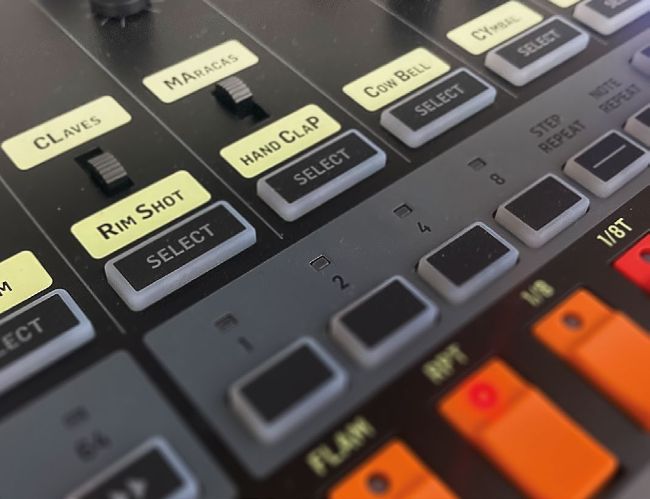
…while Behringer RD-8 fills the niche left by Roland’s reluctance to launch an 808 remake
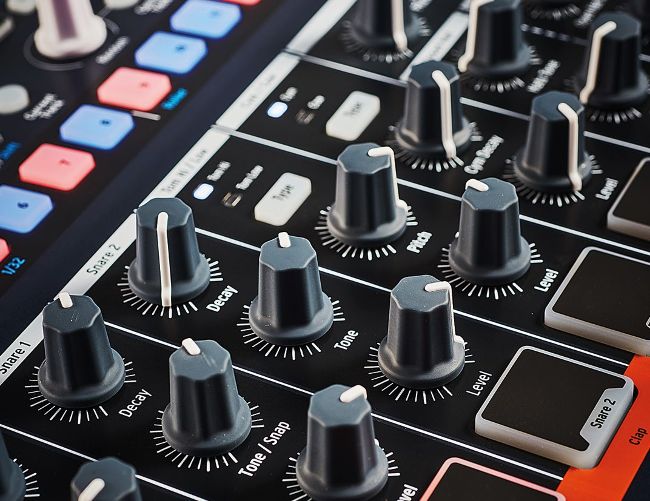
The Arturia DrumBrute Impact doesn’t hunt the vintage ideal, but it’s still a classic
Behringer
RD-8
Behringer’s latter-day approach of releasing close remakes of vintage instruments can be somewhat divisive. The RD-8 has to be one of the less contentious though; Roland have made it clear they have no intention of relaunching an analogue 808, and the original was one of the most regularly sampled and emulated instruments of all time long before Behringer got involved.
In the flesh, the RD-8 differs somewhat from the design of the 808, but where it matters though, it’s bang on. The analogue sound engine is meaty and warm, and the kick, toms, rim and snares sound near enough indistinguishable from the original. There are slight differences in the tone and pitch of the cymbals, hats and cowbell, but we wouldn’t say they necessarily sound worse. The RD-8 hardware is chunky too, which could be seen as impractical, but it lends it an authentic feeling of heft that’s missing from Roland’s Boutiques or, to an extent, the TR-8S. Its size leaves room for full jack outputs for every one of the 11 tracks, plus – one of our favourite features – a return input allowing for an external effects loop.