THE GREAT UNKNOWN
For more than 30 years, Lyle Workman has been the go-to sideman, session player and film music composer for discriminating artists. On Uncommon Measures, he revels in his own artistic identity.
BY MICHAEL ROSS
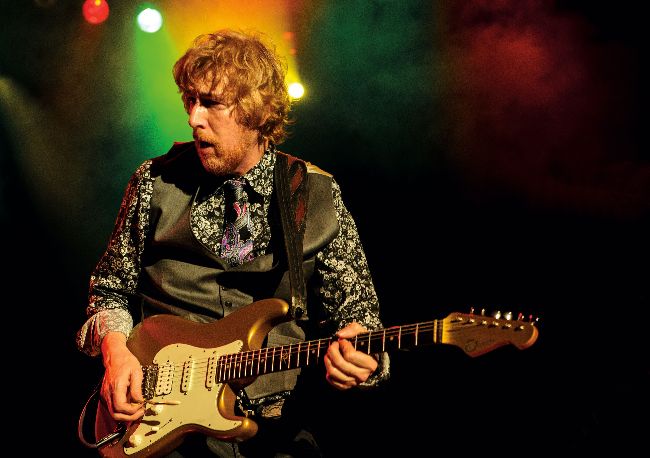
Lyle Workman onstage with his Thorn SoCal R/S with Shoreline Gold finish
TOM DELLINGER
LISTENING TO “NORTH STAR,” the nine-minute-plus opus on Lyle Workman’s record, Uncommon Measures (Blue Canoe Records), you feel like you are hearing the overture to an epic, exciting movie, perhaps one about pirates, cowboys or even a galaxy far, far away. Searing slide guitar slips into sections of skittering strings, and fusion flurries are followed by heralding brass parts. There’s even a drum solo. The miracle is that, like a great movie overture, the disparate elements hang together with an overarching theme. Elsewhere on the album, Workman plays Django-style acoustic, country twang and chiming pop riffs. Is there anything this man can’t play? “If there was any difficult classical guitar, that would be an area I’m least qualified in,” he says. “I would have to spend six months practicing only that.”
Workman’s career is easy to envy: gigging and/or recording with Sting, Beck, Todd Rundgren, Bootsy Collins and Frank Black, as well as writing the music for a series of major movies, starting with Judd Apatow’s 40-Year-Old Virgin and continuing through Superbad, Forgetting Sarah Marshall and others. Though it should be noted that his achievements are less about luck than a combination of hard work, drive and chutzpah. When Frank Black asked him what he was doing for the next couple of months, Workman responded, “Playing with you.”

TOM DELLINGER
With such a varied skill set and résumé, it is not surprising that Uncommon Measures draws from myriad musical and cinematic influences. What is surprising is how it reflects a unique and consistent point of view. Speaking in depth about his career, Workman reveals how he was able to cohere his wideranging inspirations, the joys of poweramp distortion and where it all began: with a father who played for fun and introduced him to the instrument. In Workman’s teens, a teacher schooled him in the modes and set him working his way up and down the neck learning arpeggios. This began the fledgling player on the road to the amazing technique he evidences on Uncommon Measures. “I was always trying to play difficult stuff,” he reveals. “I was really into Steve Morse and John McLaughlin. When trying to work up a riff, I would use a metronome to try to increase the speed.” Two years of college, studying theory, composition, harmony and sight reading taught him to put names on the things he could already play. “It had all been learning how to play things by ear off of records,” he says.