THUNDERBYRD
SOME GUITAR HEROES ARE ESTEEMED FOR THEIR TECHNICAL FLASH. BUT THERE ARE OTHERS WHOSE GUITAR WORK IS UPSTAGED BY THEIR CONTRIBUTIONS AS SONGWRITERS, SINGERS, TRENDSETTERS AND TASTEMAKERS — GUITARISTS WHOSE SOUND IS SO INEXTRICABLY WOVEN INTO THE FABRIC OF ROCK THAT THE WHOLE THING WOULD BE UNTHINK ABLE WITHOUT THEM. THAT’S THE KIND OF GUITAR HERO ROGER McGUINN I S.
BY ALAN DI PERNA
OVERLOOKED, UNDERRATED, SIDELINED AND DOWNPLAYED SIXTIES GUITAR HEROES PART 1: ROGER McGUINN
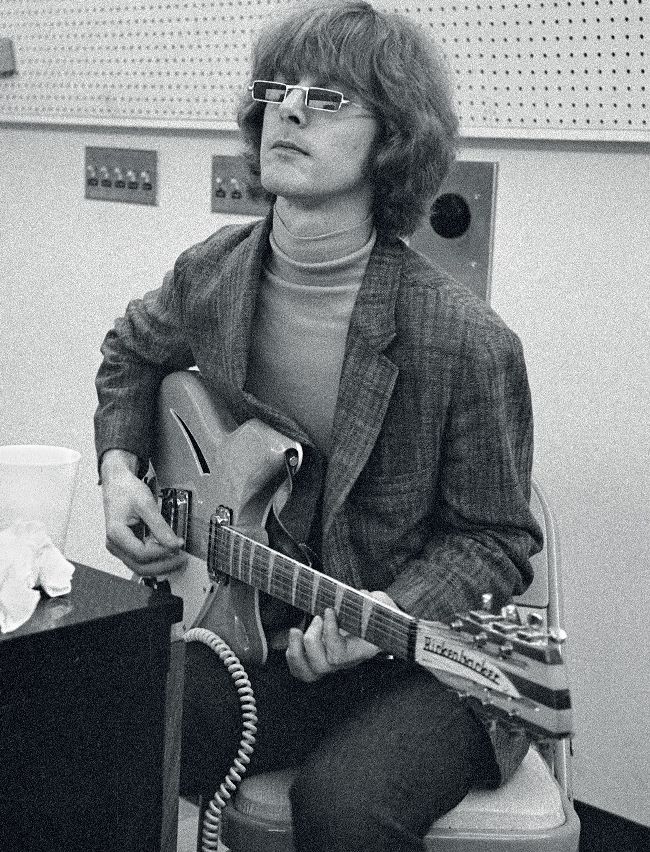
June 2, 1965: McGuinn — with his Rickenbacker 360/12 — at a Byrds recording session in Los Angeles
CBS VIA GETTY IMAGES
NOVEMBER 1990, I SAT IN THE CONTROL ROOM AT CAPITOL RECORDS’ STUDIO B IN HOLLYWOOD AND WATCHED ROGER MCGUINN RECORD 12-STRING ELECTRIC GUITAR OVERDUBS FOR “SOMEONE TO LOVE,” THE LEAD TRACK FROM HIS BACK FROM RIO ALBUM, RELEASED IN ’91. THE ROOM WAS AWASH IN THAT GLORIOUS, PLANGENT RICKENBACKER JANGLE THAT IS MCGUINN’S GREATEST GIFT TO THE RICH LEXICON OF ROCK GUITAR STYLES. I WAS BOTH IMPRESSED AND INSPIRED BY HIS NUANCED COMMAND OF THE SIGNATURE MODEL RICK 370/12 HE WAS PLAYING AT THAT TIME — TRYING OUT SUBTLE VARIATIONS IN PHRASING, PUNCHING IN A PULL-OFF TRILL TO END A LINE MORE GRACEFULLY.
There was something familiar in the song’s ascent from E minor to G major, via a D passing chord with F# in the bass. Producer David Cole called out, “Hey, how does ‘Eight Miles High’ go?” Without missing a beat, McGuinn played the entire iconic solo that he’d recorded nearly a quarter of a century earlier, note-for-note, flawlessly.
Because I’d started playing guitar in the mid Sixties, McGuinn had always been a major hero. Not just for his playing and singing, but also the aura of serene cool he emanated back when he was still called Jim McGuinn. In junior high school, I’d had my McGuinn-style “granny” sunglasses confiscated by the school’s Dean of Discipline. Lots of kids wore them. Factories started mass producing the things when McGuinn’s band, the Byrds, became one of the biggest rock groups on the planet with the 1965 release of their debut single, an electrified cover of Bob Dylan’s “Mr. Tambourine Man.”
At the vanguard of the folk rock phenomenon, the Byrds were the bridge that led from the British invasion into the psychedelic era. They’re the pied pipers who transported us from “yeah yeah yeah” to “Purple Haze,” basically. George Harrison proclaimed the Byrds “The American Bea-tles.” Like Bob Dylan himself, the Byrds were, for the most part, seasoned folk musicians who’d become fascinated by the new style of electric guitar rock and roll that the Beatles, Rolling Stones, Kinks, Yard-birds, Animals and other British groups had brought to the fore.
“We were already a band and we were rehearsing and working with acoustic instruments,” McGuinn told me. “We saw A Hard Day’s Night and realized the Beatles were playing a Gretsch electric six-string, Ludwig drums and a Hofner bass. And George Harrison switched between the Gretsch and this Rickenbacker 12-string that didn’t look like a 12-string at first, because the peghead concealed six of the tuners. But when he turned sideways, I went, ‘Oh that’s a 12-string!’ I was playing a Gibson acoustic 12 with a pickup in it, but it didn’t have the kind of sound George was getting. I liked his sound better, so I went out and got a Rickenbacker 360 12-string.”
While McGuinn and his bandmates had the same gear as the Beatles, they used it to produce a distinctly different sound and overall aesthetic. What McGuinn brought to electric 12-string rock guitar was a solid grounding in folk picking — something that Harrison and other Rick-playing Brits, such as Pete Townshend, didn’t have. As a teenager in Chicago, McGuinn had studied guitar and five-string banjo at the Old Town School of Folk Music, a pioneering institution at a time when formal instruction in vernacular musical styles like folk was unheard of.
“They started around 1957,” McGuinn recalled, “and that’s when I enrolled. I was there from ’57 to 1960. I learned a lot there. I studied with [seasoned folk musician and Old Town founder] Frank Hamilton. There would be about twelve people in a class, and it was really fast learning. He’d give you a picking assignment every day. I’d go home and work on it, and we’d get another one the next day. Gradually, I got all these picking styles.”