SPACE JUNK
The space-age junk that pollutes our planet
Since the launch of Sputnik 1, the first satellite to orbit Earth in 1957, a vast amount of space debris has accumulated in its wake. This consists of anything from flecks of paint to discarded rocket boosters, ‘dead’ satellites that no longer function and equipment lost by astronauts during spacewalks.
The scale of the problem can be grasped by the fact that there are estimated to be 128 million pieces of space junk between one millimetre and one centimetre, 900,000 pieces between one and ten centimetres and more than 34,000 pieces larger than ten centimetres.
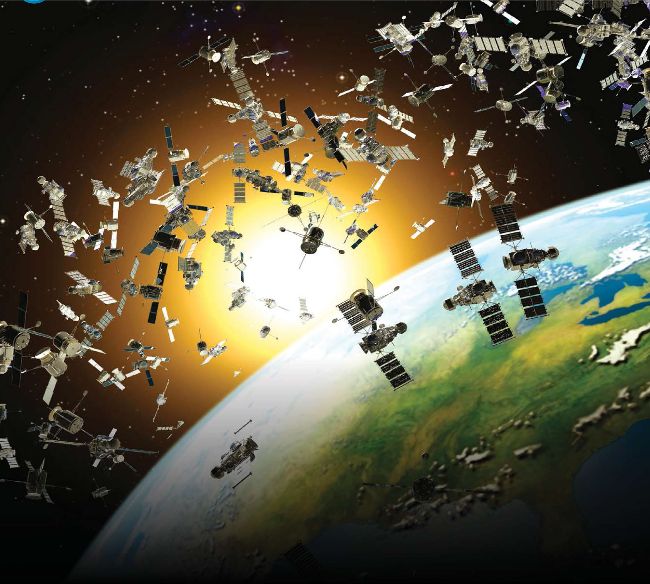
© Science Photo Library
In low-Earth orbit (LEO) this junk travels at an average speed of eight kilometres per second, which is roughly ten-times faster than a bullet. This means that even the smallest objects can damage the subsystems of a satellite. The objects measuring one to ten centimetres are part of a ‘lethal population’ because they are big enough to do considerable damage to a spacecraft, but are too small to be tracked. Larger debris is tracked and can be avoided; in the case of the International Space Station (ISS), it makes at least one manoeuvre a year to divert it from potentially lethal collisions.
In 2010 there were 13,000 near misses per week, and by 2059 it is predicted that there will be as many as 50,000. The increased need to use rocket fuel to avoid these hazards shortens the life of satellites and increases the cost of launching satellites that need to carry extra fuel.
Around 2,000 large pieces of space junk were created when the first collision between two satellites occurred on 10 February 2009. This was between US communications satellite Iridium 33 and a defunct Russian satellite, Kosmos-2251, 789 kilometres over Northern Siberia. Even worse, about 150,000 pieces of junk were deliberately created when China destroyed an inactive Fengyun-1C weather satellite with a missile as part of an anti-satellite test.