INSIDE A GIANT FUSION MACHINE
JT-60SA will pave the way for making nuclear fusion a viable energy source of the future
WORDS SCOTT DUTFIELD
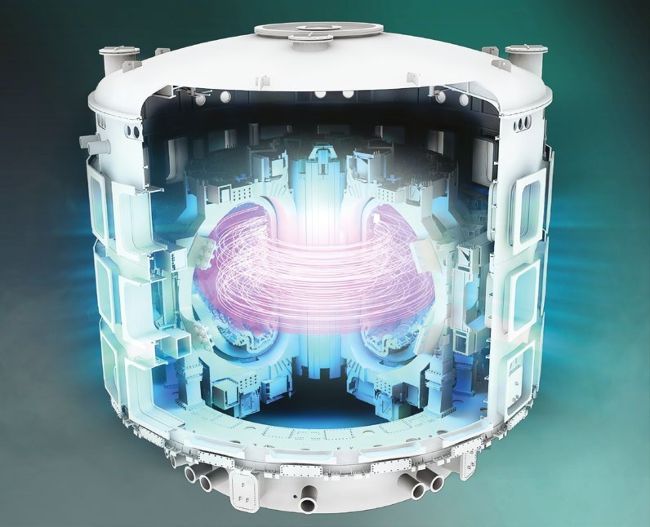
An illustration of the 30-metre-tall ITER Tokamak currently being built in France
DID YOU KNOW?
Every second the Sun converts around 550 million tonnes of hydrogen into 515 million tonnes of helium
Scientists have taken the next big stride in nuclear fusion technology with the switch-on of the Japanese Torus-60 Super Advanced (JT- 60SA), the current record holder for the world’s largest tokamak. Situated at Japan’s National Institutes for Quantum Science and Technology (QST), the tokomak has produced plasma volumes up to 135-cubic-metres and has been created in a collaboration between the European Union’s Fusion for Energy and QST. The word ‘tokamak’ comes from the Russian acronym for ‘toroidal chambers with magnetic coils’, and like others of its kind, JT-60SA generates energy by harnessing the power of nuclear fusion reactions. To achieve this, a fuel of superheated deuterium and hydrogen is injected into the doughnut-shaped vacuum chamber at the core of the machine, which is controlled by coils of superconducting magnets. A powerful magnetic field causes the fuel to swirl in a hot ring, known as plasma, around the core. The two elements are forced together until their atomic magnetic fields break apart, and the atoms fuse to form a new atom of helium. This is also how the Sun converts hydrogen into helium as it burns.