HOW RADAR WAS INVENTED
The scientific discoveries and mechanical milestones that led to the creation of one of the world’s most revolutionary technologies
WORDS SCOTT DUTFIELD
DID YOU KNOW?
The cavity magnetron is the same technology used in microwave ovens
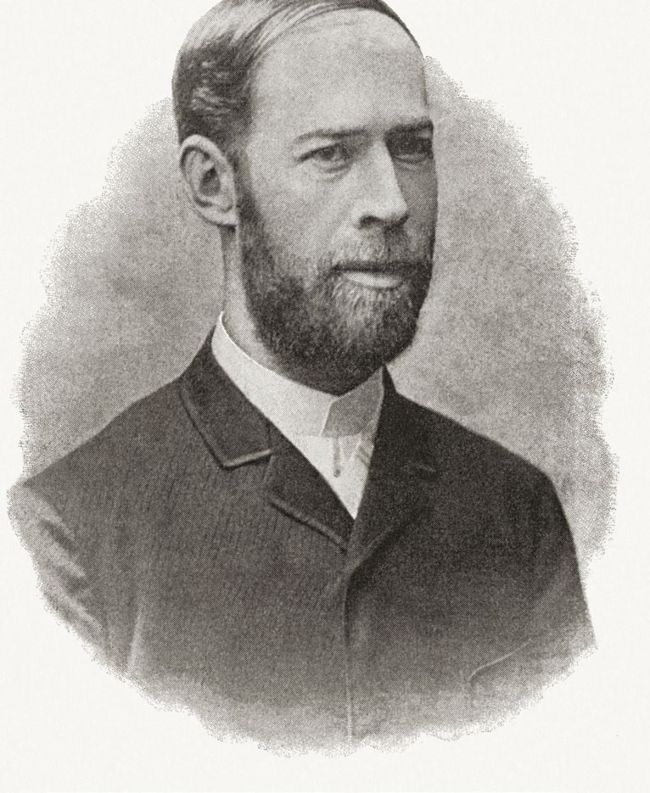
After his discovery, Hertz went on to teach as a professor of physics at the University of Bonn, Germany
FINDING RADIO WAVES
1865
In the late 1800s, German physicist Heinrich Hertz made a discovery that would change the world forever. Before Hertz’ discovery, Scottish physicist James Clerk Maxwell had predicted the existence of electromagnetic radiation in 1865 in his paper ADynamical Theory of the Electromagnetic Field, in which he described electric and magnetic fields moving in waves at equal speeds.
To put Maxwell’s theory to the test, Hertz set up a simple home experiment to produce electromagnetic waves. Hertz used an induction coil, a type of electrical transformer, and a Leyden jar as the first capacitor to create an electrical current. The induction coil and Leyden jar were then connected to a pair of copper wires attached to two metal plates. Along each wire and sitting between the metal plates were two metal spheres. A short gap of air, called a spark gap, was left between the two spheres.
When a current was passed through the copper wire, the air in the spark gap became ionised and generated an electrical spark that jumped between the two spheres. Along with the spark, Hertz discovered that the predicted electromagnetic waves had also been released by using a receiver made from a metal loop with a similar spark gap. When the waves reached the loop, another spark was generated in the receiver’s spark gap. This signified the existence of electromagnetic waves, which at the time became known as Hertzian waves, later renamed radio waves.