TECHNOLOGY
China creates the largest ever quantum computing chip
WORDS OWEN HUGHES
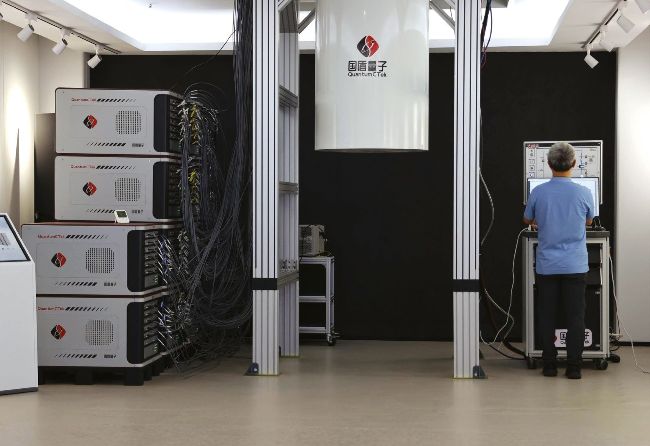
The superconducting quantum cloud platform at QuantumCTek that will utilise the new chip
Did you know?
The world’s largest quantum chip is 1,125 qubits
Scientists in China have developed a 504-qubit quantum computing chip that will be made available to researchers worldwide via a new quantum computing cloud platform. The new chip, called ‘Xiaohong’, is the biggest built by China to date and is designed to improve systems that manage the behaviour and interaction of quantum bits, or qubits, in quantum computers. The scientists hope that the chip will help scale up existing quantum computers so they can handle more complex tasks.
“The new chip, called ‘Xiaohong’, is the biggest built by China to date” and accelerate the application of quantum computing in actual scenarios.”
Xiaohong was developed by scientists at the Center for Excellence in Quantum Information and Quantum Physics, part of the Chinese Academy of Sciences (CAS). Chinese quantum computing company QuantumCTek, which received the first Xiaohong chip, will now reportedly work alongside China Telecom Quantum Group to integrate the 504-qubit chip into a new quantum computer. This system will then be made available to researchers worldwide via a quantum computing cloud platform also developed by China Telecom Quantum Group. Wang Zhen, deputy general manager of China Telecom Quantum Group, said the new system would “allow users in various fields to conduct research on problems and algorithms of practical value efficiently Xiaohong is designed to meet the performance standards of cloud-enabled quantum computing platforms like those made by IBM or Amazon Web Services. But it’s not intended as a technical rival to cutting-edge US technology such as the 1,121-qubit IBM Condor chip, said Gong Ming, a researcher at the Center for Excellence in Quantum Information and Quantum Physics. Instead, the scientists hope access to Xiaohong via the cloud will promote the development of large-scale quantum computing measurement and control systems (QCMCSs). Quantum computers work fundamentally differently from classical computers. Unlike classical bits, which can only be represented as zero or one, qubits can exist in multiple states simultaneously. This enables quantum computers to perform calculations in parallel and at nearunimaginable speeds if qubits are stitched together through quantum entanglement.
QCMCSs, meanwhile, are components that play a crucial role in quantum computing, acting as a bridge that connects traditional computers with quantum computers. This connection enables quantum computers to interpret commands received from classical computing environments and manage the state of qubits accordingly. QuantumCTek will use Xiaohong to test the ‘kilo-qubit’ quantum computing measurement and control systems developed in-house. This would “greatly influence the overall performance of quantum computers,” said Liang Futian, an associate professor at the Center for Excellence in Quantum Information and Quantum Physics.