"Such a Happy Crowd are We!"
For over 30 years the Children’s Film Foundation produced quality entertainment for young audiences, employing the cream of British filmmaking talent. John Martin remembers some of the Saturday matinee joys they brought us...
“We come along on Saturday morning Greeting everybody with a smile.
We come along on Saturday morning Knowing it is well worth while.
As members of the GB club We all intend to be Good citizens when we grow up and champions of the free.
We come along on Saturday morning Greeting everybody with a smile, smile, smile. Greeting everybody with a SMILE!”
And that was just the kids who attended Gaumont British (GB) cinema clubs on a week(end)ly basis!
Other Saturday morning matinee merriment was available, e.g. over at the rival ABC chain (“Such a happy crowd are we, we’re all pals together, we’re Minors of the A…B… C!”). Whichever corporate giant was taking your Imperial sixpence (tickets stayed at that price until decimalisation in 1971) and leading the sing-along, since 1927 it had been possible for parents to pack their kids off to a safe environment (there to stuff themselves with sweets and fizzy drinks as Flash Gordon, Tarzan, Popeye the Sailor Man and co did their respective stuff) while Mum and Dad caught up with the shopping, any work that needed doing around the house or perhaps, if they were lucky, certain other underindulged aspects of marital life. Sounds like a sweet arrangement all round, but not everybody was happy.
Gaumont/Odeon honcho Lord J Arthur Rank, principally remembered these days for setting up a Charm School, employing a succession of well oiled, muscular gong bashers and as a particularly saucy component of cockney rhyming slang, was also a convinced Methodist and socially aware kind of British movie mogul, much concerned that the preponderance of American content in this cinematic diet was not quite the thing on which to rear good citizens and champions of the free.
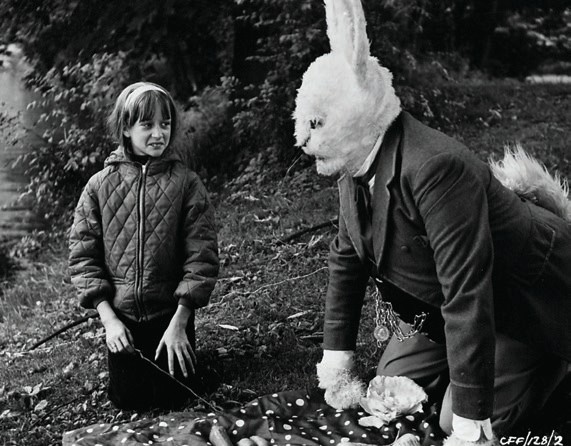
Lesley Roach as Mary with Anthony Sheppard in Mr. Horatio Knibbles (1971). Mary is disappointed when she doesn’t receive a pet rabbit for her birthday, but then she gets one after all, in the form of an imaginary friend. (Many thanks to Jill Reading at the BFI for supplying pictures for this feature)
Rank’s Gaumont-British Instructional Division was itself instructed by His Lordship to make Tom’s Ride (directed by Darrell Catling in 1944), a cautionary tale concerning the consequences of theft. Subsequently renamed The Children’s Film Department and (from 1947) CEF (“Children’s Entertainment Films”), the unit continued cranking out morally uplifting epistles for budding Saturday morning cinephiles.
In 1950 the report of the Wheare Committee, set up by the Home Office and Ministry of Education to survey the state of UK film censorship, applauded these efforts while deploring many of the “unsuitable, violent and frightening” films shown at kiddies’ matinees (it also, incidentally recommended the introduction of the iconic “X” certificate).
“This was all happening at the same time as the big Horror Comics moral panic in the UK” offers Vic Pratt from the BFI (the organisation which currently curates, conserves and disseminates the archive of films we’re about to discuss), the Methodist reaction to which was The Eagle, which the Reverend John Marcus Morris didn’t even call a comic. It was dubbed an ‘illustrated story paper’ and contained wholesome adventure stories like those of Dan Dare. Morris wasn’t trying to make things boring and sanctimonious, The Eagle was supposed to be fun and exciting, which was exactly what Lord Rank was trying for, too”.