ULTRA Q
The most expensive television series in Japan at the time, Ultra Q (1965-1967) cost nearly three times as much as the average Japanese television show. It also featured dozens of times as many weird monsters, as Michael Coldwell recalls…
The Narrator -Ultra Q: ‘Metamorphosis’
"Currently, a part of mother nature that surrounds us is starting to make a strange move. That’s right, this is a terrifying world where everything is unbalanced. For the next 30 minutes you’ll experience a parting of mind from the body and become swallowed into this mysterious time!"
In the mid-1960s, when Japanese monsters ruled the earth, Ultra Q was the ultimate creature show. Made by Tsuburaya Productions for the Tokyo Broadcasting System (TBS), it was conceived as a Twilight Zone/Outer Limits-style fantasy anthology series, only with recurring characters investigating new and ever-stranger case-loads each week. And it really delivered on the monsters: it was packed to the gills with kaiju, the strangely compelling fantasy creatures then ruling the Japanese box office courtesy of Toho Studio’s beloved Godzilla monster-verse, Daiei Film’s Gamera flying turtle series and a whole bunch of other scaly wannabes. For this reason, and the fact it had one eye trained on the toy shelves, Ultra Q was infected with a spirit of mischievousness and fun that set it apart from the more cerebral US anthology shows that inspired it.
Along with the Ultraman superhero franchise that spawned from it, Ultra Q is part of the much-loved Japanese tokusatsu fantasy genre. Literally meaning ‘special filming’, tokusatsu films and TV shows feature giant monsters and aliens, superheroes, strange robots and outrageous degrees of Earthly destruction – all rendered in a blizzard of spectacular visual effects.
It was broadcast in a weekend 7pm family slot from January 2nd to July 3rd, 1966 (with the delayed 28th and final episode not screening until December 14, 1967). The series was a massive deal for the TBS network, with each 25-minute, black and white episode executed like a mini-feature film. It was shot on 35mm film, as opposed to the 16mm stock commonly used for TV production in Japan in the 60s, and the budget for each episode was three times that of other filmed series, making it the most expensive series then produced in Japan. Failure? Not an option.
Through his ground-breaking work on the spectacular Toho monster movie series and his own company’s run of hit fantasy TV series, Ultra Q’s originator and producer Eiji Tsuburaya (1901 – 1970) was the mind’s eye of the tokusatsu filming style.
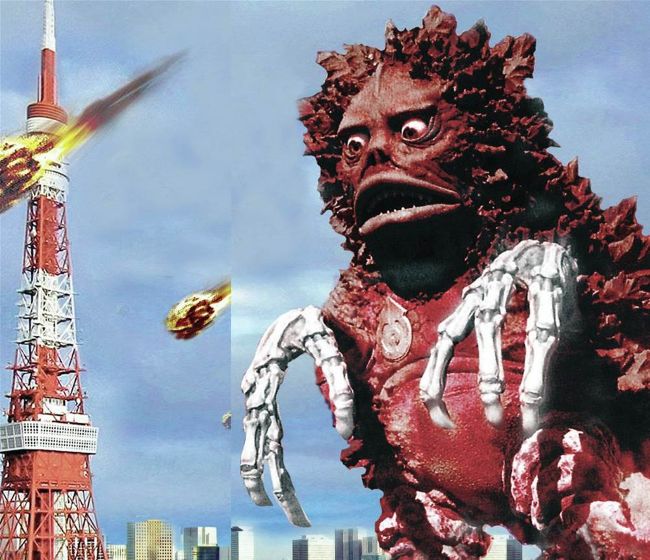
Garamon Strikes Back (1965). The robot monster is perhaps the most recognizable monster from Ultra Q, and is among the Kaiju most associated with the landmark series
A pioneering master of Japanese visual effects, he worked on over 250 movies over a 50-year career. From the ultra-reality of war to fairy-tale dreamscapes, Tsuburaya deployed every trick in the book, using elaborate miniatures, puppetry, suit-mation (stuntmen in monster suits), optical printing, pyrotechnics and water effects in ways that audiences would delightedly come to know as his ‘house style’.
His re-creation of the battle of Pearl Harbour on a (very large) miniature scale for The War at Sea from Hawaii to Malaya (1942) was so spectacularly convincing that America pinched the footage to include in its own newsreels, but he was perhaps most happy in the company of giant marauding monsters, futuristic machinery and more playful fantasy adventures. Writer August Ragone summed this game plan up elegantly in his 2007 Tsuburaya biography ‘Master of Monsters’: ‘His philosophy was that this was meant to be entertainment, and a large part of entertainment is unpredictability, Tsuburaya’s approach was to appeal to one’s heart and emotions. In his fantasy films, he wasn’t as concerned with re-creating reality as he was with creating an illusion of reality’.
His partnership at Toho with the revered director and screenwriter Ishirō Honda was one of fantasy cinema’s greatest team-ups. As well as producing the still-astonishing effects for Honda’s SF epics The Mysterians (1957) and Battle in Outer Space (1959), Tsuburaya’s team were the engine room of the two-decade Showa (meaning the time of Emperor Hirohito) era of kaiju movies. Beginning with the powerfully metaphorical Gojira (Godzilla) (1954), about the emergence of an indestructible radioactive creature that wreaks havoc on post-war Japan, Tsuburaya and Honda co-curated a shared universe of nightmare-hero creatures, including the mystical lepidoptera Mothra, tragic prehistoric warbird Rodan and three-headed fire-breathing funster Ghidorah. Godzilla may have been the King, but they all had their time to shine, reigning elemental judgement upon beautifully-constructed model cities, their high-velocity blaster beams (and occasional bizarre bodily fluids) killing untold thousands of unfortunate Japanese citizens in the process. It was phenomenal entertainment that struck a profound chord with cinema audiences. Who else to bring amazing creatures like these to TV than the man who made Godzilla roar?