21st CENTURY FOSS
Mark Campbell talks to the legendary artist Chris Foss about spaceships, steam trains, sex and a whole lot more…
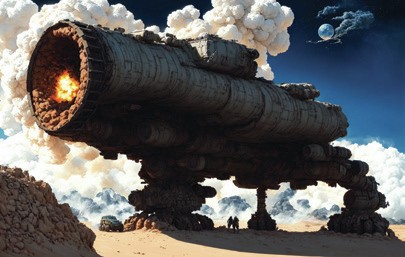
Chris Foss artwork from Jodorowsky’s
Dune
To readers of a certain age, Chris Foss needs no introduction. His extraordinarily detailed artwork adorned the covers of a myriad science fiction novels during the 1970s. It’s fair to say he painted The Future in a way no artist had ever managed to do before.
I was lucky enough to get hold of him recently, down the line from Guernsey, and what a lovely chap he was, regaling me with all manner of anecdotes about his long and illustrious career.
You were born in Guernsey in 1946, which of course had been occupied by the Nazis during the Second World War. The island was a big influence on your art, wasn’t it?
Yes. So much of my stuff is based on my fascination with the German observation towers when I was a kid. I was born a year after the war so they were still technically brand new. I had great fun climbing in and out of the concrete bunkers. Most kids want to explore holes in the ground, but it has almost cost me my life a couple of times. The influence on my art came in almost subconsciously.
What other things influenced you as a child?
That’s a very interesting question. I can still remember at school a book which riveted me. It was a big thick book called
The Boys’ Book of the Navy
and it was full of dramatic pictures of warships and exploded diagrams and I spent hours over it. That was a huge influence, and it keeps coming back in my paintings. There were terrific photographs of the scuttled German cruiser Admiral Graf Spee, with its conning tower coming up out of the smoke and flames. Images like that stick in my brain.
What was your first paid piece of art?
Well, I got to Cambridge by accident, because all I really wanted to do was go to art school and do strip cartoons. So I went to London, and in those days all the papers had a nice strip cartoon section, and I used to absolutely devour the drawings. I sent some stuff to this new magazine that had just started called
Penthouse
and the editor, Bob Guccione, flipped and said, “Yeah, this is great!” So I wrote a lovely Gothic horror story, based in Guernsey, called
Pawn: A Black Parable.
And a famous artist, I think he was in the Royal Academy, wrote in and said, “This guy is brilliant.” And that really was the start.