MAINE ATTRACTIONS
Graham Andrews looks back at the work of David McIlwain, better known by his pen name of Charles Eric Maine, whose science fiction serials published in the 1950s and 1960s were adapted for the screen by the likes of Hammer and Amicus...
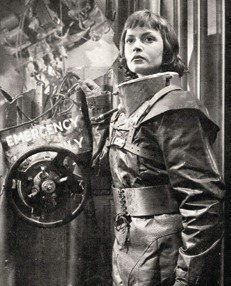
Right: Eva Bartok in Hammer’s Spaceways (1953), directed by Terence Fisher
A checklist of the most successful British science-fiction authors of the 1950s would have to include Arthur C. Clarke and John Wyndham – along with Charles Eric Maine, whose fame does not flame as brightly today. How soon they forget! More to the point of this article, however, Maine’s work made it to the silver screen long before either of his best-selling contemporaries.
First biographical things first. Charles Eric Maine (21 January 1928 to 30 November 1991) was born David McIlwain, in Liverpool. Maine (from now on) served in the Royal Air Force during the Second World War, as a signals officer – like John Wyndham in the Royal Corps of Signals, come to think of it.
After the war, he spent 14 years as a technical journalist and editor, becoming a regular science correspondent for The Times. Maine’s first short story, ‘The Mirror’ had appeared in his SF fanzine, The Satellite (October 1938). The professional breakthrough came with a radio play entitled Spaceways, written in 1951 and broadcast by the BBC a year later. Hodder and Stoughton published the novelisation in 1953, subtitled A Story of the Very Near Future.
The pre-horror Hammer/Exclusive Film Productions released a movie version that very same year, directed by Terence Fisher. Compare and contrast, starting with the book, which closely followed the radio play.
Spaceways the Novel takes place at “B” Research Site, near Silver Falls, a desert township in Nevada, from which an instrumentcarrying rocket (S.R. ONE) will be launched into permanent orbit. FBI agent Barry Conway, the newly-appointed Chief Security Officer, notices tension between key personnel members as Zero Hour approaches.
Rocket engineer Raymond Colby is obviously enjoying a carnal relationship with Marion Hills, the wife of George Hills, an electronics engineer, who does not seem to mind. Then Hills and Colby quarrel, something goes badly wrong after launching, and Colby and Marion disappear. Has George Hills committed a double murder, placing the bodies aboard the rocket, which is now circling the earth at a considerably lower altitude than planned, and will soon burn up during re-entry? FBI Special Agent John Keenan sees him as being the prime suspect, but there is no conclusive proof. The only way Hills can clear his tainted name is to blast off aboard S.R. TWO, with unexpected consequences for all concerned.
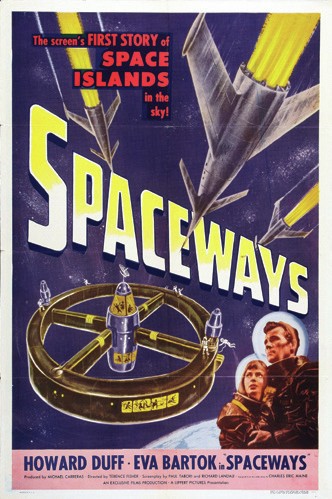
Spaceways the Movie is the same, only different, to be Irish about it. I know that the film is never exactly the book, but here we have a pure case of extremism. Produced by (later Sir) Michael Carreras, principal photography took place at Bray Studios from mid-November 1952 until early January 1953. Future Hammer scriptwriter Jimmy Sangster was the Assistant Director. Release dates: 24 June 1953 (USA); 7 August 1953 (UK).