SATELLITE DISHES
Allan Bryce takes a Missile to the Moon and discovers huge rock creatures, giant lunar spiders, and a cave-dwelling civilization made up of beautiful women... Will he ever want to return?
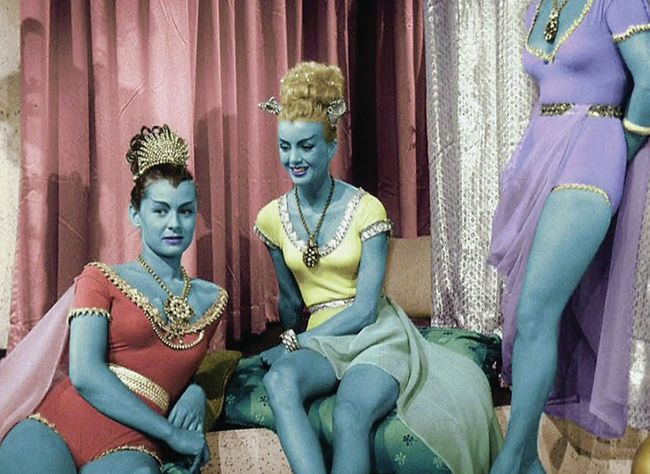
Nina Bara and K.T. Stevens
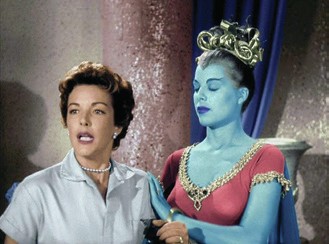
K.T. Stevens with Cathy Downs
As I write these words a total of twelve men have landed on the Moon, the first being Stanley Kubrick, er, sorry, I meant Neil Alden Armstrong, who famously said “That’s one small step for man, one giant leap for mankind” as he descended the ladder of Apollo 11 on July 21, 1969. Back then people like me envisaged that in a decade’s time we’d all be up there on Freddie Laker flights, enjoying a pint in a pub named The Sea of Tranquillity. Sadly no pub chain wanted to know, not even Wetherspoons. No atmosphere you sea, er, see.
Looking back, Moon landings were always a bit of a damp squib. The scenery in the Lake District was much more attractive, not to mention you could get cream teas there, and even the astronauts seemed happy to call it a day. Everyone, even the Russians, realised that the costs of actually living there would be out of this world.
But in the movies, the Moon remained a big deal. The Chairman of the Board even wanted to know what spring was like on Jupiter and Mars, though this apparently was beyond NASA’s budget to explore, and the Mafia would have wanted a piece of the action for sure. Back in the Fab 50s however, the lure of Earth’s only natural satellite was a siren call to every young imagination. But at 384,400 km away it would have been way too far for a Ford Thunderbird, even with a full tank, to visit.
Luckily the movies stepped in. Okay, so we’d had vintage efforts like A Trip to the Moon (Le voyage dans la lune) which was projected as far back as 1902 and inspired by a wide variety of sources, including Jules Verne’s 1865 novel From the Earth to the Moon and its 1870 sequel Around the Moon.