IT
  
Attualmente si sta visualizzando la versione Italy del sito.
Volete passare al vostro sito locale?
11 TEMPO DI LETTURA MIN

PREPARE FOR PERSEVERANCE THE NEXT MARTIAN ROVER

Launching on 17 July, NASA’s new craft will hunt for signs of past microbial life, cache rock and dig for soil samples - all while preparing for human exploration of the Red Planet

Meet the new Martian rover from NASA, Perseverance. This next-generation explorer was built upon the successes of its predecessors Spirit, Opportunity and the Mars Science Laboratory (MSL), also known as Curiosity. All of these robot explorers have worked towards helping us better understand the planet next door, Mars, and in the wider scope of science understanding the past biology and geology of other worlds. Now the Mars 2020 mission’s Perseverance rover is looking to go even further.
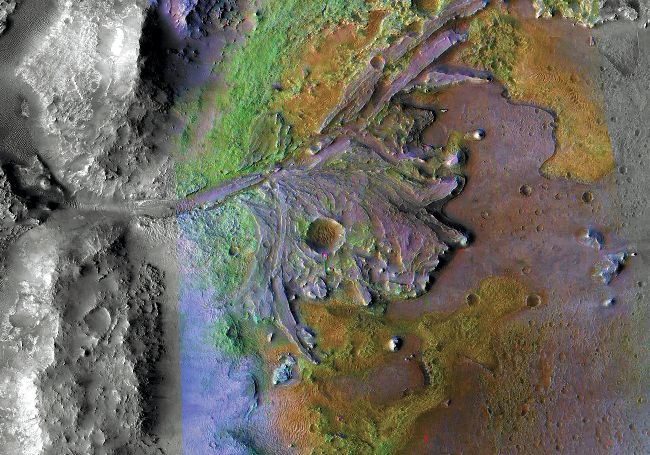
Above: NASA’s Mars Reconnaissance Orbiter has been watching over Jezero crater ahead of the rover’s arrival
© NASA/JPL-Caltech

The launch date for this mission is scheduled for 17 July 2020, but the launch window will remain open until 5 August in case of setbacks. It will fly on top of an Atlas V 541 rocket, which also launched Curiosity and InSight, from Cape Canaveral Air Force Station in Florida. However, it won’t be travelling alone. Alongside Perseverance will be a first-of-its-kind demonstration aircraft called the Mars Helicopter - more affectionately nicknamed Ingenuity. After launching the duo will spend over half a year voyaging through space to their destination, where the pair will hopefully land safely in Jezero crater on 18 February 2021. This is located on the western edge of Isidis Planitia, just north of the Martian equator.

After the much-fretted ‘seven minutes of terror’, where mission staff hold their breath for seven minutes as the rover goes through atmospheric entry, descent and landing, the rover will begin its primary mission duration of one Mars year - 687 days in Earth time. During this time Perseverance will inspect the Martian surface for signs of ancient life, characterise its geology and climate, prepare for future human exploration and collect samples of extraterrestrial rock for a future return mission.

Right: The SuperCam will scrutinise the Red Planet’s geology with unprecedented precision
© NASA

“Perseverance is the most sophisticated and complex rover mission we’ve ever sent to Mars. Perseverance has a new and updated science payload that makes it better suited for searching for ancient signs of life in the rock record of Mars than any previous Mars mission,” explains one of the Mars 2020 deputy project scientists, Dr Kathryn Stack Morgan.

Sbloccate questo articolo e molto altro con
Si può godere di:
Godetevi questa edizione per intero
Accesso immediato a oltre 600 titoli
Migliaia di numeri arretrati
Nessun contratto o impegno
Prova per €1.09
ABBONATI ORA
30 giorni di accesso, poi solo €11,99 / mese. Disdetta in qualsiasi momento. Solo per i nuovi abbonati.


Per saperne di più
Pocketmags Plus
Pocketmags Plus

Questo articolo è...


View Issues
All About Space
Issue 105
VISUALIZZA IN NEGOZIO

Altri articoli in questo numero


In This Issue
Welcome
This month All About Space takes a look into the
FEATURES
LAUNCH PAD
Unfortunately you can’t test a rover’s ability to traverse the
Liftoff! SpaceX launches first astronauts for NASA on historic test flight
SpaceX launched astronauts for the first time ever today, making
New marsquake study could shatter theories on how Mars was born
A team of researchers based at the University of Tokyo
Massive galactic disc could change our understanding of galaxies
A massive, rotating disc galaxy that first formed just 1.5
Love isolation? NASA wants you to spend eight months locked in a Russian Lab
Do you thrive in social isolation? NASA is looking for
First super-fast pulsar found snacking on companion in far-flung star cluster Words
China’s Five-hundred-meter Aperture Spherical Telescope (FAST) has uncovered the first
Scientists peer back in time to find new evidence for watery plumes on Europa
Scientists looked back in time to offer new evidence suggesting
WHAT DOES THE FUTURE HOLD FOR THE SOLAR SYSTEM?
Ever since it settled down from a period of early
SATELLITE REPAIR DROIDS
Droids could soon be placed on satellites in geostationary orbit
DESTINATION ALPHA CENTAURI
If you gaze into the night sky from Earth’s Southern
COULD IT DESTROY THE UNIVERSE?
The universe could collapse into oblivion at any moment, the
THE MAN BEHIND ROCKET LAB
Peter Beck founded Rocket Lab in 2006 and still operates
WHAT WOULD YOU SOUND LIKE ON OTHER WORLDS?
Testing your vocal cords on another planet is a deadly
NANCY GRACE ROMAN SPACE TELESCOPE
NASA takes pride in naming its telescopes after influential figures
SIZZLING SUMMER NEBULAE
Summer: where the days are longer and the nights are
Why are space-based Earth observations so important?
Satellites can trace the transport and transformation of atmospheric gases
STARGAZER
What’s in the sky?
In order to preserve your night vision, you should read
This month’s planets
Venus is usually the first planet people spot in the
Theophilus
Lunar observers often feel frustrated during summer because the Moon’s
Hunt for clusters and nebulae in Cygnus
Let’s be honest, June and July are not really the
The Northern Hemisphere
The constellations of Lyra, Aquila, Hercules, Sagittarius, Scorpius and Ophiuchus
Celestron NexStar 6SE
It’s not often that we come across a telescope that’s
Mikhail Kornienko
Mikhail Kornienko recently celebrated his 60th birthday in the comfort
Chat
X
Supporto Pocketmags