Milky Way
WHAT’S UP WITH THE MILKY WAY?
MYSTERIES OF THE UNIVERSE
A fast radio burst was detected from within our galaxy for the first time. Are we closer to uncovering their origin?
Reported by David Crookes

© Getty
On 28 April 2020, two ground-based radio telescopes detected an intense pulse of radio waves. It only lasted a mere millisecond but, for astonished astronomers, it was a major discovery, representing the first time a fast radio burst (FRB) had ever been detected so close to Earth.
Located just 30,000 light years from our planet, the event was firmly within the Milky Way, and it was, to all intents and purposes, almost impossible to miss. The Canadian Hydrogen Intensity Mapping Experiment (CHIME) and the Survey for Transient Astronomical Radio Emission 2 (STARE2) certainly had no problems picking it up. “CHIME wasn’t even looking in the right direction and we still saw it loud and clear in our peripheral vision,” says Kiyoshi Masui, assistant professor at the Massachusetts Institute of Technology. “STARE2 also saw it and it’s only a set of a few radio antennae literally made out of cake pans.”
Until that point, all FRBs had been observed outside of our galaxy. “They’ve been billions of light years away, making them a lot harder to study,” says PhD candidate Pragya Chawla from McGill University in Canada. April’s discovery was also notable for being the most energetic radio blast that astronomers have ever recorded in the Milky Way, but what made it most exciting is that scientists are now closer to determining the origin of FRBs than at any point since they were originally discovered.
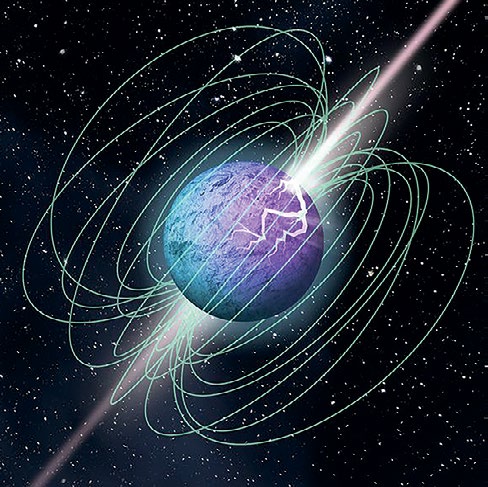
An artist’s impression of the SGR 1935+2154 magnetar during an outburst, highlighting its complex magnetic field structure and beamed emissions
© McGill University Graphic Design Team
That happened in 2007, when Duncan Lorimer and David Narkevic were studying data taken by the Parkes radio dish in Australia. Discovering an FRB so close to home has been the breakthrough astronomers have wished for ever since. “We can learn more from a source that’s 30,000 light years away than one that’s a billion or more light years distance,” Masui affirms. “We finally have a nearby source to study.”