Sirius
The ‘Dog Star’ hasn’t been around very long in cosmic terms

© NASA, ESA
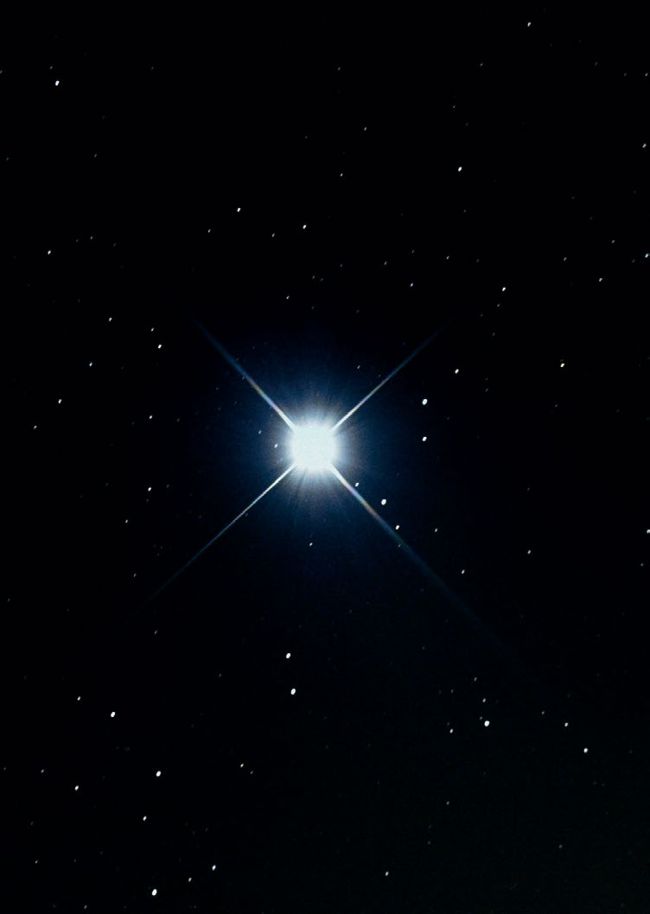
The brightest star in our night sky, it’s very hard to miss Sirius’ bright blue-white glow with its high magnitude of -1.46. Although the star’s official designation is Alpha Canis Majoris after the constellation that hosts it, the star has been referred to by many different names by various cultures since ancient times. The name Sirius comes from the Greek word for ‘glowing’ or ‘scorching’, fitting for a star so intense.
Sirius isn’t actually that bright in comparison to giant stars like Rigel in Orion, however. It appears so vivid to us because it is one of our closest stellar neighbours. Lying only 8.58 light years from us, it is the 5th-closest stellar system to home. Sirius is actually getting closer to us at a rate of 7.6 kilometres (4.7 miles) per second, meaning it will gradually glow even brighter in the sky in the future.
In 1844, German astronomer Friedrich Wilhelm Bessel observed that Sirius behaved strangely, following a wobbly course through the sky. He suggested that there might be a hidden mass orbiting a common centre of gravity with Sirius, with an orbital period of around 50 years. Because the mass of the object would have to equal about that of the Sun to cause the disruption in Sirius’ motion, Bessel’s idea was met with some scepticism.
Sirius has a smaller white dwarf companion
Source:Wikipedia Commons © IMellostorm
18 years later, however, these assumptions were proven correct when American astronomer Alvan Clark spotted a new small star near Sirius. Astronomers didn’t know it at the time – and wouldn’t for about five decades – but they had just observed the first white dwarf star, a small but massive stellar remnant. This companion, dubbed Sirius B, would have once been a main sequence star like Sirius A, both born at the same time from the collapse of a cloud of interstellar gas and dust.