NASA
COMPLETE GUIDE TO NASA
IT’S AN ORGANISATION KNOWN THE WORLD OVER, WITH ITS AMBITIOUS GOALS INSPIRING OTHERS TO DREAM OF TRAVELLING AMONG THE STARS. HERE’S YOUR DEFINITIVE GUIDE TO THE HISTORY OF NASA
Written by Colin Stuart
© NASA; Getty
1950s
The National Aeronautics and Space Administration was founded on 29 July 1958 when President Eisenhower signed the National Aeronautics and Space Act. It was a direct response to the launch of the world’s first satellite, Sputnik 1, by the Soviet Union on 4 October 1957. “It is of great urgency and importance to our country, both from consideration of our prestige as a nation as well as military necessity, that this challenge be met by an energetic program of research and development for the conquest of space,” read a report from January 1958. NASA was established to do just that.
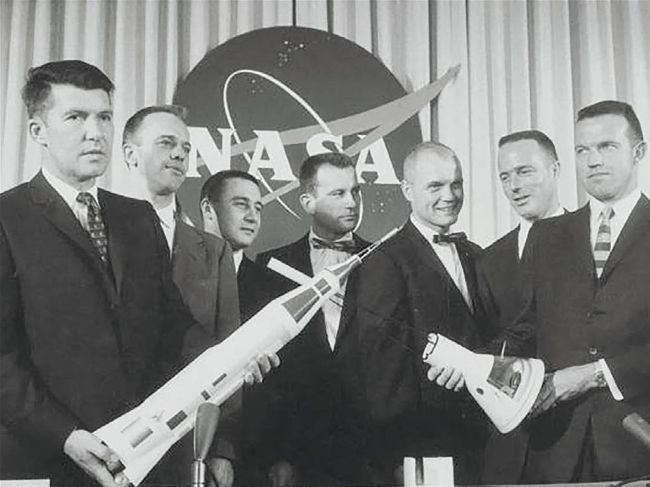
Attention quickly turned to human spaceflight with the commencement of Project Mercury. Seven potential astronauts, known as the ‘Mercury Seven’, were selected from a pool of US test pilots. Candidates had to be between 25 and 40 years old, and no taller than 5 feet 11 inches (1.8 metres). Their identities were announced to the world on 9 April 1959. A group of female candidates, now known as the ‘Mercury 13’, were not included.
© NASA
Apollo
Probably the most famous NASA program of all time, this ambitious series of missions culminated in 12 moonwalkers visiting our lunar neighbour, performing experiments and collecting Moon material for study back on Earth.

© NASA
1960s
NASA was pipped to the post again when Soviet cosmonaut Yuri Gagarin became the first human in space on 12 April 1961, completing one orbit of the planet. On 5 May the same year, Alan Shepard became the first American in space when he undertook a 15-minute suborbital flight aboard the Freedom 7 spacecraft. Three weeks later, President John F. Kennedy took things up a gear by setting the ambitious goal of landing astronauts on the Moon by the end of the decade.
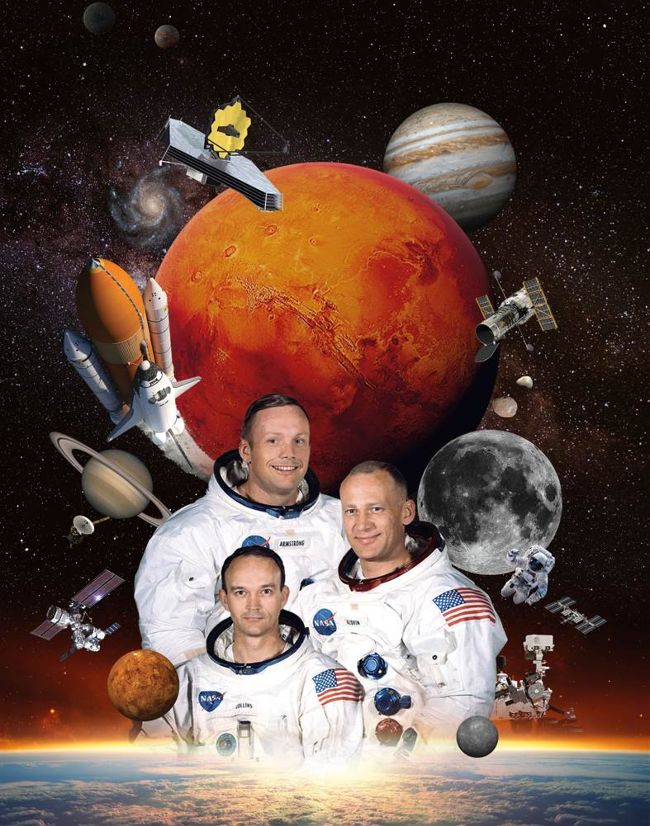
After testing spaceflight capabilities with the Gemini program, NASA started its fabled Apollo program to meet Kennedy’s target. After much planning, Apollo 8 and Apollo 10 saw astronauts fly around the Moon for the first time. Then, on 20 July 1969, Neil Armstrong and Buzz Aldrin set foot on the lunar surface. An estimated 650 million viewers watched worldwide – about one out of every six people on the planet. At last NASA had a significant Space Race victory over the Soviet Union. Two more moonwalkers, Pete Conrad and Alan Bean, left their footprints in the lunar dust before the decade was out as part of the Apollo 12 mission.