Some seasoned astronomers have never seen this small planet. Here’s how you can...
Some seasoned astronomers have never seen this small planet. Here’s how you can...
In Greek mythology, Mercury was the messenger of the gods and was quick and elusive. This is probably where the nearest planet to the Sun got its name, orbiting the Sun in just 88 days. Because of this, it’s never very far from the Sun in our skies and regularly shifts its location from either the east side or the west side of the Sun. The furthest point east or west, known as an elongation, is therefore the best time to try to see the planet.
To further complicate matters, the altitude above the horizon above which Mercury can be seen can also change, and so not every elongation is favourable for viewing it. This is due to the angle of the ecliptic path – the path that the Sun and planets appear to take across the sky – changing as we orbit the Sun. When the ecliptic path has a steep angle to the horizon, we usually get favourable elongations of Mercury, and therefore stand a much better chance of seeing it.
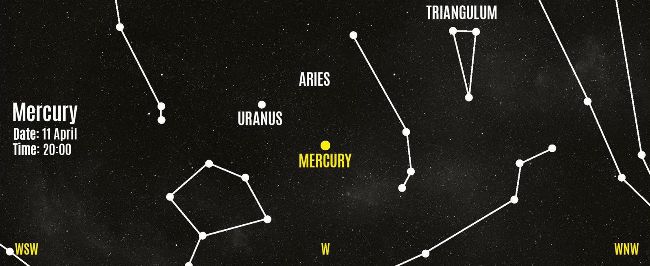
Because of this, Mercury is only ever visible in twilight skies, either just after sunset or just before dawn depending on whether it’s going through an eastern or western elongation. Above all else, if you hope to see this little and elusive planet, you will need to have very clear skies and a clear horizon, with no trees or buildings in the way. Twilight makes it all the harder to spot, but it’s not too difficult if you know where you should be looking.
But a warning needs to be issued here. Do not attempt to go looking for Mercury with any optical aid, such as binoculars, a telescope or even a camera, until after the Sun has fully set or a minute or two before dawn, as it would be very easy to accidentally catch the sunlight in your optics, with all the inherent risks to your eyes that may bring. Desktop planetarium software such as Stellarium will give you a good indication of where you should be able to find the planet on any given date or time, which should help considerably.
“To the naked eye, Mercury will look like a moderately bright star”
To the naked eye, Mercury will look like a moderately bright star, glowing in the twilight with a pinkish hue. Binoculars will show it as something non-stellar, although it will take more magnification than binoculars can usually give to show it as an appreciable disc. Binoculars are very helpful in actually locating the planet. Scanning the area in slow, steady lines, sometimes called ‘sweeping’, is an effective method of picking up Mercury in the twilight sky. Once it’s located, it’s much easier to find it again. A small telescope will show its true nature. Mercury will be seen as having distinct phases, like those of the Moon, depending on how far along it is into its orbit around the Sun. This will change over the few days that Mercury will be viewable. At its greatest elongation – the point that it’s furthest from the Sun from our point of view – it will show a half phase. In other words, half the disc will be illuminated. It will also be at its brightest.
Larger telescopes with higher magnifications will show a larger disc of the planet, and the phase will be easier to see. But the blurring effects of our atmosphere will make imaging Mercury a challenge through a telescope. Unfortunately, Mercury is just too small and far away to show any features other than its phase in amateur telescopes, but don’t let that put you off taking a look. This fascinating world has many secrets yet to be revealed, and surprisingly few amateur astronomers have laid their eyes on it.
© NASA
WHAT CAN I EXPECT TO SEE?
Naked eye
Not far above the horizon and just after sunset, you should see a moderately bright star.
10x50 binocular
Binoculars will make it easier to spot Mercury, which looks like a tiny version of the Moon.
Small telescope
A small telescope will enable you to view the phase of Mercury quite clearly.
Medium telescope
A medium-sized telescope will show the disc of Mercury quite well, as well as its phase.
Large telescope
Mercury appears very bright through a large-aperture telescope, with a distinct phase.