WILDLIFE WORKSHOP
Highlights from the updated edition of The Wildlife Photography Workshop by Ben Hall and Ross Hoddinott
W hether you are a newcomer to nature photography or an experienced professional, the aim is the same: to improve and develop. It is human nature to strive to do better and to learn, and this is why photographic workshops are so popular. The Wildlife Photography Workshop isn’t intended as a substitute for attending an on-location workshop – there is no better way to learn than doing. However, it is not always possible to retain all the information you learn during a workshop; not everything will sink in. Also, workshops aren’t cheap; not everyone can afford one or justify the time away from work or family life. These are among the reasons why we decided to create this ‘workshop’ in book form.
It is designed to provide a useful, practical resource, covering all the essential tools and techniques you need to take better nature photographs. The book is illustrated with our own wildlife images, all captured ethically and using the skills and techniques we share over the next 12 pages. Put simply, this is a wildlife photography workshop in book form. We hope you enjoy it.
Ross Hoddinott
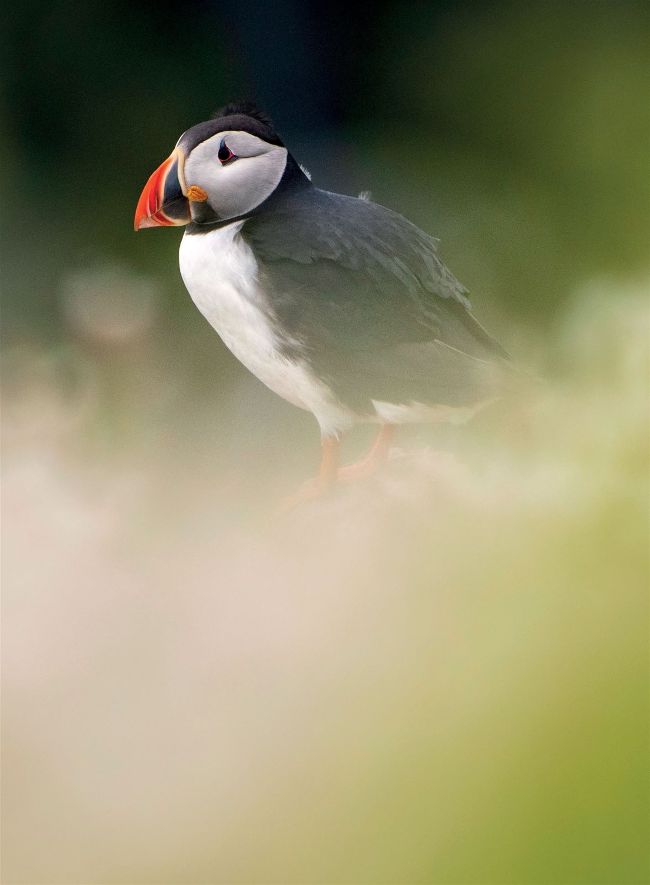
Atlantic puffin (Fratercula arctica)
Imagine a grid overlaying your viewfinder, dividing it into thirds horizontally and vertically. The points where the lines intersect are particularly powerful points to place your subject or key elements of interest.
Settings: Nikon D500 and 100-400mm (at 400mm); 1/800 sec at f/5.6, ISO 800, handheld.
READER OFFER
Ammonite Press is pleased to offer Digital Camera readers in the UK an exclusive offer – visit giftstome.co.uk and use the code R5638 to get 20% off your copy of The Wildlife Photography Workshop (RRP £16.99, now £13.60, plus postage and packing). The offer is available until 18 October 2024. https://giftstome.co.uk
www.digitalcameraworld.com
250mm
1 LENSES
How to choose the correct optics for capturing wildlife photography
O ne of the key reasons why mirrorless and DSLR systems are the only real choice for wildlife photographers is their compatibility with a huge range of interchangeable lenses. You can customise your system by investing in the focal lengths that suit the subjects you wish to capture – for example, longer ‘telephoto’ lengths for photographing birds and mammals from a distance, or a macro lens for small insects. Lens choice is important, greatly dictating the look, feel, context, and impact of your nature shots.
FOCAL LENGTH
The focal length of a lens determines its angle of view and the extent to which the subject will be magnified. It also helps to determine perspective. The focal length is represented in millimetres, with a low number indicating a short focal length (large angle of view) and a high number representing a long focal length (small angle of view).
Optics range greatly in design and strength, from circular fisheyes, which offer an ultrawide, distorted perspective, to powerful telephotos exceeding 800mm. Human eyesight is roughly equivalent to 50mm, so a lens of this range is considered ‘standard’. Anything smaller than 50mm is typically referred to as being ‘wide angle’, while anything longer is considered ‘telephoto’. A longer focal length gives a greater magnification of the subject than a shorter lens from the same distance. The relationship is geometric: assuming the same subject-tocamera distance, doubling or halving the focal length will also double or halve the size of the subject in the frame.
As we’ve seen, many consumer cameras have a smaller sensor than the 35mm or full-frame standard and this effectively increases the focal length of the lens. As a result, a shorter lens is required to achieve an equivalent angle of view. It is for this reason that camera/lens combinations are often stated in terms of their 35mm-equivalent focal length.
IMAGE STABILISATION
Many modern lenses benefit from optical image stabilisation (OIS) technology, particularly longer focal lengths that are more difficult to handle and keep still due to their length and weight. OIS is designed to compensate for the photographer’s natural movement, minimising or eliminating the effect of ‘camera shake’. Camera shake shifts the angle of incoming light relative to the optical axis during exposure, often imperceptibly to the naked eye, resulting in image blur.
TOP TIP TELEPHOTO LENS
For bird and mammal photography, a focal length of at least 300mm is required. Fast, prime telephoto lenses are quite pricey but an excellent choice if your budget allows. Zooms with a variable aperture tend to be cheaper and lighter but are slower, too.
www.digitalcameraworld.com
400mm
Ross Hoddinott
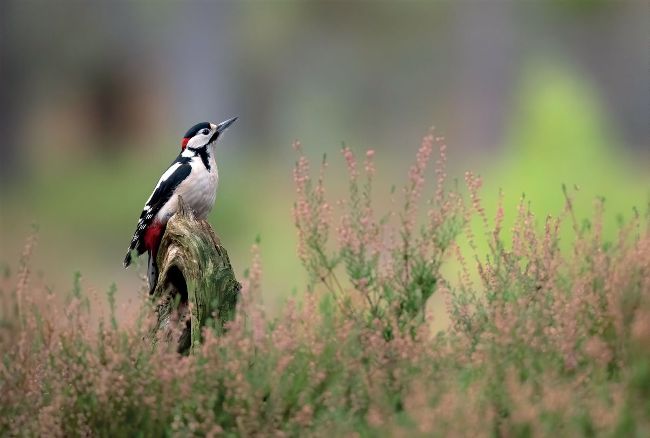
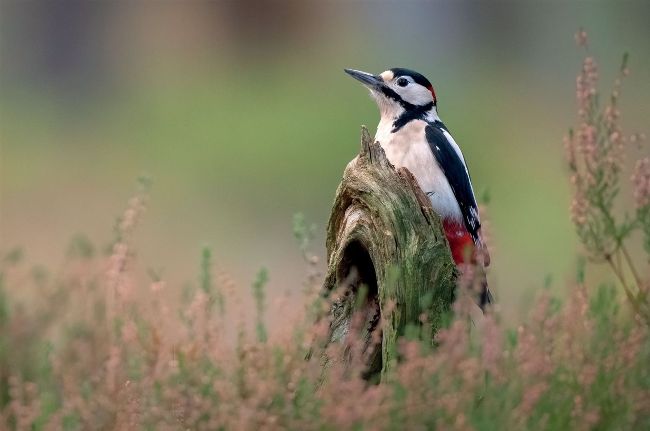
Great spotted woodpecker (Dendrocopus major)
You can completely alter the look, feel and emphasis of a photo by adjusting lens focal length. In this instance, I first photographed this woodpecker using a focal length of 400mm to capture a frame-filling shot. I then pulled back to around 250mm to include more negative space and a greater sense of context. My position remained the same, but the two images appear very different.
Settings:
Nikon D850, 100-400mm, 1/500 sec at f/5.6, ISO 800, handheld.
TOP TIP STABILISE YOUR IMAGES
Make sure OIS (image stabilisation) is switched off if your camera is fixed to a tripod. Although unusual, some forms of OIS can generate blur if no movement is detected.
OIS technology can allow photographers to shoot up to three or four stops slower than would otherwise be possible without dedicated camera support, such as a tripod or monopod. Using internal motion sensors, or gyroscopes, OIS works in inverse relation to the movement of the lens, maintaining the position of the incoming light rays on the camera sensor.
Lens brands have different names for OIS – for example, Vibration Reduction (VR) for Nikon or Image Stabilizer (IS) for Canon – but the principles behind the technology are the same. Many modern cameras now boast in-body image stabilisation (IBIS) too. One advantage of this innovative technology is that all attached lenses benefit. Some modern camera systems even produce enhanced levels of stabilisation when OIS and IBIS are combined – beyond what one or the other would be capable of.
LENS TYPES FOR NATURE PHOTOGRAPHY
Telephoto
A lens with a focal length of more than 50mm is generally regarded as a telephoto lens. Telephoto lenses have a narrower angle of view than the human eye, so a scene or subject appears magnified in the frame. Telephotos are available in a wide range of strengths, up to and even exceeding 1,000mm. They can be divided into three categories, depending on focal length: short, medium, and long. A focal length of 50-135mm is considered a short telephoto. For most subjects – certainly timid ones – this focal range is limiting and will not give you the reach you require. However, it is a useful range for shooting wider views of subjects, perhaps to show them in context with their surroundings, and for combining with close-up attachments. A lens in the region of 50–100mm is ideal for use with an extension tube.
Medium telephotos, typically in the region of 135-300mm, and long telephotos of 300mm or more, are most suited to wildlife photography. Their higher magnification makes them ideal for shooting animals – photographing birds from a hide or large mammals from further away, for example. These lenses not only magnify the subject, allowing you to responsibly capture intimate images of subjects that would run or fly away if you tried to approach them, but they also foreshorten perspective. This means that elements within the frame appear closer to each other than they really are, which can be effective when you want a background subject to impose itself on the foreground.
Depth of field is inherently shallower with longer focal lengths, and front-to-back sharpness is limited even at smaller apertures. While this means that you must focus with pinpoint accuracy when using long focal lengths, a telephoto’s narrow depth of field can also be a useful creative tool, helping you to isolate your subject from its surroundings. For photographing birds and mammals, a focal length of 300mm is generally considered a minimum requirement.
Wide-angle
A lens with a focal length shorter than 50mm is deemed wide-angle. While they are often