TAMING TIGERS
It’s not every day you get to play with Tigers...Bruce didn’t hesitate at accepting Triumph’s offer to test out the new 900 Rally Pro and GT Pro.
WORDS : DANGEROUS
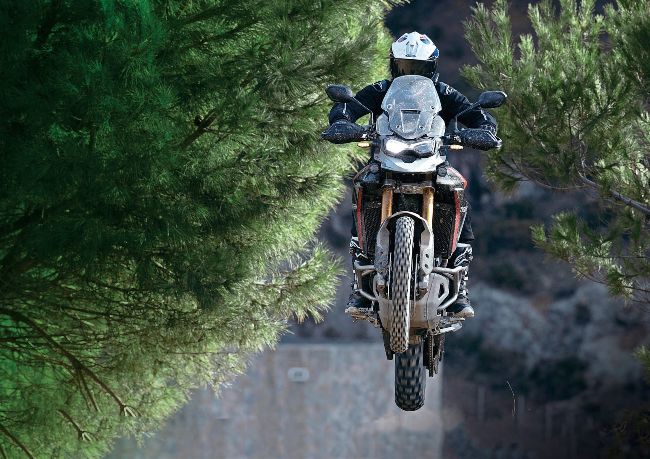
TRIUMPH TIGER 900 GT PRO / TIGER 900 RALLY PRO
PICS : CHIPPY WOOD / GARETH HARFORD

Lads on tour...
It’s not every launch where you get back at base so pumped up that you feel obliged to indulge in a rolling burn-out for all and sundry to see. With some brands, that kind of antic will get you barred from future tests faster than a pisshead can down a pint, but that’s how my day in the saddle of Triumph’s latest and greatest Tiger 900 befittingly came to an end. In my defence, after arguably one of the best rides I’ve had in recent years, hitting the trails high above Malaga, I simply wasn’t thinking straight, drunk on adoration for this absolute beast of a bike. But before I go reasoning my tyre-shredding antics any further, I should properly introduce this protagonist. It only seems like yesterday I was out in the north of Spain performing similarly daft antics on the then brand-new Tiger 800, some 13 years ago. That bike was a blast, but it was also a mere foundation for what soon followed, when the bigger, more powerful and smarter Tiger 900 hit the scene in 2020, improved in practically every way, and especially so in the engine department thanks to the aforementioned bigger displacement and integration of what Triumph calls its T-plane crank – a means of altering the firing order and consequent performance of the triple. The end result was more torque, more character, and more than 45,000 units sold.
The Tiger 900 has been a massive hit for the Hinckley-based brand, but the story isn’t over yet. Triumph is one of the most ambitious,
future-focused powerhouses on the market.
WHERE’S THE EXTRA 13BHP FROM?
When you learn that the updated Tiger engine is not just more economical, but cleaner too, it gets you wondering how on earth Triumph managed to squeeze another 13bhp out of the triple motor. Logic suggests, as we’ve become used to these days, that just hitting legislative targets alone often means a bike’s power figures go on the decline, not the up… so what’s the secret? Well, there’s not really much of a secret to it: it’s more a case of how the engine’s been developed. While most of the bottom end remains as was, the top has been treated to a good old dose of shiny bits, including new pistons that not only increase the compression ratio, but also allow for a cleaner burn. The Tiger’s also got a new cylinder head with larger inlet ports, while the exhaust ports have been kitted with oval casings to optimise gas flow. And while they were at it, it also made sense for the engineers to show a bit of love to the camshafts, which now feature a higher lift and add to the performance of the triple. You get the gist, the list goes on... to the extent that it’s fair to say most of the top end is wholly new, egged on further by 15mm longer intake trumpets, lighter and freer-flowing exhaust headers, plus a shiny new end can. Add all this together and you’ll understand where the added oomph comes from.
Leggete l'articolo completo e molti altri in questo numero di
Fast Bikes
Opzioni di acquisto di seguito
Se il problema è vostro,
Accesso
per leggere subito l'articolo completo.
Singolo numero digitale
March 2024
Questo numero e altri numeri arretrati non sono inclusi in un nuovo
abbonamento. Gli abbonamenti comprendono l'ultimo numero regolare e i nuovi numeri pubblicati durante l'abbonamento.
Fast Bikes
Abbonamento digitale annuale
€40,99
fatturati annualmente
Abbonamento digitale di 6 mesi
€21,99
fatturati due volte l'anno
Abbonamento digitale mensile
€4,99
fatturati mensilmente