Horse health
EHV Outbreak
The current human pandemic has put nearly everyone on edge about potential disease outbreaks, including horse owners now confronted with an EHV outbreak.
BY SARAH E. COLEMAN
For populations around the globe, the 2020 COVID-19 pandemic was a nightmare. But for horse owners, 2021 and 2022 brought heightened concern over horse health when worldwide outbreaks of equine herpesvirus (EHV-1) began.
An early 2021 EHV-1 outbreak killed 18 horses on mainland Europe and affected horses in Belgium, Denmark, France, Germany, Italy, Qatar, Spain, Slovakia, Sweden and Switzerland.
This year, rashes of infections in the U.S. have caused the cancellation of myriad events, resulting in multi-million dollar economic losses.
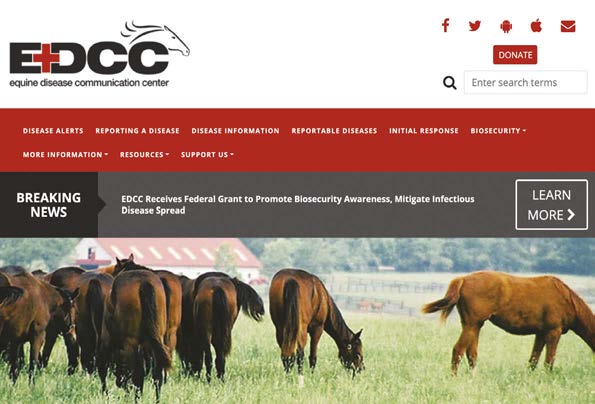
The Equine Disease Communication Center compiles alerts and information about diseases in the U.S. equine population.
An EHV-1 infection can be tricky to control; nearly all horses will be exposed to it in their lifetime, and the virus can be carried inactive for years. An active EHV-1 infection often causes respiratory disease, but it can also cause abortion in mares. The disease can occasionally lead to a life-threatening neurologic disease called equine herpesvirus myeloencephalopthy (EHM).
One of the first large-scale outbreaks that brought EHV-1 to the forefront was the multi-state outbreak among horses that attended the 2011 National Cutting Hose Association (NCHA) Western National Championships held in Ogden, Utah. In total, 90 horses were confirmed to have EHV-1 from 10 states; 13 were euthanized or died. (See “2011 EHV Outbreak in Utah,” pg. 40.)
CENTRAL INFORMATION
With this outbreak, it became apparent that the equine industry had no cohesive way to get out accurate information regarding some infectious equine diseases.
In 2015, with industry support, the American Association of Equine Practitioners (AAEP) took the lead in creating the Equine Disease Communication Center (EDCC; www.equinediseasecc.org). This website provides alerts and information about diseases in the equine population, similar to how the Centers for Disease Control and Prevention (CDC) provides human health updates.