Linux on your phone
Jump to LineageOS
Enjoy fully featured Android without all the proprietary bits.
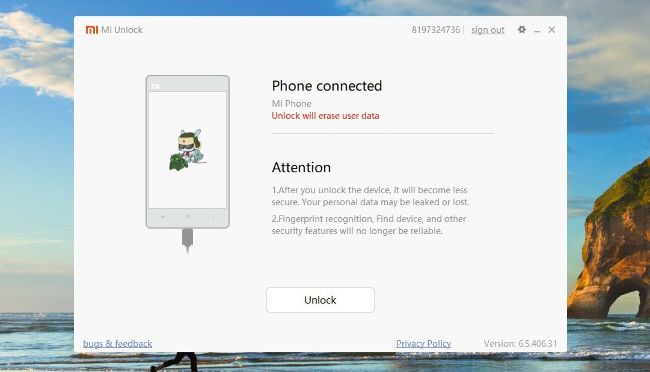
Xiaomi’s unlock tool makes you jump through all sorts of hoops. We used a burner SIM and throwaway email to register.
The Android Open Source Project is where manufacturers can stay secure. manufacturers start when they want to port Android to a new device. Manufacturers add in the drivers (and other hardware-specific code), as well as perhaps custom UI overlays. If this all passes Google’s muster (see box on previous page), the device can be shipped with Android pre-installed. Those wanting to compile custom ROMs for that device may find that the manufacturer has open sourced the code they added in (namely device trees, hardware libraries and things that end up in the vendor partitions), but this is rarely the case. Even if they provide something, drivers for the GPU, cameras, GPS and the baseband modem itself will more than likely only exist as proprietary blobs. Those are no use for compiling AOSP, so custom ROM developers must find another way.
LineageOS is the most popular AOSP fork, having emerged from the ashes of the almost-as-popular CyanogenMod in 2016. LineageOS is much easier to port to other devices as the team has developed shims and layers so that vendor blobs can be used natively there. As such, its official builds offer across-theboard hardware support. So, newer hardware can enjoy the latest Android features without having to wait for manufacturers’ updates. And older hardware neglected by