Masterclass
HOW TO MODEL FLYING SCOTSMAN
IN THE POST-BR PRESERVATION ERA
George Dent recreates his first meeting with Gresley’s famous ‘A3’, by polishing up a pre‐owned Hornby model.
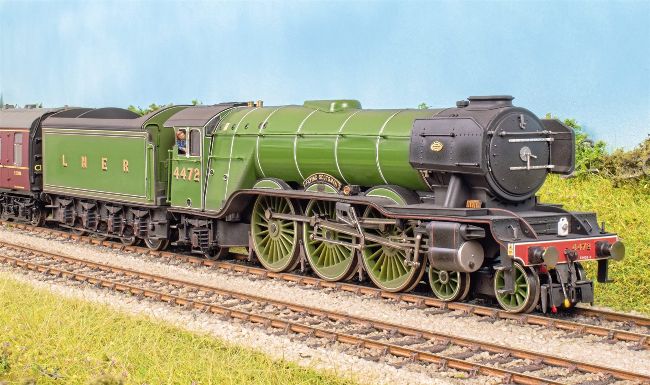
PHOTOGRAPHY: GEORGE DENT
Despite being a train nut for as long as I can remember, my first encounter with Flying Scotsman was not until 2003, while in my mid-20s. Working at the National Railway Museum at the time, the famous ‘A3’ had been overlaying at the York site in between main line railtour duties and was simmering away quietly in the dawn sunlight as I clocked on for my shift.
This was just a year or so before ‘Scotsman’ would be acquired for the National Collection, and the iconic 4‐6‐2 was in its ‘hybrid’ condition with double chimney, smoke deflectors and LNER lined Apple green livery, which had stirred a little controversy among LNER aficionados.
Maybe it’s my LMS leanings, but I prefer the ‘A3’ with its smoke deflectors. Like a ‘Duchess’ or ‘Royal Scot’, the deflectors give the ‘pointy’ end of a large steam locomotive a greater sense of structure.
Whatever the technical or aesthetic merits of the German-style smoke deflectors, when faced with creating a model of ‘Scotsman’, I wanted a replica of the locomotive in the condition I first saw it. Despite Hornby offering a number of attractive commemorative models this year, none of the versions suited my particular era, so I was faced with scouring the pre-owned market.