A CLOSE ENCOUNTER OF THE MEGA-ARACHNID KIND! PART 2
Last month, Dr Karl Shuker documented reported sightings of a giant spider in 2005 made by an American soldier in Louisiana, who contacted him via email. However, the soldier also stated that he had two further encounters with such creatures during 2007, in much the same location.
Dr Karl Shuker
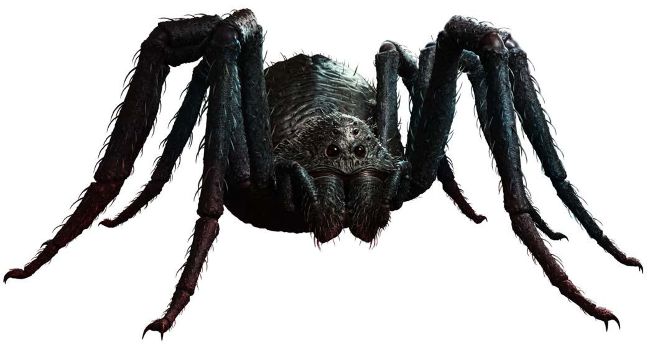
Exclusive sign courtesy Gembuls/
www.shutterstock.com & giant spider courtesy Warpaint/
www.shutterstock.com I ended the first article by quoting a section from Sgt S’s email to me sent on 29 July 2019, concerning his 2005 sighting. Yet this same email also contained a full account of his two 2007 sightings, plus some thoughts by him concerning the possible lifestyle of these mega-spiders. I am now publishing this information here for the first time, along with my analysis of these events.
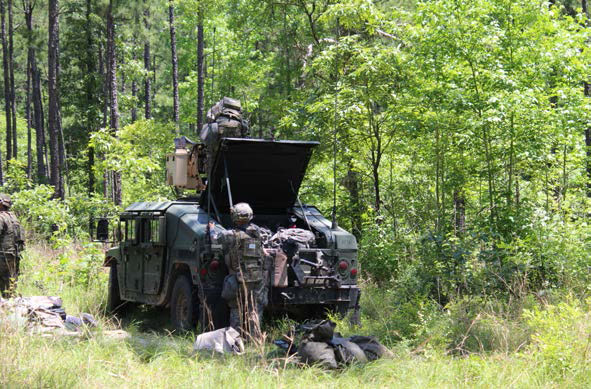
An army training exercise taking place in the woods at Fort Polk, Louisiana where the mega-arachnids were supposedly encountered, being seen there by a number of people.
Photo courtesy WanderinNomadPhotography/
www.shutterstock.com The first 2007 sighting
Sgt S (whose real name and rank I have on file, but who wishes to remain anonymous until one of these mega-arachnids is caught) wrote as follows about these subsequent encounters. This is his account, in his own unedited words:
“During another pre-deployment training exercise at Fort Polk, Louisiana, within the Fort Polk Wildlife Management Area and centered at FOB Forge in the same area as the 2005 sighting, I briefly observed another giant spider in daylight hours and again at night. This one was different than the 2005 sighting as it was larger, with thicker legs and body, as well as a darker coloring. I attached a map depicting the approximate location of each sighting.
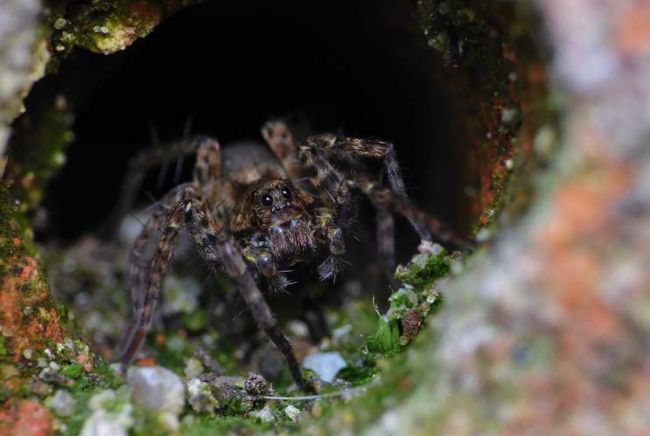
The giant spider had two conspicuous shiny eyes.
Photo courtesy Jordan Roper/
www.shutterstock.com “The first sighting was in the late afternoon when two other soldiers and I went for a run on Alligator Lake Loop, a wide dirt road between two wooded areas near Highway 469. One of the soldiers began suffering from heat exhaustion and sat down in the road. We moved her to the shade, and I ran for help. When I returned with the medics, they placed the patient on the truck, and we all started moving back when a Sergeant complained he stepped on something sticky.
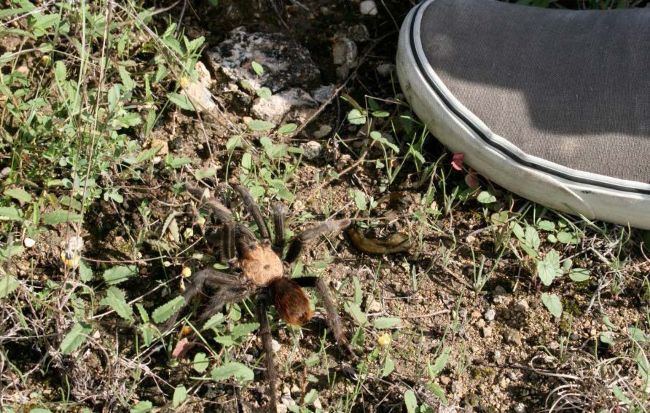
Tarantulas do occur in the USA. This individual - a Amula red rump tarantula (Brachypelma albiceps) - was photographed near Austin in Texas, but these spiders are tiny in comparison to those described by Sgt S. This individual is set against a size 10.5 (UK)/11 (US) shoe.
Photo courtesy Davejenk1ns/Wikipedia/CC BY-SA 3.0.
“Immediately a batch of leaves on the embankment started moving. He and I both saw the head of a giant hairy spider pop up and back down. He wrote it off as a squirrel, but I clearly saw it pop up and move its head around then drop back down. It had two huge shiny black eyes each about three or four inches (=7.5-10cm) around.
“The head itself was bigger than one foot (= 30cm) and looked like the head of a tarantula. It had thick hairy bristles all over it with large white or clear fangs which were only partially exposed, but with smaller horizontal pinchers facing each other at a small mouth about two or three inches (= 5 or 7.5cm) each.”
Leggete l'articolo completo e molti altri in questo numero di
Practical Reptile Keeping
Opzioni di acquisto di seguito
Se il problema è vostro,
Accesso
per leggere subito l'articolo completo.
Singolo numero digitale
Issue 124
Questo numero e altri numeri arretrati non sono inclusi in un nuovo
abbonamento. Gli abbonamenti comprendono l'ultimo numero regolare e i nuovi numeri pubblicati durante l'abbonamento.
Practical Reptile Keeping
Abbonamento digitale annuale
€39,99
fatturati annualmente
Abbonamento digitale di 6 mesi
€21,99
fatturati due volte l'anno