IT
  
Attualmente si sta visualizzando la versione Italy del sito.
Volete passare al vostro sito locale?
13 TEMPO DI LETTURA MIN

CRESTED GECKOS

How to house crested geckos

James Brereton MSc and Louis Pereira report on their new research into enclosure design for crested geckos, reviewing also the way that housing systems for reptiles have changed over recent years, and the impact that this has had within the hobby.
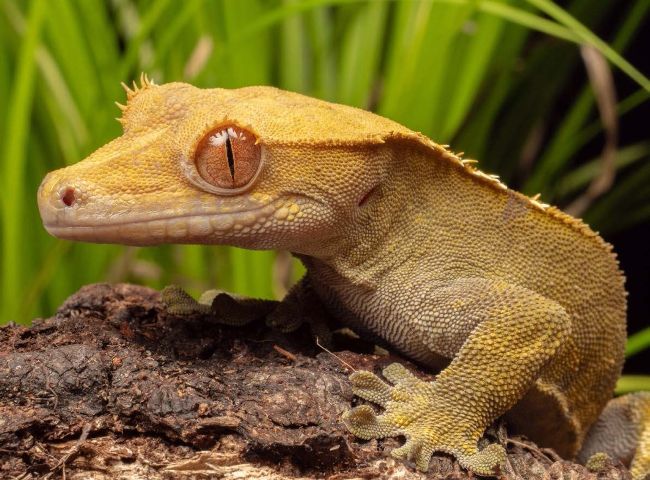
Photograph courtesy ChristianRogersPhotograph/www.shutterstock.com

When it comes to the design of vivarium housing, the focus until recently was very much driven by concerns around hygiene. As such, enclosures veered towards being simplistic in both style and decor, being furnished with easy-to-clean substrates and fixtures. The theory behind this ‘artificial’ appearance was to create a diseasefree environment, with the thinking being that the likelihood of animals becoming ill in such surroundings would be minimised.

This concept obviously still has value of course, and a relatively spartan style of exhibit is still of particular value under certain circumstances. It is especially recommended within reptile stores for example, where the stock is changing regularly, and the accommodation is being used for different species. The emphasis on hygiene serves as a barrier to prevent the risk of transferring an infection, and particularly in cases where this may not be evident in the first place.

For example, there is evidence to show that African clawed frogs (Xenopus laevis) may carry chytrid fungus on their skin, despite displaying no obvious symptoms themselves. By contrast, chytrid is fatal to many other amphibians and is responsible for vast declines in wild amphibian populations. Similarly, Horsfield’s tortoises (Agrionemys horsfieldii) show no symptoms when carrying a particular strain of herpesvirus, which is likely to be fatal to other tortoise species.

Under such circumstances, enclosures need to be simple enough to ensure that they can be deep cleaned before and after each occupancy. This type of simplistic design is also beneficial for when animals need be quarantined. If an animal is found to be infected, the substrate and all features within the enclosure will need to be stripped out and disinfected regularly too, thereby providing a practical way of minimising the risk of reinfection. For this reason, veterinary clinics also tend to have more simplistic set-ups, with the emphasis on hygiene.
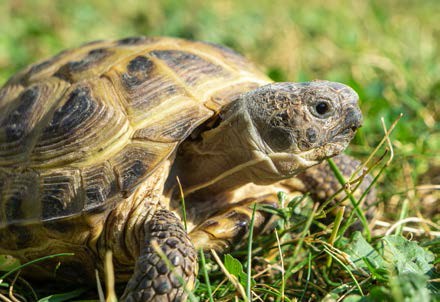
Horsfield’s tortoises can be an asymptomatic carrier of a chelonian herpesvirus.
Photo courtesy MattLphotography.

A different approach

However, a greater understanding of herptile welfare and behaviour in recent years has revealed various issues with overly-simplistic enclosure designs, especially for long-term use. During the course of millions of years, amphibians and reptiles have adapted to specific environmental niches, developing complex prey capture techniques and predator evasion strategies.

Leggete l'articolo completo e molti altri in questo numero di Practical Reptile Keeping
Opzioni di acquisto di seguito
Se il problema è vostro, Accesso per leggere subito l'articolo completo.
Singolo numero digitale Issue 128
 
€4,99 / issue
Questo numero e altri numeri arretrati non sono inclusi in un nuovo abbonamento. Gli abbonamenti comprendono l'ultimo numero regolare e i nuovi numeri pubblicati durante l'abbonamento. Practical Reptile Keeping
Abbonamento digitale annuale €39,99 fatturati annualmente
Risparmiare
33%
€3,33 / issue
Abbonamento digitale di 6 mesi €21,99 fatturati due volte l'anno
Risparmiare
27%
€3,66 / issue
ABBONAMENTO ALLA STAMPA? Disponibile su magazine.co.uk, la migliore offerta di abbonamento a una rivista online.
 

Questo articolo è...


View Issues
Practical Reptile Keeping
Issue 128
VISUALIZZA IN NEGOZIO

Altri articoli in questo numero


Practical Reptile Keeping
Welcome
Would you be able to recognise if your reptiles were
Regulars
A unique survivor
► Featuring stories this month about the lifestyle
Understanding the monarch’s migratory urges
The monarch butterfly (Danaus plexippus) creates one
The most deadly hunters ever known?
A new study based on fossilised specimens of members
Major breakthrough in understanding killer fungal disease
For frogs dying of the invasive chytridiomycosis disease
New hope for Hawaiian land snails
Scientists have described a new native Hawaiian land
How biodiversity can help to repel invaders
When the USA flooded Panama’s Chagres River valley
The egg detectives
Back in 2011, Chilean scientists discovered a mysterious
A long-standing mystery solved
A fossil known as Tanystropheus which was first described
A case of concealment
Paul Donovan looks at the subject of camouflage in amphibians, and why it is both well-developed and diverse in this group.
AMPHIBIAN FOCUS
Laos warty newt (Paramesotriton laosensis)
Suitable lighting
DO YOU NEED A HELPING HAND OR ADVICE?
Next issue.
John Courteney-Smith MRSB looks at recent advances
Features
Reptile obstetrics
What are the potential problems that that can arise in the case of a female reptile, when she is laying eggs or giving birth? Here are the key signs that can indicate an impending problem which you need to be aware of, and what can be done, in terms of treatment. The risk is present – even in the case of female reptiles being kept on their own, and should not be underestimated as veterinarian Dr Tariq Abou-Zahr MRCVS explains.
Snail-eating snakes
Most snakes can be maintained quite successfully on a diet of rodents, but there are exceptions. Snail-eating snakes, also known as slug-eating snakes, fall within this category, but they are rarely available, and very little has been documented about them up until now, as Christian Castille explains.
Can your reptiles recognise you?
Owners often report that their reptiles recognise them when they enter the room, reacting accordingly. However, what would happen if your reptile saw your photograph, or indeed a video of its prey instead of the real-world object? Would the outcome be the same? Questions such as these are studied in the field of science known as visual cognition, and some amazing results are emerging, as Dr Julia Mueller-Paul reports in this article.
African spur-thighed (sulcata) tortoises
This species has become much more commonly available over recent years. Hatchlings will grow into large tortoises though, with even bigger personalities, and they must have generous amounts of space, heat and food in order to thrive, and that will be expensive, advises Dillon Prest.
Unravelling the truth
Dr Karl Shaker focuses close to home in his regular column this month, highlighting three cases of accounts of mystery animals reported from the British Isles across the centuries, which help also to reveal the processes involved in determining whether or not such creatures might actually exist.
YOU & YOUR Reptiles
If you have a favourite photograph of one of your reptiles
Chat
X
Supporto Pocketmags