Forensic Pseudoscience
Reviews of Forensic Science Reform: Protecting the Innocent, edited by Wendy J. Koen and C. Michael Bowers; The Psychology and Sociology of Wrongful Convictions: Forensic Science Reform, edited by Wendy J. Koen and C. Michael Bowers; and Blinding as a Solution to Bias: Strengthening Biomedical Science, Forensic Science, and Law, edited by Christopher T. Robertson and Aaron S. Kesselheim
REVIEWED BY TERENCE HINES
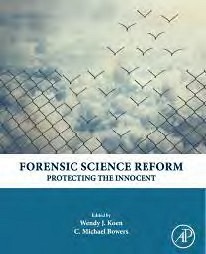
London: Academic Press/ Elsevier. 2017. 366 pp. $150. ISBN 13: 978-0128027196
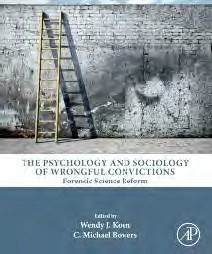
London: Academic Press/ Elsevier. 2018. 382 pp. $125. ISBN 13: 978-0128026557
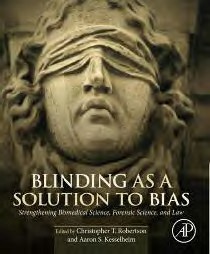
London: Academic Press/ Elsevier. 2016. 371 pp. $99.95. ISBN 9780128024607
ALTHOUGH THERE HAS FOR SOME TIME been doubt about the various forensic techniques that are still presented as useful on TV crime shows, it wasn’t until 2009 and the publication of the National Science Foundation’s report titled Strengthening Forensic Science in the United States: A Path Forward that the problems with these techniques generated considerable public and professional attention. The first two books reviewed here provide comprehensive and up-to-date discussions of the problems with specific forensic techniques and the psychological and sociological phenomena that can lead to miscarriages of justice. The third shows how the technique of blinding, well known in studies of medical and psychological therapies, can make some, but not all, of the techniques discussed in the first two books less error prone.
Forensic Science Reform is a comprehensive review of nearly a dozen wellknown forensic techniques and methods. All 11 chapters are organized in an interesting and, as far as I know, unique way. Each begins with a case study showing how the use or misuse of the approach being discussed led to a specific, and serious, miscarriage of justice. The case study is, with one exception, followed by a review of the literature on that specific technique.
The list of methods and concepts that are invalid or just don’t work as advertised is long and some will be familiar from popular culture. The topic of the first chapter, compositional bullet lead analysis (CBLA), will not be so familiar. The idea is that a metallurgical analysis of a bullet found at a crime scene can reveal whether said bullet came from the same batch as a bullet, or bullets, found later belonging to a suspect. It seems a reasonable hypothesis, like so many in the area of forensics. The trouble is that it’s not. The technique made several incorrect assumptions about the metallurgy of lead bullet manufacture. The most problematic was that the “few small samples taken from the bullets [involved in a crime] are compositionally representative of the source from which they originated” (p. 9). Since the original source, a vat of molten lead that produced thousands of bullets, was itself not homogeneous (source homogeneity was another assumption), this basic assumption was false. The technique was abandoned by the FBI in 2005. But 2500 cases where CBLA was used, some of which resulted in convictions, remain “in review limbo” (p. 21).
Chapter 6 covers a related topic— the identification of the firearm from which a bullet was fired, or a shell casing ejected based on the “tool marks” found on the bullet or casing. The 2009 NSF report was highly critical of tool mark analyses because of the lack of information on the reliability and validity of opinions based on such analyses. Since then the situation has improved somewhat with additional research. The bulk of chapter 6 concerns how judges have responded to legitimate concerns raised by the defense about the validity of firearms identification testimony by experts. These responses have frequently been inadequate.
Chapter 2 discusses the microscopic analysis of hair. The problems with hair analysis became public knowledge in 2015 when it was found that FBI forensic examiners who had used hair analysis had come to incorrect conclusions in over 90% of the cases they examined, although as Max Houck, the author of chapter two notes, some have argued that the 90% figure may overstate the problem somewhat. So, the important question is “how accurate is hair analysis?” It depends on how accuracy is measured. Houck makes it clear that hair analysis has not been used, in any legitimate forensic setting that he could find, as a method to specifically identify an individual. Such use may occur in fiction of course. The chapter covers the history and early use of hair analysis and concludes with a detailed section discussing just how accurate hair analysis is or can be under certain conditions. My impression from this discussion is that hair analysis is best at excluding hair as a piece of evidence. Just because a hair found at a crime scene and one taken from a defendant were “similar” or “consistent” in some way should not be seen as evidence that the former was from the latter person. Houck makes the important point that with the advent of DNA technology, hair analysis is only a first step. Hair “[m]icroscopy and DNA analysis can provide important information to an investigation because they both analyze different characteristics” (p. 52).
Chapter 3 on arson analysis makes a point that is echoed in several other chapters in the book. Many of the accepted tenets behind different investigative techniques are little more than “old cops’ tales” passed down from one generation of police investigators to the next. These investigators typically have little or no scientific training and the techniques they embrace are, when studied scientifically, without foundation. This seems especially true in fire investigations where almost any pattern of burns, or lack thereof, can be interpreted as evidence of foul play. This is pareidolia at the crime scene. The same is true of bite mark evidence (chapter 5), which is “unscientific and unreliable, and thus grossly unfit for use in criminal proceedings” (p. 163). Nothing more need be said here about this particularly useless forensic technique. The same point can be made about blood pattern analysis (Chapter 9). The patterns of blood spatter can be (mis)interpreted to mean almost anything. The author Barie Goetz comments on the similarity between the culture of arson investigators and proponents of blood pattern analysis: “What one officer believes and teaches becomes folklore for an entire community of officers” (p. 282). The continued reliance of courts on such evidence, as well as the expectations of juries fueled by popular CSI-type TV shows that these sorts of evidence will be introduced, puts numerous innocent defendants at risk.