BE-BOP DELUXE
Hatchet job: art-rock outriders’ messy but majestic debut reborn.
By Jim Wirth
Axe Victim (reissue, 1974)
1 REISSUE OF THE MONTH 8/10
KEEN to sign up the quirky singer-songwriter whose self-released solo hippie oddity Northern Dream had been getting regular play on John Peel’s Radio 1 show, EMI’s A&R men lured Wakef eld troubadour Bill Nelson down to London, but were somewhat nonplussed when he announced that he had formed a band. Invited to see Be-Bop Deluxe play at the Staging Post near Leeds in 1973, the big-city rock scouts were less than bowled over.
In his sleevenotes to this super-abundant version of Be-Bop Deluxe’s debut album, Nelson remembers that the men from EMI deemed the band he formed after a chance reunion with former schoolmate Ian Parkin “not really up to professional standards”. They clocked that Nelson’s canny triangulation of David Bowie space shtick and pop-art guitar heroics sent northern audiences wild, but might not wash with hip sophisticates down south.
The art-school-educated Nelson quite possibly agreed with them. Axe Victim’s explosive title track suggests strongly that the tactically dolled-up Be-Bop Deluxe were not quite on the same page as the Roxy Music f ends that roared them on at such glam-rock hotbeds as Scamps Discotheque in Huddersfield and the Cumberland Hotel in North Ferriby. “You came to watch the band, to watch us play our parts,” he sings. “We hoped you’d lend an ear, you hoped we’d dress like tarts.”
“Axe Victim” is an art crisis disguised as a show-stopper. The seagull caws of Nelson’s guitars showcase his Phil Manzanera dexterity, but the lyrics reveal doubt behind his Max Factor makeup - the concern that he might be barking up the wrong musical tree. “Last night I saw the future,” he sings as he looks back on another successful club date with Be-Bop Deluxe. “This morning there’s no hope.”
A reasonably wizened 25 when Axe Victim was f nally released in June 1974, Nelson made signif cant sacrifices to keep Be-Bop Deluxe afloat. He refused a concrete of er to re-record Northern Dream for EMI, and demurred when he was sounded out as a guitarist for a putative supergroup featuring Jimi Hendrix Experience drummer Mitch Mitchell, Free bassist Andy Fraser and pub belter Frankie Miller.
To keep spirits up and momentum going, he put out Be-Bop Deluxe’s debut single “Teenage Archangel” in 1973 on his own Smile label - a good three years before the Buzzcocks’ “Spiral Scratch” EP blew the trumpet for the DIY revolution - but the major labels remained unconvinced. “It’s amazing, isn’t it, that a band as good as that has no recording contract,” grumbled John Peel as he introduced Be-Bop Deluxe’s debut Top Gear session later that year. EMI were duly guilt-tripped into taking a chance on them.
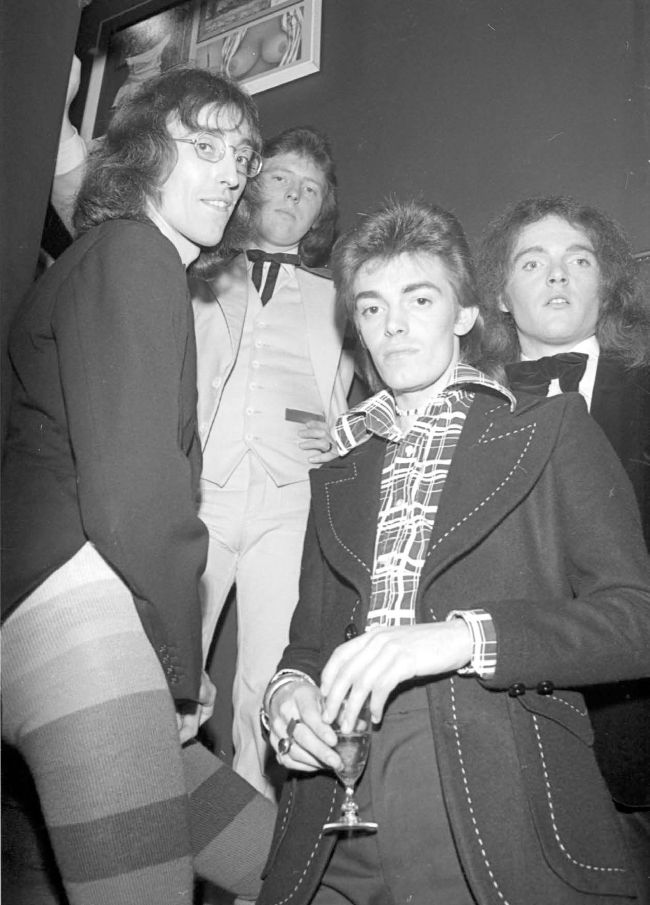
“Not really up to professional standards”: Be-Bop Deluxe, with Bill Nelson second right, 1974
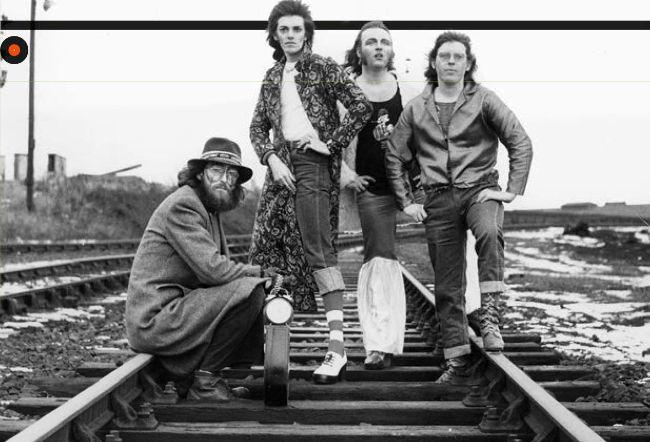
“You hoped we’d dress like tarts”: the short-lived Axe Victim lineup
With the songs that make up 1975’s gleaming Futurama mostly written, Nelson might have hoped that Be-Bop Deluxe would get a chance to accelerate away from the glitter repertoire that must have seemed passé when Bowie retired Ziggy Stardust in July 1973. Instead, he was told to focus on songs that fans “up north” were already familiar with. Reluctantly, he agreed. Nelson is not overly enamoured of Axe Victim (“f awed but not without charm,” he concludes), but it is a magnif cently evocative period piece, highlighting Be-Bop’s imagination and glam-inspired desire to transcend T-shirt-and-jeans reality. A dream group orbits above the grey planet on the subtly psychedelic “Jet Silver And The Dolls”, while God’s Own Country morphs into a post-apocalyptic Diamond Dogs wasteland on “Adventures In A Yorkshire Landscape”. Re-recorded after its first appearance on Northern Dream, Nelson’s walking tour of the Wakef eld hinterlands captures the old world crumbling (“mirrors in ballrooms lie smashed on the ground”), but a typically luminous guitar solo sprays dayglo brights among the ruins. “Jets At Dawn” takes an even more dramatic leap into fantasy world, Nelson’s vision of life at the end of the war to end all wars ending up a mix of JG Ballard gothic and hippie whimsy.
EMI perhaps hoped that Be-Bop Deluxe might be saleable as a Queen-style hard rock band; their bluesy roots certainly show through on “No Trains To Heaven” and space-age boogie “Rocket Cathedrals”, but Nelson was always angling for something more esoteric. He takes delight in transforming an Edward Hopper painting into the angular “Night Creatures”, eavesdrops on the S&M freaks in the outré “Third Floor Heaven”, and - playing with the form - gauchely hides his then-girlfriend’s name in the initials of the title of the giddy “Love Is Sweet Arrows”.
Later incarnations of Be-Bop Deluxe would give considerably less away. Axe Victim feels like a last blowout before the serious work begins. Nelson reckons closer “Darkness (L’Immoraliste)” - written on piano rather than guitar - was a signpost to that more considered future, but it’s actually the most ludicrous, extravagant thing here. An orchestra and a heavenly chorus whip Nelson’s sixth-form verse into something that sounds like Roxy Music’s “A Song For Europe” being butchered by The Brotherhood Of Man. Garish, but fun.
Neither glam nor prog, Axe Victim landed with something of a crunch on release; Nelson hated the “heavy metal” sleeve Harvest foisted on it, and came to recognise his bandmates’ limitations after they supported fellow travellers Cockney Rebel on a 1974 tour. With a new lineup, Be-Bop Deluxe rode the slipstream of punk, before Nelson bleached out any lingering traces of his clubland past to emerge as an arty auteur in the early ’80s, two parts David Byrne, two parts Robert Fripp.
Axe Victim may blurt out stupid things and betray Nelson’s unworldliness, but there’s no disguising the imagination at its core as it clears the ground so the likes of Ultravox!, XTC and Wire could tread less cautiously in the years to come. Not up to professional standard maybe, but - in its own way - phenomenal.
Extras: 8/10. Audiophiles can debate the benefits of the new stereo and surround-sound versions of the LP, while glam nerds will feast on alternate versions from the album sessions, plus both sides of their Bowie-indebted homemade debut single, “Teenage Archangel”. More thrilling still is a three-track demo recorded for Decca in 1973 and both of the band’s first two Peel Sessions. It’s little wonder the bar-room boogie of “Bluesy Ruby” was left of Axe Victim, but “I’ll Be Your Vampire” and “Mill Street Junction” are glittering prizes.
NELSON’S CHOICE
The pick of Be-Bop Deluxe and beyond
BE-BOP DELUXE
Futurama
HARVEST, 1975 Reinvented as a space-age power trio, Be-Bop Deluxe made their
second LP with Queen producer Roy Thomas Baker, but if the transatlantic sound has divided opinion, there’s no doubt that Nelson hit his pinnacle as a show-off guitarist here. The dramatic “Between The Worlds”, “Music In Dreamland” and “Maid In Heaven” (a Top 40 hit in 1976) are career pinnacles. 8/10
BILL NELSON’S RED NOISE
Sound-On-Sound HARVEST, 1979 Having bowed to management advice to
keep the Be-Bop Deluxe name going through the punk years, Nelson enlisted his brother Ian on saxophone when he finally went solo. The future-facing
Sound-On-Sound
nods toward Talking Heads’ art-school clatter and Nelson’s punk-literate, art-school manifesto “Revolt Into Style” is a mighty single. 8/10
BILL NELSON
Chimera MERCURY, 1983 Extraordinarily prolific in the early 1980s, Nelson hit a synthy sweet spot
with this mini-LP, based on rhythms he was sent by Yellow Magic Orchestra’s Yukihiro Takahashi. Mick Karn’s slippery bass and Nelson’s neon-bright guitar work decorate a fusion of Berlin-era Bowie and
Avalon-stage
Roxy Music. Hear “Another Day Another Ray Of Hope” and be converted. 8/10
SLEEVE NOTES
CD 1 - original album remastered: Tracks 1-10 then bonus tracks: 11 Teenage Archangel (1973 single)
12 Jets At Dawn (1973 single version) 13 No Trains To Heaven (fi
rst
mix)
14 Axe Victim (fi
rst
mix)
CD 2 - new stereo mix: Tracks 1-10 then bonus tracks: 11 Axe Victim (firstversion)
12 Night Creatures (spoken word version)
13 Rocket Cathedrals (fi
rst
version)
CD 3 - sessions 1. Axe Victim (Peel Session, Nov 1973)
2 Bluesy Ruby (Peel Session, Nov 1973)
3 Tomorrow The World (Peel Session, November 1973)
4 Axe Victim (Decca demo session, Dec 1973)
5 I’ll Be Your Vampire (Decca demo session, Dec 1973)
6 Adventures In A Yorkshire Landscape (Decca demo session, Dec 1973)
7 Bluesy Ruby (Decca demo session, Dec 1973)
8 Third Floor Heaven (Peel Session, May 1974)
9 Mill Street Junction (Peel Session, May 1974)
10 15th Of July (Invisibles) (Peel Session, May 1974)
11 Adventures In A Yorkshire Landscape (Peel Session, May 1974)
DVD - Axe Victim, 5.1 surround sound mix Tracks 1-10 then bonus tracks: 11 Axe Victim (firstversion)
12 Night Creatures (spoken word)
13 Rocket Cathedrals (first version)
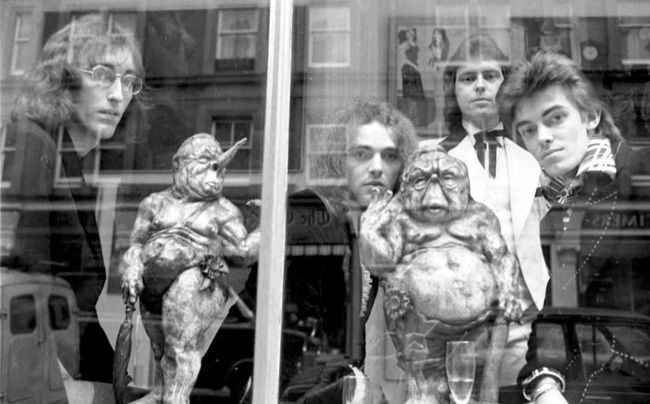
Statuary bodies: Be-Bop Deluxe meet Heath and Wilson, 1974 Below: Bill Nelson at home in York, England in 2019