BORN TO REIGN
The coolest rockstar in the world right now is not a white boy with a guitar. It’s a New York-based Pakistani woman, singing mainly in Urdu, who’s redefined the parameters of 21st-century music with her unique and intoxicating blend of styles and traditions. With new album Night Reign poised to nudge her very subtly towards the mainstream, AROOJ AFTAB talks wit, whisky and Auto-Tune with Sam Richards. “I wanted to pull at your little mind-strings…”
THERE is a song on Arooj Aftab’s new album called “Whiskey”. In keeping with the overall theme of Night Reign, it’s more about deciphering the mysterious codes of the nighttime – do they really like you or are they just drunk? – than it is about Aftab’s love of whisky. But she wants to make it clear that she does also love whisky. “I really like Macallan,” she confides. “I want them to endorse me, but they only endorse very old-fashioned men, the kind of Rotary Club guy. Actually, they’re like, ‘We don’t need to endorse you – you basically buy so much Macallan, we’re fine.’ I like a good Scotch, but lately all my whisky-drinking friends have switched to mezcal for some reason. They say it’s way smoother, the hangover is less and it’s less crazy.” She looks unconvinced. “Less crazy?
Has anyone ever seen me after two things of tequila? I’m a maniac.”
There are few artists you’d rather spend a sunny afternoon in London with than Arooj Aftab. Far from the dubiously exoticised “Sufi goddess” of some write-ups, she’s much more complex and intriguing and real: a singer with a devastating voice making adventurous music of rarified beauty who also swears like a trooper, enjoys a drink and can hold forth entertainingly on topics ranging from 18th-century poets to Netflix comedies.
Aftab has requested we meet at the Barbican, scene of a triumphant 2022 show that announced her arrival as a major player in contemporary music. “It’s still one of the most memorable shows I’ve played,” she recalls fondly. “Everybody was screaming, the crowd was buzzing, it was sold out and beyond, Anoushka [Shankar] guesting, Talvin Singh was there… such a great show.” Although she has played the venue again since with her improvisatory trio Love In Exile, she’s never had a chance to linger. This is the first time she’s visited the Barbican’s brutalist terrace, with its quirky art installations and green oblong lake. “Good place for a date,” she observes, as ducks waddle happily past the arty couples gesticulating intently to each other by the fountains.
Amid this polite scene, Aftab cuts quite a dash in her double-breasted Al Capone suit, white shoes, gold chain and conspicuous designer sunglasses. Evidently she is relishing her new role of international rock star, while remaining cautious as to how much of this swagger she allows to seep back into the music.
“Arooj has always been a unique person, in the way she carries herself and in the way that she manifests her musical ideas,” notes long-time friend and close collaborator Maeve Gilchrist. “I think a lot of her artistic vision comes from an inner world that she nurtures and gives space. It’s been really great to see her grow in confidence with her stage persona and play with the audience. But the core person is very much the same.”
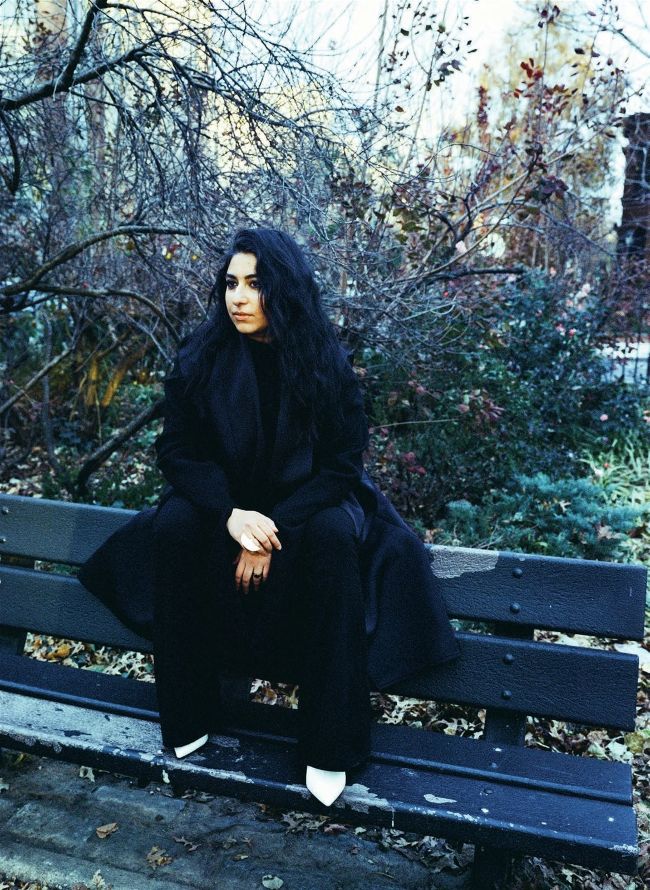
Arooj Aftab: “I’m giving it my full, 100 per cent shot”
Photo by POONEH GHANA
Aftab’s life has certainly changed a great deal since Vulture Prince came out in April 2021, initially on the indie classical label New Amsterdam. At that point, she was still working a day job in post-production, which she was finally able to quit upon signing to Verve, who reissued Vulture Prince the following year. Since then, she’s spent most of her time on the road – last year she played around 200 shows, and she only just returned home from an Australasian tour before flying over here to promote her new album – but she shows no signs of flagging or becoming jaded with the whole shebang.