LAURIE ANDERSON
8/10
New York avant-garde doyenne’s flight of fancy.
By Piers Martin
Amelia
NONESUCH
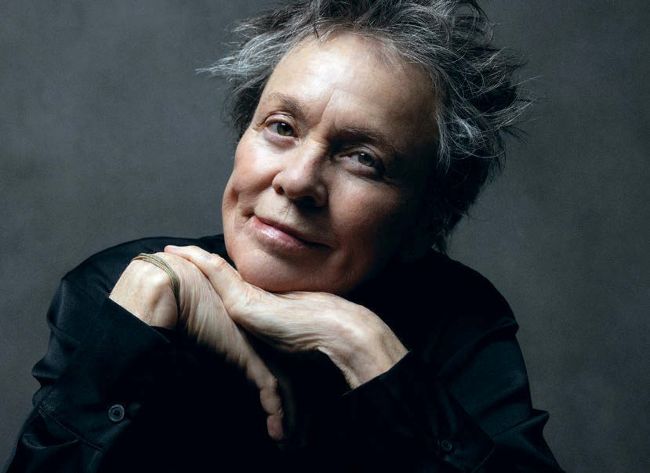
Laurie Anderson: reassuring narrator
AMELIA EARHARTwas the pioneering American aviator who, among her many achievements, became the first woman to fly solo across the Atlantic,in 1932. She led the way in other areas too, using her fame to champion women’s rights, including the Equal Rights Movement, endorse commercial air travel, write bestselling books, take on sponsorship deals and, more broadly, promote her passions in public. She had the ear of President Roosevelt and blazed a trail for women in an industry where female pilots and mechanics are still woefully underrepresented.
EBRUYILDIZ
On Amelia, Laurie Anderson tells the story of Earhart’s life as she makes her fateful attempt, in 1937, to circumnavigate the world in a Lockheed Model 10-E Electra plane. It’s a riveting tale anyway, straight out of an Indiana Jones movie, but Anderson – who was first commissioned to work on this back in 2000 and has performed versions of it, on and off, since then – puts herself in Earhart’s position, right in the cockpit, so that we experience the journey as a daily diary inspired by Earhart’s own pilot entries. With Anderson at the controls, imagining what it’s like to fly, it flows as if in a dream state – part biography, part hallucinatory audiobook.
Having written about herself from an anthropological point of view for much of her career – most recently on 2018’s Landfall, with Kronos Quartet, about Hurricane Sandy, and 2015’s reflection on mortality, Heart Of A Dog – Amelia is Anderson’s first major work of biography. But she approaches Earhart with the same cool-headed mix of fascination and curiosity as any of her weightier subjects, looking for what made the woman tick and extracting the humanity in the story through her research. Of course, both Anderson and Earhart are pioneers in their respective fields, and you sense that Anderson sees something of herself in the way Earhart instinctively positioned herself at the forefront of communications, science and technology in the 1930s while breaking down barriers between the sexes. “She was the original blogger,” says Anderson, noting that had Earhart lived, she planned to open an engineering school for girls. As Earhart declares, in a broadcast excerpt Anderson uses for one track: “This modern world of science and invention is of particular interest to women, for the lives of women have been more affected by its new horizons that any other group”.
Anderson calls her first performance of Amelia, at Carnegie Hall in New York in 2000, “a train-wreck”, and so this final recorded version, propelled by an orchestral score that conjures the serenity and anxiety of flight, is the result of years of tweaks and improvements. She added a layer of electronics, guitar and percussion, as well as engine and external sounds for a more immersive listen, and presents each of the 22 tracks as a short diary entry, either a paragraph or page, narrated by Anderson in that calm, reassuring voice. “I remember going to the airfields at night in Los Angeles, and watching the daredevil pilots do loop de loops in the sky”,she says on “Flying At Night”, which Earhart would have done. As the custodian of her late husband Lou Reed’s archive, Anderson, who is 77, knows how difficult it is to assemble biography – Amelia can only be her interpretation of events, laced with that quality of magic realism Anderson brings to all her projects.