PRUNING STONE FRUIT
Professional nurseryman David Patch highlights the principles which underlie the pruning of stone fruit trees and how to put these into practice
David Patch
SEE MORE IN DIGITAL KG +
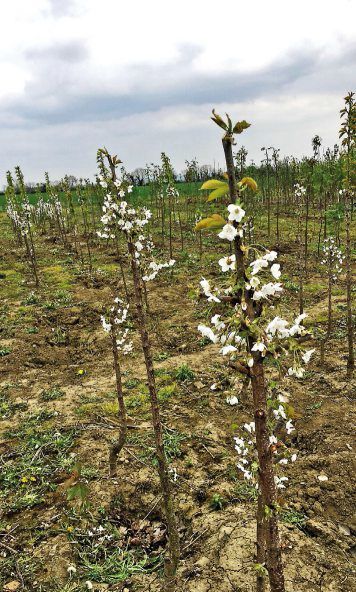
Young cherry ‘Sunburst’ trees with tops removed to encourage branching
Sweet cherries, greengages, nectarines, apricots, peaches, the classic Victoria plum… the stone fruit family contains some of the most delicious fruit the home gardener can grow. Cropping at the height of summer, they harness the sun’s warmth and turn it into sweet delights bursting with nectar like flavour. Pruning of these trees seems to cause people a lot of headaches – what to prune and when – but follow a few simple rules, understand the principles behind them and you will have regular crops of these stars of the orchard.
SUMMER JOB
The first key point to remember – all stone fruit should be pruned during the summer. This is done to avoid serious diseases such as silver leaf and bacterial canker, which can prove fatal. Silver leaf (Chondrostereum purpureum) is a fungal disease which attacks stone fruit trees, especially Victoria plums, causing the leaves to develop a silvery sheen and affected branches to die back. When these branches are cut, there will be dark staining through the centre of the wood. Silver leaf spores are released between September and May, particularly during periods of wet weather, and carried by the wind. In some cases the foliage doesn’t actually turn colour, the first sign of the problem will be branches starting to die back. It is probably the most common cause of death for stone fruit trees, and the reason why pruning should always be carried out during the growing season when there are fewer spores around.