30 years of Linux
CELEBRATE 30 YEARS OF LINUX!
How a 21-year-old’s bedroom coding project took over the world and a few other things along the way.
Linux only exists because of Christmas. On January 5, 1991, a 21-year-old computer science student, who was currently living with his mum, trudged through the (we assume) snow-covered streets of Helsinki, with his pockets stuffed full of Christmas gift money. Linus Torvalds wandered up to his local PC store and purchased his first PC, an Intel 386DX33, with 4MB of memory and a 40MB hard drive. On this stalwart machine he would write the first-ever version of Linux. From this moment on, the history of Linux becomes a love story about community collaboration, open-source development, software freedom and open platforms.
Previous to walking into that computer store, Linus Torvalds had tinkered on the obscure (UK-designed) Sinclair QL (Quantum Leap) and the far better-known Commodore VIC-20. Fine home computers, but neither was going to birth a world-straddling kernel. A boy needs standards to make something that will be adopted worldwide, and an IBM-compatible PC was a perfect place to start. But we’re sure Torvalds’ mind was focused more on having fun with Prince of Persia at that point than specifically developing a Microsoftconquering kernel.
“A 21-year-old, barely able to afford an Intel 386 DX33, was about to start a development process that would support a software ecosystem…”
LINUS TORVALDS’ ACHIEVEMENT
Let’s be clear: a 21-year-old, barely able to afford an Intel 386 DX33, was about to start a development process that would support a software ecosystem, which in turn would run most of the smart devices in the world, a majority of the internet, all of the world’s fastest supercomputers, chunks of Hollywood’s special effects industry, SpaceX rockets, NASA Mars probes, selfdriving cars, tens of millions of SBC like the Pi and a whole bunch of other stuff. How the heck did that happen? Turn the page to find out…
Pre-Linux development
Discover how Unix and GNU became the foundation of Linus Torvalds’ brainchild.
To understand how Linux got started, you need to understand Unix. Before Linux, Unix was a well-established operating system standard through the 1960s into the 1970s. It was already powering mainframes built by the likes of IBM, HP, and AT&T. We’re not talking small fry, then – they were mega corporations selling their products around the globe.
If we look at the development of Unix, you’ll see certain parallels with Linux: freethinking academic types who were given free rein to develop what they want. But whereas Unix was ultimately boxed into closed-source corporatism, tied to a fixed and dwindling development team, eroded by profit margins and lawyers’ fees, groups that followed Linux embraced a more strict open approach. This enabled free experimentation, development and collaboration on a worldwide scale. Yeah, yeah, you get the point!
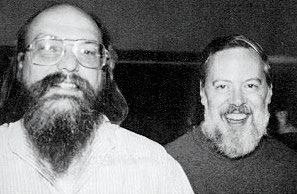
Ken Thomas (left) and Dennis Ritchie are credited with largely creating much of the original UNIX family of operating systems, while Ritchie also created the C language.
Back to Unix, which is an operating system standard that started development in academia at the end of the 1960s as part of MIT, Bell Labs and then part of AT&T. The initially single or uni-processing OS, spawned from the Multics OS, was dubbed Unics, with an assembler, editor and the B programming language. At some point that “cs” was swapped to an “x,” probably because it was cooler, dude.
At some point, someone needed a text editor to run on a DEC PDP-11 machine. So, the Unix team obliged and developed roff and troff, the first digital typesetting system. Such unfettered functionality demanded documentation, so the “man” system (still used to this day) was created with the first Unix Programming Manual in November 1971. This was all a stroke of luck, because the DEC PDP-11 was the most popular minimainframe of its day, and everyone focused on the neatly documented and openly shared Unix system.
In 1973, version 4 of Unix was rewritten in portable C, though it would be five years until anyone tried running Unix on anything but a PDP-11. At this point, a copy of the Unix source code cost almost $100,000 in current money to licence from AT&T, so commercial use was limited during the 70s. However, by the early 80s costs had rapidly dropped and widespread use at Bell Labs, AT&T, and among computer science students propelled the use of Unix. It was considered a universal OS standard, and in the mid-1980s the POSIX standard was proposed by the IEEE, backed by the US government. This makes any operating system following POSIX at least partly if not largely compatible with other versions.
LINUX RUNS EVERYTHING
Developing software for supercomputers is expensive. During the 1980s, Cray was spending as much on software development as it was on its hardware. In a trend that would only grow, Cray initially shifted to UNIX System V, then a BSD-based OS, and eventually, in 2004, SUSE Linux to power its supercomputers. This was matched across the sector, and the top 500 supercomputers (www.top500.org) now all run Linux.
Internet services have also all been developed to run on Unix systems. Microsoft and BSD systems do retain a good slice of services, but over 50 per cent of web servers are powered by Linux. Recent moves to virtual services with container-based deployment are all Linux-based. Microsoft’s cloud service Azure reports that Linux is its largest deployment OS and, more to the point, Google uses Linux to power most of its services, as do many other service suppliers aka AWS.
Android’s mobile OS share dropped in 2020 to just 84 per cent – it’s powered by Linux. Google bought the startup that was developing Android in 2005. LineageOS (https://lineageos.org) is a well-maintained fork of Android and supports most popular handsets well after their manufacturers abandon them.
Space was thought to be Linux’s final frontier, because it’s not a certified deterministic OS, which is the gold standard for real-time OSes in missioncritical situations. Turns out that SpaceX rockets use Linux to power their flight systems, using a triple-redundancy system, while NASA has sent Linux to Mars in its helicopter drone, Ingenuity. Tesla is also reportedly running Linux in its cars.
Linux has also been at the heart of Hollywood’s special effects since 1997’s Titanic used a Linux server farm of DEC Alphas at Digital Domain to create its CGI. DreamWorks’ Shrek in 2001 was the first film that was entirely created on Linux systems. Meanwhile, Pixar ported its Renderman system to Linux from SGI and Sun servers around 2000, in time to produce Finding Nemo in 2003.

Linus Tovalds being interviewed by Linux Format back in 2012.

Linux Format interviewed Richard Stallman, the creator of the GNU free software movement, in 2011.
At the end of the 1980s, the Unix story got messy, with commercial infighting, competing standards and closing off of standards, often dubbed Unix Wars. While AT&T, Sun Microsystems, Oracle, SCO, and others argued, a Finnish boy was about to start university…
We GNU that
Before we dive into the early world of Linux, there’s another part of the puzzle of its success that we need to put in place: the GNU Project, established by Richard Stallman. Stallman was a product of the 1970s development environment: a freethinking, academic, hippy type. One day, he couldn’t use a printer, and because the company refused to supply the source code, he couldn’t fix the issue – supplying source code was quite normal at the time. He went apoplectic and established a free software development revolution: an entire free OS ecosystem, free software licence and philosophy that’s still going strong. Take that, proprietary software!