THRIFTY STITCHER
Claire-Louise Hardie reveals how to adjust trouser and skirt patterns for a full or flat bottom
ABOUT CLAIRE-LOUISE
Claire-Louise is an author, pattern designer, teacher and costumier. We recommend her online course
www.learntosewwithapro.com/ ultimate-beginners
Claire-Louise’s book, The Great British Sewing Bee: Fashion With Fabric, accompanied the third series of the show and is priced at £20 from
www.quadrille.co.uk
Join Claire-Louise’s monthly sewing club and learn how to take your sewing to the next level with expert tips, tricks and techniques to try. Visit
www.thethriftystitcher.co.uk to find out more
I’m following up on last month’s rounded tummy adjustments in Part 2: the full (or flat) bottom adjustment – this is a very similar process, except we’re adding additional fabric into the bottom area rather than the tummy area. Unlike the tummy, where we only looked at adding for roundness, this time, we’ll be looking at taking away fabric too for those with a flatter bottom. The range of bottom shapes is vast, and we cannot expect one pattern to fit all. However, knowing how to add a little extra for a peachier derriere or taking a little out for a flatter bottom will cover most people’s needs to get a better booty fit.
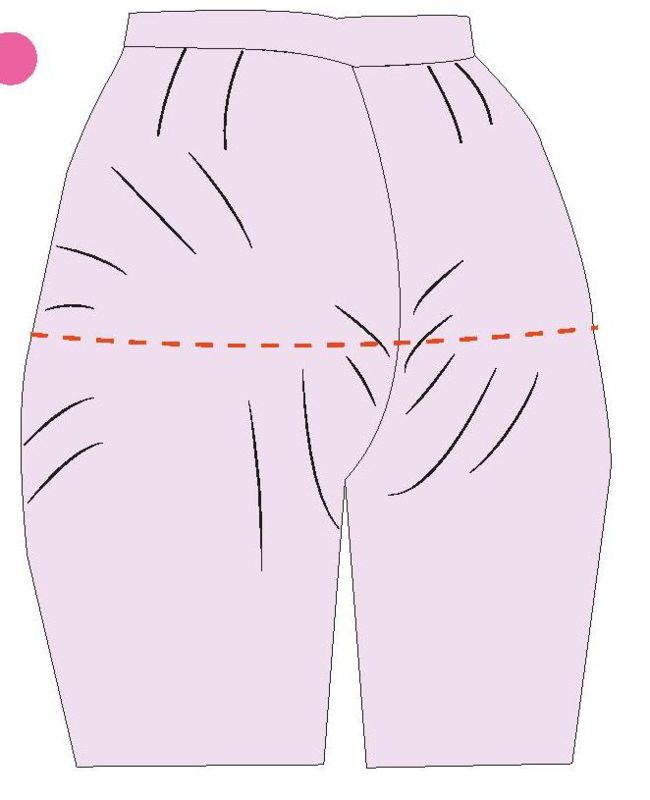
A
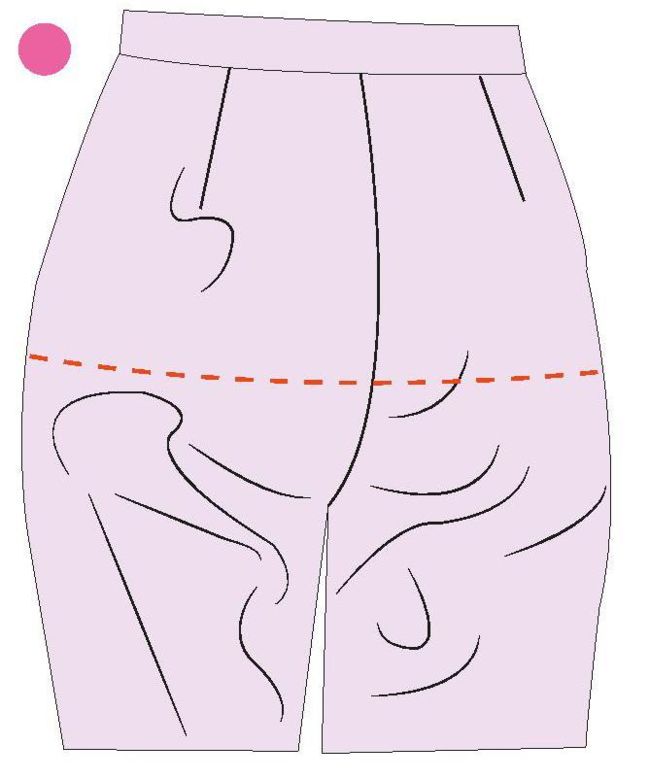
B
A
B
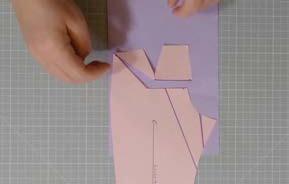
C
DIAGNOSING IF A FULL-BOTTOM ADJUSTMENT IS NECESSARY.
Even if you know you have a ‘peachy, rounded bottom’, you may not need to use this adjustment all the time, depending on the amount of ease in the pattern and its style. Since trousers wrap around the body in 3 different planes, it’s always a good idea to make a toile to test the fit. Again, the analogy of a round balloon pushing through a flat piece of silk and causing distortion in the fabric is a great way to visualise a need for this adjustment – as the balloon pushes further into the silk, it begins to distort the flat surface of the silk, creating lines that radiate out from the middle where the balloon pushes forward. If, after making a toile or a test version, you notice radial lines or tension like in picture A, then a full-bottom adjustment is a good solution for you! Another indicator is that the waistline/waistband dips down at the centre back, as seen in the diagram – this indicates that there’s not enough length along the back crotch seam to go over the full-bottom; it’s what Patrick Grant and Esme Young refer to as a ‘hungry bum’!