5 years of Apple silicon
The first M-series chip was a game-changer when it arrived in 2020. Here we reveal its surprising evolution and find out what’s next…
Written by David Crookes
When Apple acquired
PA Semi for $278 million in April 2008, few imagined the true impact the purchase would have. At the time, it was suggested Apple was more interested in the fabless, PowerPC chip design company talent and that they would, in all likelihood, primarily work towards the creation of an Apple-owned chip for the iPhone.
No-one really thought it would eventually lead to Apple creating super-powerful chips that would outstrip those of established manufacturers. But that is exactly what happened.
Apple did indeed mainly concentrate on the mobile market at first. The A4 chip made its debut in the first generation iPad in 2010 and, since then, Apple has scaled up and branched out. Drawing on the expertise of a growing number of engineers across the world, it has sought fresh avenues for its technology, namely the S-series of chips for Apple Watch and the H and W chips for AirPods.
Then, on 22 June 2020, as the world was still coming to terms with the widespread effects of the Covid-19 pandemic, Apple’s CEO Tim Cook hosted the first online-only Worldwide Developers Conference (WWDC).
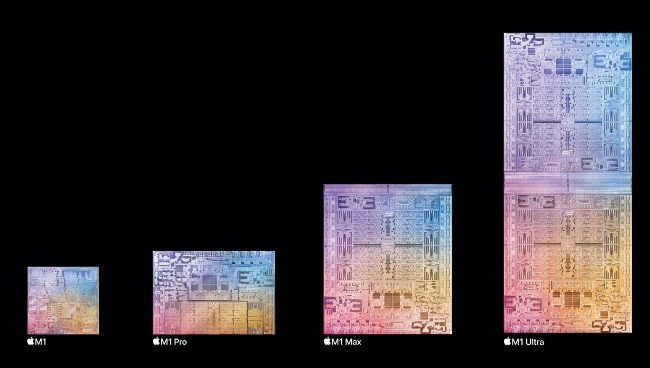
The M1 line-up introduced the now familiar silicon chip variants. Note the two M1 Max chips making up M1 Ultra thanks to UltraFusion.
Image credit: Apple Inc
Millions watched the live stream from Apple Park and heard Cook talk of a long-rumoured change: Apple’s transition to Apple silicon. “With its powerful features and industry-leading performance, Apple silicon will make the Mac stronger and more capable than ever,” Cook declared. And he wasn’t wrong.
Cook’s words heralded the most significant shift in Mac architecture since Apple’s switch from PowerPC processors to Intel in 2005. It was also on a par with Apple’s move from the Motorola 68000 series to PowerPC processors in 1994.
Power up
In both cases, Apple wanted processors with better performance per watt and simpler instructions for faster execution. “Computer designers use the phrase PPA – Power/Performance/(Chip) Area,” David Patterson, the pioneering professor of computer science at the University of California, Berkeley, told MacFormat. “PowerPC had better PPA and that’s been the reason for each transition from 68000 to PowerPC to Intel x86.”