REACHING FOR THE STARS
A lot of the technology in your PC and your home originated in spaaaaaaace.
Ian Evenden explains
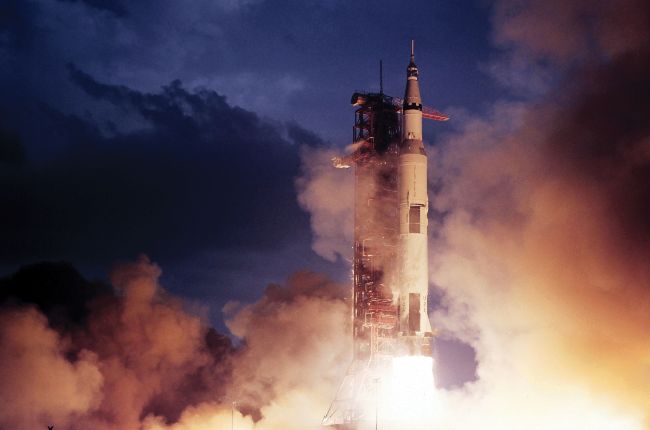
The Apollo missions used several technologies that have subsequently entered everyday terrestrial life.
© STF/AFP VIA GETTY IMAGES
THAT GOVERNMENT-FUNDED space agency your taxes support, NASA, doesn’t just strap people to the top of a firework and aim them at the Moon. It doesn’t even do that much now, but focuses on robotic exploration of Mars and crewing the International Space Station.
This is an agency, after all, that has three probes currently on their way out of the solar system, including the fastest human vehicle ever launched. It has put robots on Mars, probes on Venus (briefly), and sent more to investigate Mercury and the outer planets. Its latest Martian rover is a nuclear-powered laser-armed tank with a helicopter strapped to it.
Along the way, you’d expect it to pick up some neat new technology—and it has. Some of it has become so everyday that we almost no longer think of it, and some of it is in your PC. So, from the essential to the futuristic to the urban myths, here are the NASA inventions that have helped humanity the most.
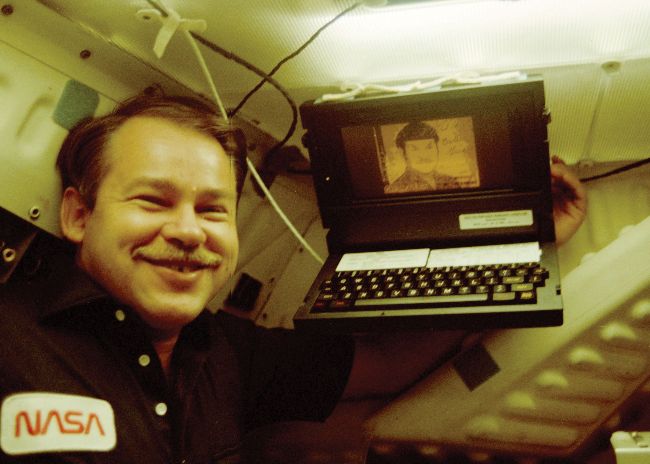
Astronaut John O. Creighton poses with onboard GRiD Compass computer, displaying a likeness of Star Trek’s Mr. Spock, aboard Space Shuttle Discovery mission STS-51-G on June 18, 1985.
PORTABLE COMPUTERS
THE GUIDANCE COMPUTERS aboard space capsules were one thing, but it was only a matter of time before NASA wanted to take general-purpose computers into space. Beige boxes with CRT screens were too heavy and cumbersome to be shot into orbit aboard the Space Shuttle, so portable units were explored. This was the 1980s, though, and laptops were somewhat primitive.
In 1982, however, a company called GRiD developed the Compass, a computer that looks recognizably like a laptop. It was powered by an Intel 8086 CPU, with up to 512Kb of nonvolatile magnetic bubble memory (a defunct technology that was very durable, but tended to run a little hot), and things like disk drives available as peripherals. The casing was magnesium, and designed to act as a large heatsink for the CPU, memory, and the 320x240 plasma screen (which could be read in even the strongest sunlight, thanks to its bright orange text display). It came preloaded with office software, and cost the equivalent of $23,000 in today’s money ($8,000 back in 1982).
NASA and the US military took no notice of the price tag, and enthusiastically embraced this little (10lb) machine, blasting it into orbit in 1983 and sending it into combat with paratroopers. Competitors such as the Osborne 1 or the Compaq Portable used CRT displays, and couldn’t match the Compass’s toughness (one reportedly survived the tragic 1986 Challenger disaster). NASA’s only modifications to the hardware were a new cord to match the Shuttle’s power system, bits of Velcro to hold it in place, and a fan to aid in cooling, as convection is tricky in space. On the software side, however, the newly rechristened SPOC (Shuttle Portable On-board Computer) received special graphical software to display the orbiter’s position relative to Earth, and a backup copy of the re-entry program, just in case.