CHOOSE THE BEST VPN PROVIDER
Nate Drake gives you the rundown on how to select the very best VPN service for your needs
1996 WAS A GREAT YEAR.
Major League Soccer came to the US for the first time, and the N64 was released in Japan and the USA. It’s also the year that brilliant Microsoft and US Robotics employees helped to create PPTP (Point to Point Tunneling Protocol), birthing the very first VPNs (Virtual Private Networks).
The original idea was that employees working remotely could securely ‘dial in’ to their corporate network to access resources. This meant any internetconnected computer could effectively become a part of any intranet.
PPTP has since been superseded, but the basic mechanics of modern VPNs are much the same—the ‘client’ creates an encrypted ‘tunnel’ to a VPN server, through which they can then access the network and the internet.
Recent years have seen the rise of many dedicated VPN online services, which allow users to connect to the internet via the provider’s own servers.
Connecting in this way means that a user’s IP matches that of the server itself, so they can appear to be in a different country. This is a good way to access georestricted content like Netflix.
Still, not all VPN services are created equal. In this guide, you’ll discover how to pick the best one for your needs.
WHY WOULD YOU WANT A VPN?
This may seem like an obvious question, but they have many uses. If you’ve been researching VPN services online, you may already think that you have the answer, since many offer protection from malware, safety from hacking, and guarantee online privacy.
If you believe this, it’s time for some hard truths. Firstly, using a VPN in itself doesn’t guarantee your privacy online. While your client device can establish an encrypted connection to the VPN server, even if set up correctly this simply makes it much harder for your ISP to track your online activities.
In simplest terms, the VPN server to which you connect fetches online content for you, so if that server is compromised by a hacker or corrupt VPN employee, your personal data is at risk. If your VPN client software is compromised or your VPN service only supports weaker protocols, you can also be targeted by hackers directly. Of course, connecting to the internet directly is no guarantee of online safety either, but it’s important to understand that when you subscribe to a VPN service, you’re just shifting your trust from your ISP to your VPN provider.
This may not trouble you as much if you want to use a VPN for other reasons. For instance, if your VPN provider has servers in multiple countries, you can use it to access content that would otherwise be geo-restricted. This can be handy if, for instance, you’re on vacation in Europe and want to watch shows on Netflix USA.
If you plan to use your VPN service in this way, first check their website to make sure they have multiple server locations for the country in which you appear to be. This is important, as some online platforms like Netflix actively scan for VPN usage and may not play content if you appear to be connecting from the IP of a known VPN server. If your provider has hundreds of different server locations then all you usually need to do is switch VPN servers and try again.
Ideally, try to sign up to a VPN service that offers a free trial so you can test it out with your chosen platform. That way there’s no risk if you’re still blocked.
Aside from securing your connection and watching TV abroad, VPNs have other uses. For instance, ISPs often engage in bandwidth ‘throttling’ or ‘shaping’, where they deliberately slow down types of content, like streaming video. If you connect via a VPN, however, all data is encrypted, so your ISP can’t discriminate in this way. Some VPN providers like NordVPN even have specialist servers for content like P2P downloads.
Some websites (particularly for airlines and hotels) can also display different prices, depending on your location. You can take advantage of this ‘price discrimination’ by connecting via a server based in another country.
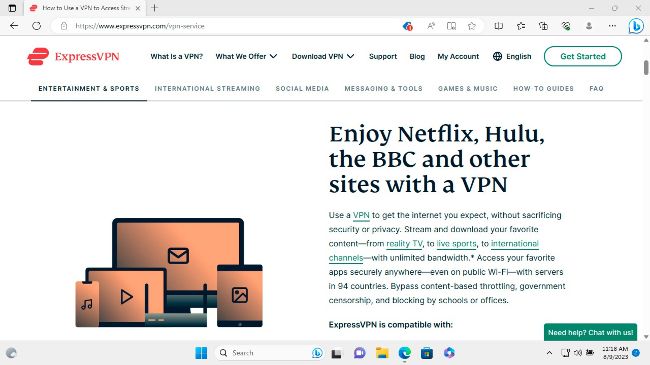
Some providers, like ExpressVPN, specify compatible platforms like Netflix.
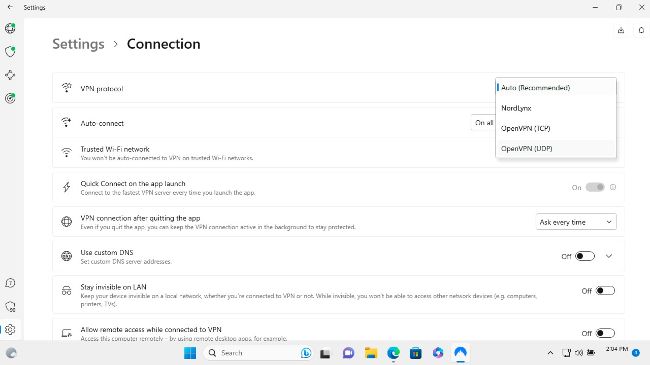
A good VPN client will clearly display all available protocols.
© NORDVPN /EXPRESSVPN
Thinking about why you want to use a VPN will help you make better choices when deciding on a service. Privacy lovers will want a VPN with a “no logs” policy and strong encryption protocols. People who want to access geo-restricted content will be more motivated by the number and locations of servers. Research your chosen provider to be sure that they meet your needs before clicking ‘Subscribe’.