RE ARTICLE
TINY PANZER
Clayton Ockerby tackles the IBG Models 1:35 scale Panzer II Ausf. b, not to be confused with the Panzer II Ausf. B!
I must admit, when IBG announced the release of these (essentially) prototype Panzer IIs I wasn’t really planning on one to be in my build queue anytime soon. I love the Panzer II, and the Panzer I for that matter, but there is something about the running gear on these early version IIs that reminded me of an adult trying to wear children’s shoes… But as the modelling Gods often do, they had other ideas for me, and I found the kit on my workbench and was asked to build it for this article.
As with pretty much every model I have in the queue I start the research process and more often than not end up falling in love with the subject. It’s an interesting thought isn’t it…the more we learn about something the more we tend to like about it.
In 1934, it became clear that the strike power of the Panzer 1 wouldn’t be adequate against some of the emerging tanks of the time. Delays in the design and production of the Panzer III and IV meant it was necessary to search for a temporary solution to help to offer the German military something with a little more potency.
Krupp, MAN, Henschel, and Daimler-Benz all were approached to submit designs for this weapon however it was Dailmer-Benz and MAN that would win out in the end. Design of the Panzer II began of the 27TH of January 1934 and saw the first incarnation of the tank ready for trails in February of 1935. The initial design was based heavily off the Panzer 1 however the major difference was the vehicle had a larger turret that was able to house a 20mm anti-tank gun.
Production of the Panzer II Ausf. a (not to be confused with the Ausf. A) in 1935 and would see the first combat ready tank roll off the assembly line 18 months later.
The Ausf a was divided into three main sub-variants. The Ausf a/1was built with a cast idler wheel with rubber tires, and after only 10 examples was changed to a welded part.
The Ausf a/2 included upgrades to allow better access to the engine, and the Ausf a/3 included improved suspension and engine cooling. 75 units were produced in total between May of 1936 and February of 1937.
The Ausf b (again, not to be confused with the Ausf B) was the next version in the evolution of the Panzer II. The Ausf b saw improvements in the suspension system which resulted in a wider track as well as a longer hull. The engine was upgraded to a Maybach HL62 TR and the entire drivetrain was replaced to match. Armour was also increased to 10-12mm with meant the tank now weighed 7.9 tonne. Only 25 examples of the Panzer II Ausf b were made.
The Panzer II went on to play an important role in the early years of World War II, during the Polish and French campaigns.
The kit looks quite nice in the box, but sometimes the build doesn’t translate…so with high hopes I began the build.
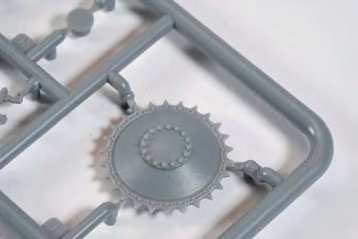
Construction began with the wheel sections. Care was required to remove the drive sockets from the sprues because the gates were attached to the teeth in the part. It would be very easy to accidently remove the detail in that part.
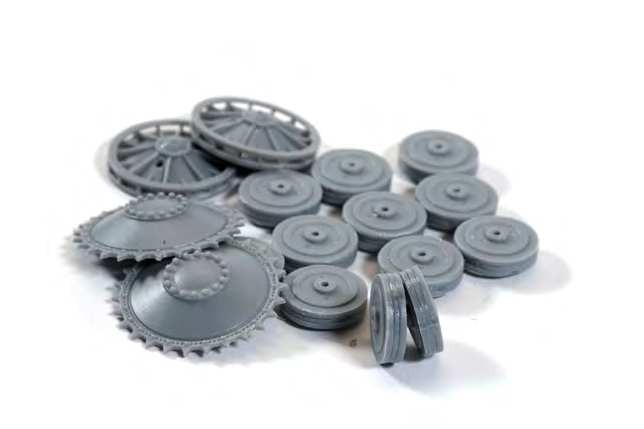
Each wheel includes three-disc sections per piece. The connection points were shallow, and care was required to ensure they all sat correctly before applying the glue. The assembly shows some distinctive lines where the parts are sandwiched together, but interestingly the wheels on the actual tank display a similar look. I know IBG are planning on releasing a set of resin wheels for this range of kits and I would think it would be worth consideration.