Masterclass
Keep On Running: Class 150 ‘Sprinters’ at 40
Looking at railways in detail
The ‘Sprinter’ DMU revolution of the 1980s reaches its 40th anniversary in 2024. Ben Jones celebrates the units that transformed regional services across Britain and are still going strong today.
By the early 1980s, British Rail’s regional and secondary services were in trouble. Service quality was declining as dilapidated first ‐generation Diesel Multiple Units (DMUs) were patched up to keep them running. On longer distance routes, locomotive-hauled trains formed of life-expired Mk 1 and Mk 2 coaches were also falling behind the times. The cost of maintaining these ageing trains was increasing, but BR also faced the major issue that many vehicles had dangerous asbestos insulation, which would be extremely costly to remove.
Around the same time, BR was in the process of restructuring itself into business sectors focused on the different requirements of inter-city, freight and parcels traffic, plus the dense commuter network of London and the south-east of England. The remaining passenger traffic across England, Wales and Scotland was grouped into a sector – appropriately, if somewhat patronisingly – christened ‘Provincial Services’.
While they may not be everyone’s favourite trains… the Class 150s have proved to be a solid investment
Provincial was responsible for a very diverse collection of (usually) loss-making secondary, regional and branch line services stretching from Penzance to Thurso and Pwllheli to Lowestoft. Equally diverse was its rolling stock fleet, ranging from 1950s diesel railcars to 1970s EMUs and a large roster of Mk 1/ Mk 2 coaches powered by Class 31s, 33s, 37s, 45s, 47s and 50s.
From the late 1970s, BR’s Research and Development department ”had been investigating options for improving secondary services, testing concept vehicles such as Leyland National bus-based railbuses and a Mk 1 coach re-bodied with an experimental Leyland-based body. These were joined in 1982 by a pair of prototype Class 210 diesel-electric multiple units (DEMUs) based on the highly successful Mk 3 bodyshell (see panel).
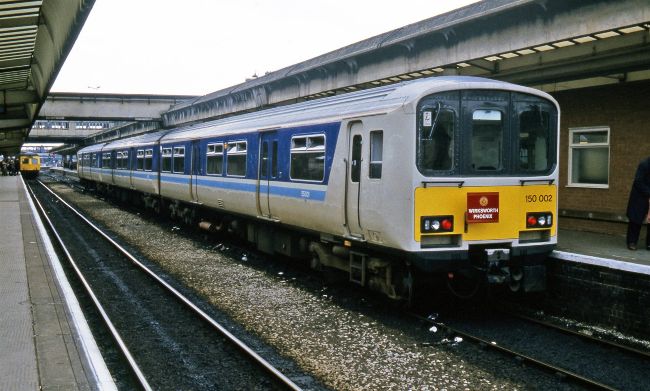
the second Class 150/0 prototype, 150002, ran several special trips along the Wirksworth branch from Derby in May 1985.
COLOUR RAIL
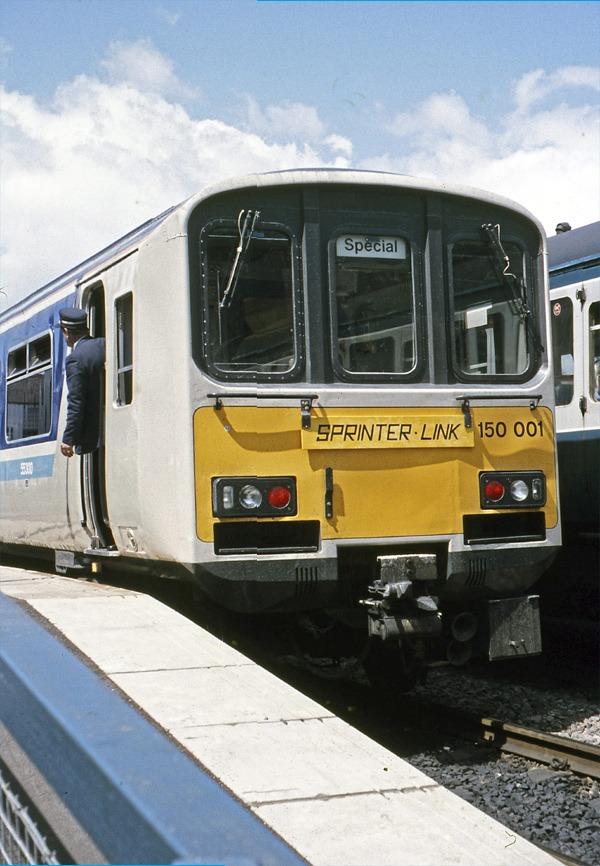
The two prototype Class 150/0 units travelled widely to raise public awareness of BR’s new trains. Doyen 150001 operated services from Cardiff into the Welsh Valleys during the summer of 1985.
COLOUR RAIL
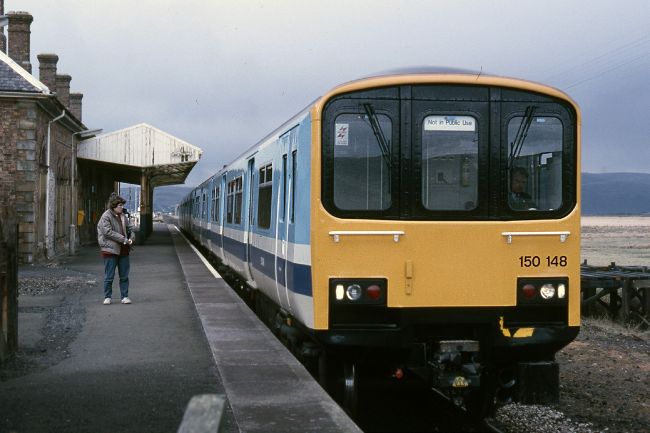
Wearing original BR Provincial livery, Class 150/1 150148 pauses at Borth in April 1986, during trials on the Cambrian routes.
COLOUR RAIL
Although the railbus prototypes eventually evolved into the Class 141-144 ‘Pacers’, these experiments did not deliver the results BR wanted and in 1983 it called for new submissions from train builders for cheaper, less ambitious designs than the Class 210.
The maximum speed specification was lowered from 90mph to 75mph, and the requirement for compatibility with Mk 3 based EMUs was dropped.
In addition to good ride quality, the specification included auto-coupling, an operational range of 1,000 miles and intervals of five years or 350,000 miles between major overhauls.
In comparison to the previous generation of DMUs, which typically used a pair of small diesel engines under each power car, the new generation trains would have only one underfloor engine per car. However, even two-car trains would be able to continue in service with one engine out of use. A modular approach envisaged sets of up to four cars fitted with amenities such as toilets and luggage spaces. These requirements were translated into a technical specification which was issued to various rolling stock manufacturers for competitive tender.