TUBE STOCK
An inventive ADVANCE
London Transport’s innovative 1938 Tube Stock proved remarkably long-lasting. The first cars entered service on June 30 1938, with the final survivors of those exiled to the Isle of Wight withdrawn on January 3 2021. David Jukes recounts the stock’s history from experimental prototypes to the present day.
David Jukes
Masterclass
Looking at railways in detail
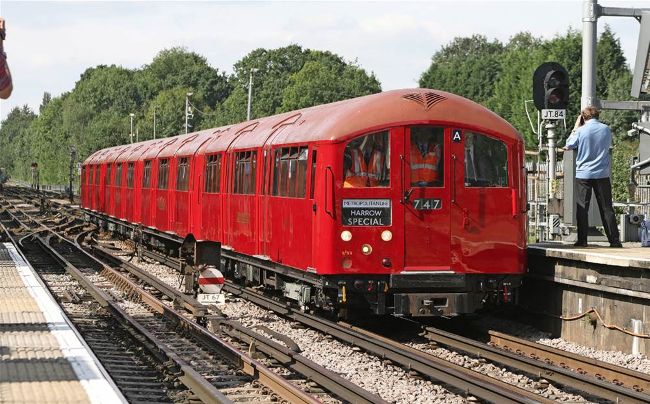
A four-car unit of 1938TS (10012-012256-12048-11012) is preserved by London Transport Museum in operational condition, as seen here at Chalfont & Latimer while working special services between Amersham and Harrow-on-the-Hill on September 14 2008.
DAVID JUKES
The London Passenger Transport Board’s formation on July 1 1933 led to the expansion of London Underground services. The 1935-1940 New Works Programme included proposals for various line extensions, several of which were already experiencing capacity problems.
Future stock requirements repeatedly changed during the planning stages, but it was ultimately resolved to provide new higher capacity trains on the Morden-Edgware (later renamed the Northern) and Bakerloo Lines; the displaced Standard Stock replacing life-expired cars on other lines.
The determined solution for higher capacity trains was to mount control and other electrical equipment below car floors and find a manufacturer able to supply smaller traction motors. The existing use of large traction motors required Tube car floors to be raised above the motor bogies, above which were equipment compartments with consequent loss of potential passenger space.
“The 1935TS ran on the Piccadilly Line between 1937 and 1940; technical difficulties meant the trains had to be stored until 1948”
1935 TUBE STOCK
Construction of a ‘highspeed’ six-car tube train to the new layout was authorised in May 1935 with the order soon increased to four trains for demonstration of control products by Crompton Parkinson, General Electric Company, British Thomson-Houston and Metropolitan Vickers. This 1935 Tube Stock (1935TS) was an early demonstration of William Sebastian Graff-Baker’s inventive skill as it incorporated several new features and was an immense advance from the preceding Standard Stock. Graff-Baker (1889-1952) was appointed Chief Mechanical Engineer (Railways) in 1935 and played an important role in rapidly developing the Underground’s rolling stock.
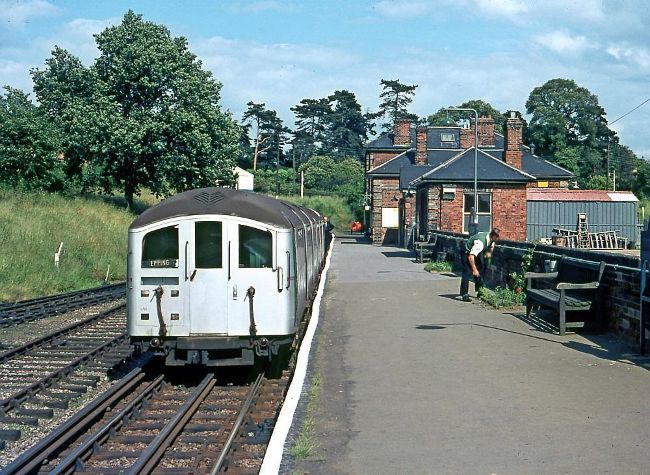
An idyllic scene at Ongar as a member of station staff tends the flowerbeds, while 10009, 70512 and 11009 wait to depart to Epping, in June 1965.
HUGH BALLANTYNE/RAIL PHOTOPRINTS
The Metropolitan Cammell Carriage and Wagon Company (MCCW) built 24 Driving Motors (DM) fitted with one Crompton Parkinson C200 traction motor per bogie and formed into two-car units. Eighteen had semi-circular streamlined driving cabs (10000-11000 to 10008-11008, inclusive), while the final six had conventional flat ends (10009-11009 to 10011-11011, inclusive); the stock formed into like-numbered pairs.
They were coupled mechanically, electrically, and pneumatically by means of a new automatic Wedglock coupler. Also specially designed were compressors of compact dimensions based on tramcar designs. All cars were 52ft 6in long with two double-leaf and one single-leaf air-operated doors per side. Forty fixed and two tip-up seats were fitted. External livery was essentially red and cream with grey roofs; red was applied beneath the waistrail, on the inner car ends and to the passenger doors below roof level – the flat-ended cars also had full red cab ends.