Secrets of the Steering Wheel Club
What's the collective noun for racing drivers? You'd have needed it in the 1960s to describe the denizens of this comfortable May fair bolt hole. Gordon Cruickshank explores the club, its members, and what happened to the magnificent collection once on display there
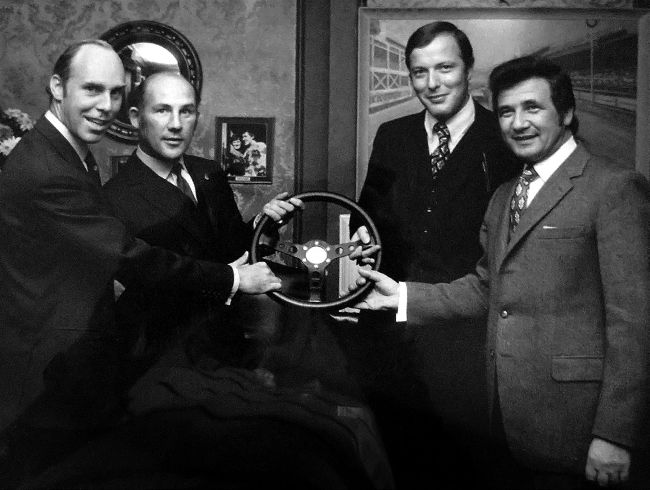
Richard Atwood, left, and Hans Herrmann, right, pose with Stirling Moss and Rico Steinman on adding their 1970 Le Mans-winning wheel to the club display
It was a great club. I’m amazed somebody hasn’t restarted it.” That’s Sir Jackie Stewart’s take on the Steering Wheel Club, Mayfair home from home for racing drivers. In the 1960s and into the 1970s everybody went there, including international grand prix drivers when they were over here; with a busy bar and restaurant it was a social hub, and in an area packed with drinking holes it stood out for the decorative feature that gave it its name – racing car steering wheels.
Contributed as a matter of pride by drivers and teams, dozens of wheels decorated every wall in the bar; wood and leather rims held by Hawthorn, Fangio, Clark, Hill, Brabham, Brooks, Hunt – not to mention the crumpled one that formed the handle to the phone booth, retrieved from Innes Ireland’s Lotus 19 wrecked at Seattle in 1963. Many were from winning machines – Aston Martin's victorious DBR1, Clark’s ’63 championship machine and his 1965 Indianapolis winner, Hill’s 1962 title car, the 1970 Herrmann/Atwood Le Mans Porsche 917 victor, Cobb’s Railton LSR car, Parry Thomas’ Babs. Not to mention helmets, goggles, banners and trophies from throughout the sport’s history. And in 1988 when the club folded – they all vanished.
We brought together two figures with close connections to the fondly remembered West End venue to reminisce, and perhaps help explain the mystery of the missing memorabilia: Keith Grant was its manager from 1980-86, while Ian Macfadyen is the nephew of club founder John Morgan and runs a website on it. He also has a fine selection of club memorabilia, including ashtrays, membership cards, badges and the club's booklet of cocktails, Recipes for Refuelling. And only recently, Keith Grant found a cache of club records which adds much colour to the history as well as emphasising just what was lost with that collection.
Morgan was a major figure in the sport in the Fifties: clerk of the course and starter for all five Aintree grands prix and secretary of the BARC, while co-founder Desmond Scannell had a similar role at the BRDC. It was 1946 when they found a small flat in Brick Street, Mayfair and opened the United Motor Sports Club. In the economic shadow of WWII they had to install utility furniture, with air raid shelter bunks for seats, though a bar designed by Anthony Heal of the smart Tottenham Court Road furniture store added style. Thanks to the co-owners’ connections it soon became a welcoming base for drivers, constructors, owners, organisers and journalists. And for the BRDC, whose affairs were run from a small back room. It wasn’t long before those wheels began to decorate the walls, making it clear who this place was aimed at. It wasn’t always demure; some happy members set a world record for the number of people perched in and on a Messerschmitt Kabinenroller, respected writer and commentator John Bolster riding shotgun in the fresh air.