THE CHANGING MAN
In motor racing, John Gentry has left few stones unturned. Damien Smith meets the popular British draughtsman and engineer to look back at an extraordinary Zelig-like career that has taken in Formula 1, Can-Am and 500cc motorbikes. Not bad for a man without design qualifications
MARCH, SHADOW, FITTIPALDI, Tyrrell, ATS, Toleman, Renault, Alfa Romeo, Brabham, Benetton; then there was a leftfield switch to Suzuki and Yamaha in motorcycling, before a return to four wheels to work on a Volvo estate touring car… Prolific John Gentry has been a rolling stone during his multicoloured five-decade motor sport career, spent as a master draughtsman and race engineer for the likes of Emerson Fittipaldi, Chris Amon, Gilles Villeneuve, Jean-Pierre Jarier, Teo Fabi, Derek Warwick, Elio de Angelis, Ron Haslam and many more. This is some racing life, and for a man who prides himself on his dedication to the minutiae of detailed design, it all seemed to happen purely by chance.
He welcomes Motor Sport (pre-lockdown) to his beautiful home nestled in a corner of a picturesque Oxfordshire village. The craggy features, creased smile and soft timbre as he speaks reflect a surprisingly gentle character for a battle-hardened, well-travelled racing lifer. John is a popular man in the business and it’s easy to see why.

Above, from left: Gentry worked for Roberts Yamaha in the Wayne Rainey era of the early ’90s
JOHN GENTRY PERSONAL ARCHIVE, GETTY IMAGES, JUTTA FAUSEL
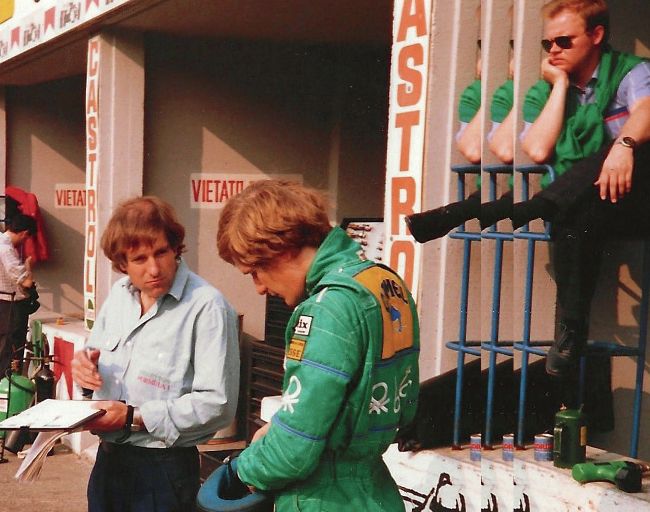
With Thierry Boutsen at Benetton in 1988

Talking shop with fellow designer Ricardo Divilain, 1979, the Brazilian who was technical director at Fittipaldi until 1982
Before we get down to the details of his incredible life, there’s a tour to undertake. Up a steep flight of stairs is his converted attic office, a perfect nook with plenty of natural light, lined by photos – motorcycles outnumber the cars – and souvenirs that each carry a story. In one corner, he points to what could be a worksurface, if it was clear. Somewhere under there is the draughtman’s board he took with him when he left March – for the first time.
Back downstairs, we step into his wife’s stylish, more spacious and less cluttered office (well, she is an interior designer) and John draws back a curtain. What it reveals is his ‘museum’: a cluster of classic motorcycles pristinely restored by his own hand and packed into a secret room. There’s a Suzuki RG500 in factory Sheene colours, a BSA Goldstar, a 350cc Yamaha and myriad Hondas, his favourite machine maker. Hung from a rail is his collection of instantly recognisable leathers: the names read Schwantz, Haslam, Kocinski… He’s enjoying our astonishment as we gawp open-mouthed in wonder. Motor sport has clearly treated him well. So tell us your story, John...
GENTRY WAS BORN IN KINGSTON UPON THAMES in 1950 and left school at 15 without a single qualification. “I didn’t enjoy school much,” he says. “I was good at technical drawing and football. I played for Kingstonian’s ‘A’ team, but wasn’t good enough to turn pro.”
The school youth employment officer, fearing for his chances of landing a job, suggested he become a TV repair man. “I didn’t want to do that: I wasn’t even old enough to drive so I couldn’t be the man in the van,” he says with a chuckle. “I persevered and saw an ad in our local paper, the Surrey Comet, for a junior draughtsman in a contract drawing office in Chessington. I went for the interview and got the job. It was a really good grounding.”
Today, budding engineers with high ambition need a raft of top-grade qualifications even to be considered by premier-ranking companies. It was a different world in the 1960s. “I saw another job advertised in the Comet, God bless ’em, for a draughtsman at AC Cars in Thames Ditton,” says John. “AC were known for the Cobra, of course, and the 428, so that was good. But I found myself getting involved in a project for the Ministry of Health: invalid carriages, the little blue three-wheelers. AC had the contract to build those. It had a Steyr-Puch engine in the back, which was easy enough, but you had to design the steering mechanism for all kinds of disabilities, which made you work a bit. I enjoyed that, but at the same time I was getting more interested in motor racing.”