U bekijkt momenteel de Netherlands versie van de site.
Wilt u overschakelen naar uw lokale site?
9 MIN LEESTIJD

Why are space-based Earth observations so important?

Our experts answer your questions

Satellites can trace the transport and transformation of atmospheric gases like ozone, carbon monoxide, nitrogen and even some organic compounds. Some of these gases can also be seen day and night. We use these gases to study how emissions from cars, industry, trees and fires all mix and change as they travel across the globe.

Studying atmospheric chemistry from the ground is like if you are trying to make a map but you can only walk over a few square kilometres and look around. If you get in a hot-air balloon, helicopter or aeroplane, you see the connections and context. It’s like that for us, except with something that is evolving and changing.

Weather satellites were a huge transformation, especially for things like storms that have huge impacts on people. Now we can see hurricanes and typhoons in advance, and all of the data from these satellites has been important in the improvement of weather forecasts.
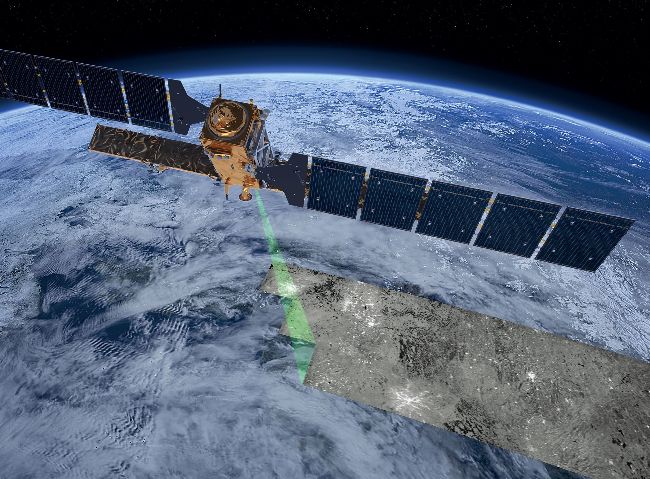
Below: Satellites observing Earth have been able to reveal a lot about how our home planet is evolving
ESA; Headshot © NASA’s Goddard Space Flight Center

We also have new techniques to use from space. A recent NASA article detailed the ice loss and growth on Antarctica using the space-based ICESat-2. It uses a laser to send out light pulses and then measures the timing of the returned light to get a really precise measurement of where the surface is. We are learning a lot about ice sheets and glaciers and how they evolve, which is really important for understanding our changing planet.

Dr Annmarie Eldering is deputy project scientist for NASA’s Orbiting Carbon Observatory-2 (OCO-2)

Did you know?

NASA’s TIROS-1, launched in April 1960, sent back the first television footage of weather patterns to be taken from space.

Ontgrendel dit artikel en nog veel meer met
Je kunt genieten:
Geniet volledig van deze editie
Direct toegang tot 600+ titels
Duizenden oude edities
Geen contract of verplichting
ABONNEER NU
30 dagen proberen, dan gewoon €11,99 / maand. Op elk moment opzeggen. Alleen nieuwe abonnees.


Meer informatie
Pocketmags Plus
Pocketmags Plus

Dit artikel komt uit...


View Issues
All About Space
Issue 105
IN DE WINKEL BEKIJKEN

Andere artikelen in dit nummer


In This Issue
Welcome
This month All About Space takes a look into the
FEATURES
LAUNCH PAD
Unfortunately you can’t test a rover’s ability to traverse the
Liftoff! SpaceX launches first astronauts for NASA on historic test flight
SpaceX launched astronauts for the first time ever today, making
New marsquake study could shatter theories on how Mars was born
A team of researchers based at the University of Tokyo
Massive galactic disc could change our understanding of galaxies
A massive, rotating disc galaxy that first formed just 1.5
Love isolation? NASA wants you to spend eight months locked in a Russian Lab
Do you thrive in social isolation? NASA is looking for
First super-fast pulsar found snacking on companion in far-flung star cluster Words
China’s Five-hundred-meter Aperture Spherical Telescope (FAST) has uncovered the first
Scientists peer back in time to find new evidence for watery plumes on Europa
Scientists looked back in time to offer new evidence suggesting
WHAT DOES THE FUTURE HOLD FOR THE SOLAR SYSTEM?
Ever since it settled down from a period of early
SATELLITE REPAIR DROIDS
Droids could soon be placed on satellites in geostationary orbit
DESTINATION ALPHA CENTAURI
If you gaze into the night sky from Earth’s Southern
COULD IT DESTROY THE UNIVERSE?
The universe could collapse into oblivion at any moment, the
PREPARE FOR PERSEVERANCE THE NEXT MARTIAN ROVER
Meet the new Martian rover from NASA, Perseverance. This next-generation
THE MAN BEHIND ROCKET LAB
Peter Beck founded Rocket Lab in 2006 and still operates
WHAT WOULD YOU SOUND LIKE ON OTHER WORLDS?
Testing your vocal cords on another planet is a deadly
NANCY GRACE ROMAN SPACE TELESCOPE
NASA takes pride in naming its telescopes after influential figures
SIZZLING SUMMER NEBULAE
Summer: where the days are longer and the nights are
STARGAZER
What’s in the sky?
In order to preserve your night vision, you should read
This month’s planets
Venus is usually the first planet people spot in the
Theophilus
Lunar observers often feel frustrated during summer because the Moon’s
Hunt for clusters and nebulae in Cygnus
Let’s be honest, June and July are not really the
The Northern Hemisphere
The constellations of Lyra, Aquila, Hercules, Sagittarius, Scorpius and Ophiuchus
Celestron NexStar 6SE
It’s not often that we come across a telescope that’s
Mikhail Kornienko
Mikhail Kornienko recently celebrated his 60th birthday in the comfort
Chat
X
Pocketmags ondersteuning